
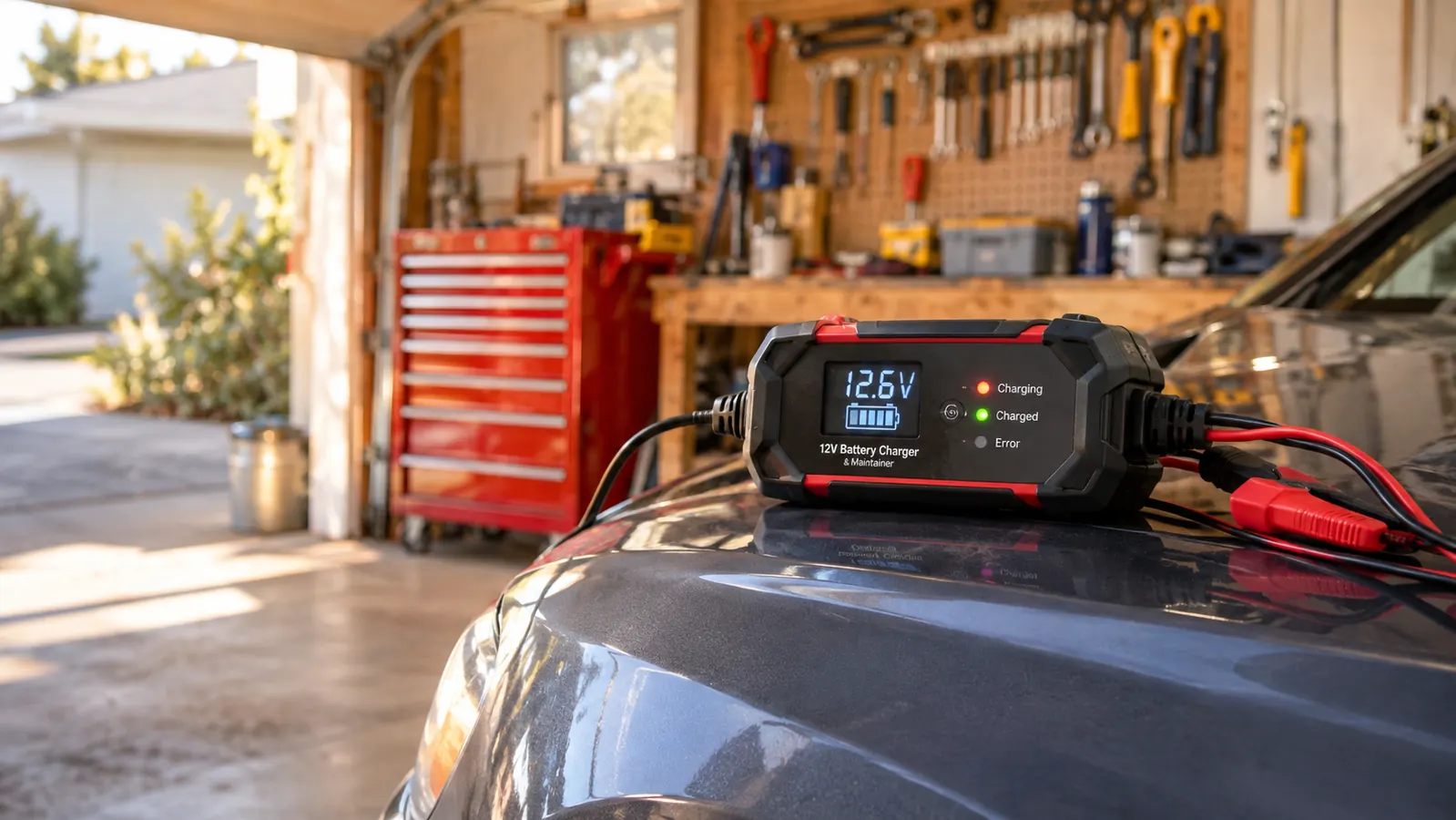
The NOCO GENIUS5 sat on the corner of my workbench for two months before I trusted it with anything I cared about. I had a 1991 Mazda Miata that went flat every three weeks if I did not drive it, a 2012 Toyota Tacoma with about 168,000 miles on it, and a long-standing suspicion of anything that advertises itself as smart. Two months was enough to settle it. The charger now lives on the shelf above the bench and comes down most weekends.
I am writing this because a star rating does not tell the whole story. The GENIUS5 holds a 4.6 average across more than 21,000 ratings, which is a hard number to fake and a hard number to earn. But an average tells you whether people liked a thing after they opened the box. It does not tell you what the thing is bad at, and it does not tell you whether it fits the battery sitting in your garage right now. That is the gap I want to fill, including the parts that are not flattering.
The Quick Verdict
A compact 5-amp charger and maintainer that does honest work on car, motorcycle and small engine batteries. It is patient rather than fast, and it will not rescue a battery that is already gone.
Amazon Check Today's Price →The charger that earned a permanent spot on my shelf
5 amps, 6 and 12 volt, lead acid and lithium iron phosphate, with an integrated thermal sensor that adjusts the charge for garage temperature. Backed by a 3 year limited warranty.
Amazon Check Today's Price on Amazon →What the GENIUS5 Actually Is
Strip the packaging language away and it is a 5-amp smart charger. It takes 120-volt household current in and puts out 5 amps at 12 volts, and it also handles 6-volt batteries. It charges flooded lead acid, AGM, gel, SLA and VRLA, and it charges lithium iron phosphate packs as well, which matters if you own a newer motorcycle or a lithium swap in a project car. The body measures about 3.4 inches deep, 4.6 inches wide and 8 inches tall, so it takes up less shelf than a loaf of bread.
NOCO lists it as compatible with cars, boats, motorcycles, ATVs, RVs, trucks, SUVs, scooters, lawn mowers and tractors. That is a wide net, and the reason it matters is that most people do not own one battery. They own a car battery, a mower battery, and a battery in something else that only gets used twice a year. One box that covers all of them is worth more than three boxes that each cover one.
The smart part is real but modest. An integrated thermal sensor reads ambient temperature and adjusts the charge based on it. That sounds like brochure filler until you have tried to charge a cold battery in an unheated garage in January and watched a dumb charger either crawl or push harder than it should. My garage swings from the low forties in winter to over a hundred in summer, so I have used this thing at both extremes and the charge behavior does change with the seasons.
How I've Used It
Three batteries, fourteen months, no drama. The first is the Miata, which is the reason I bought a maintainer in the first place. A 1991 car with a small battery and a slow drain from a stereo the previous owner installed will flatten itself in about three weeks of sitting. The second is the Tacoma, which mostly gets driven daily but sits for a week or two at a time when I am working long shifts at the water department. The third is the riding mower battery, which is exactly the kind of small lead acid pack that dies quietly over a winter.
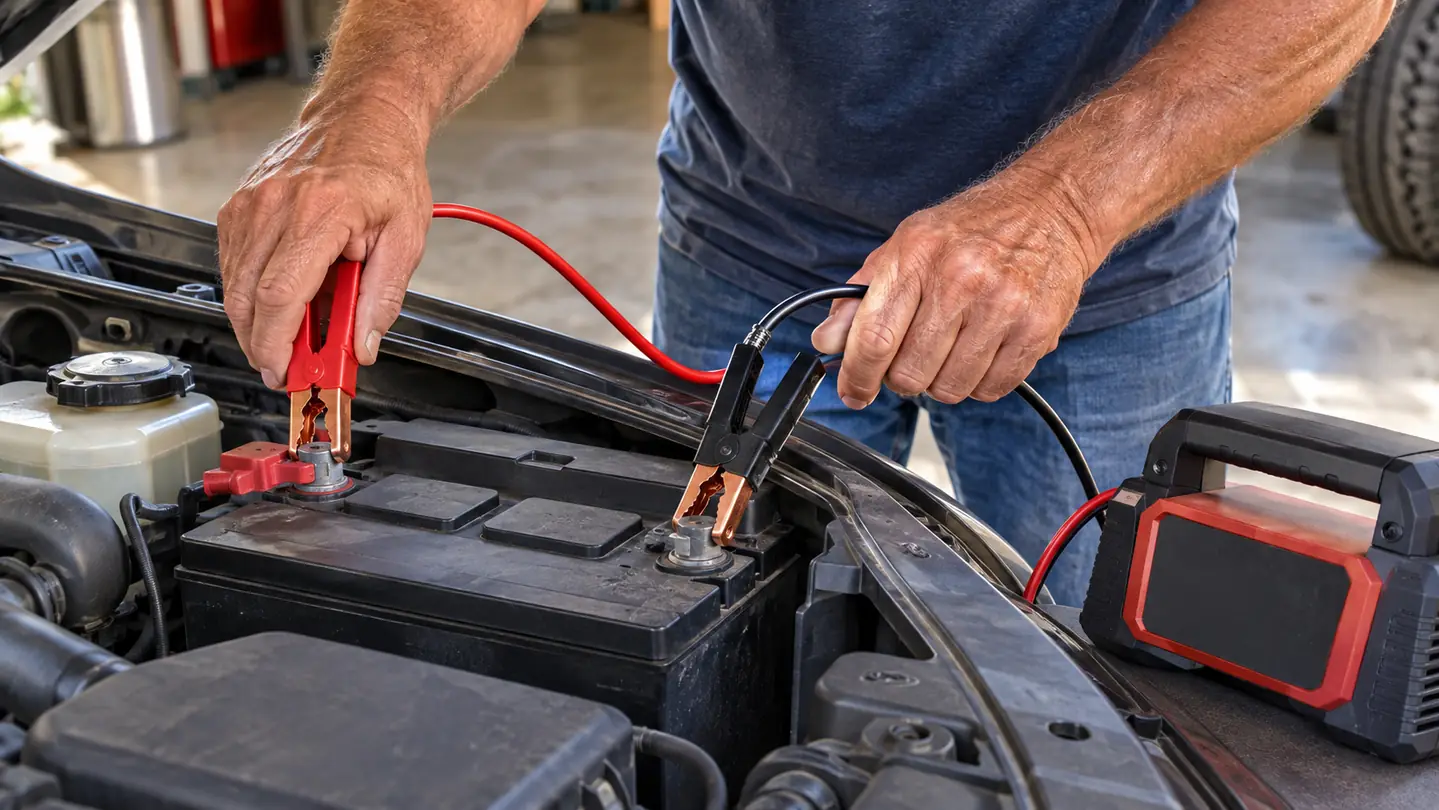
My routine is the same every time. I clip the battery clamps on, positive first, then negative, plug the unit into the wall, and walk away. I do not stand there watching it. The charger manages the taper on its own and I check back the next morning. That is the entire relationship. It is not an interactive device and I do not want it to be.
The honest number to plan around is charge time. The specification lists 8 hours, and that matches what I have seen on a normal car battery that is low but not destroyed. On the mower battery, which is small, it is much quicker. On the Tacoma after I left the dome light on for two days, it took most of an afternoon and into the evening before the charger was done. If you are expecting a fast top-up before a dinner reservation, this is the wrong tool and I would rather tell you that now.
There was one failure worth describing, because it is the useful kind. The battery in the Miata finally gave up last spring, and the charger would not bring it back. I left it connected for a full day and the battery still would not hold. That is not a defect. A battery that has been run flat hard too many times is finished, and the correct response is to buy a new one rather than a bigger charger. What I took from it is that the unit is honest with you. It does not pretend to fix something that is past fixing.
Where It Genuinely Shines
Maintainer duty is the whole reason to own one of these. A battery that sits at a partial charge sulfates, and sulfation is what actually kills a battery, not age. Keeping a spare vehicle on a charger that holds it up between drives is the simplest preventive maintenance you can do for a car you only drive on weekends. The GENIUS5 does that without any input from me, and it has kept the Miata starting on the first turn in February for two winters running.
The size and power numbers are worth a note. NOCO claims this generation is 34 percent smaller and delivers over 65 percent more power than the one it replaces. I cannot verify either figure against a unit I do not own, but the practical result is a charger I can carry in one hand and set on a fender without worrying about knocking it off. It is small enough that I have taken it to my brother's house to deal with a lawn tractor battery, which is not something I would do with a heavy shop charger.
The certifications are also real rather than decorative. The unit is listed as meeting CEC, FCC and UL standards, and the warranty is a 3 year limited one. Three years on a device that lives in a garage and gets plugged in overnight is a reasonable commitment, and it is one of the reasons I stopped treating it as a temporary experiment and started treating it as part of the tool collection.
I also like that I do not have to think about it when the weather turns. That thermal sensor is doing quiet work the whole time. A charger that ignores temperature will either undercharge in the cold or push harder than it should in the heat, and either way you are shortening the life of the battery you were trying to protect. That is the part of this thing I did not expect to care about and now would not give up.
A maintainer's only job is to be boring. This one is boring. It sits on the fender, holds the Miata's battery up through two winters, and never once made me get out the multimeter to check on it.
What Nobody Tells You Before You Buy
First, 5 amps is a ceiling, not an average. If your battery is deeply drained, this charger will get there eventually, but eventually is the operative word. A big truck battery or a deep cycle marine battery run flat will take the better part of a day. People buy a 5-amp charger expecting trickle charger patience with a faster finish, and mostly get that, but the finish is still measured in hours.
Second, the connection is made with battery clamps. That means opening the hood, reaching down to the battery, clipping on, and reversing the process when you are done. For a weekend car that is fine and takes fifteen seconds. If you pictured leaving a lead permanently attached under the hood so you could just plug in a connector, this is not that setup, and you should plan the routing before you commit rather than after.
Third, and this is the one that causes the unhappy ratings, it will not bring back a battery that is already dead. A charger maintains a healthy battery and recharges a discharged one. It does not reverse damage from a battery that has been flat for six months, and no charger at any amperage honestly does. If your battery will not hold a charge after a full cycle, the charger is telling you the truth and the answer is a new battery, not different equipment.
Fourth, it is not a jump starter and it is not a power supply. It will not let you run a radio or a diagnostic tool on a car with a flat battery, and it will not start anything. It charges batteries. That sounds obvious until you read reviews from people who bought it expecting a portable jump pack and were disappointed by the result, and I would rather you not join them.
Fifth, the smart features do not make it a substitute for knowing what battery you have. Lithium iron phosphate, AGM, gel and flooded lead acid all want slightly different treatment at the margins, and while the charger handles all of them, you still have to know which one you are clipping onto. That is honest advice rather than a complaint about the product. The charger cannot choose for you, and if you do not know, that is a five-minute check on the label before you plug anything in.
What I Considered Instead
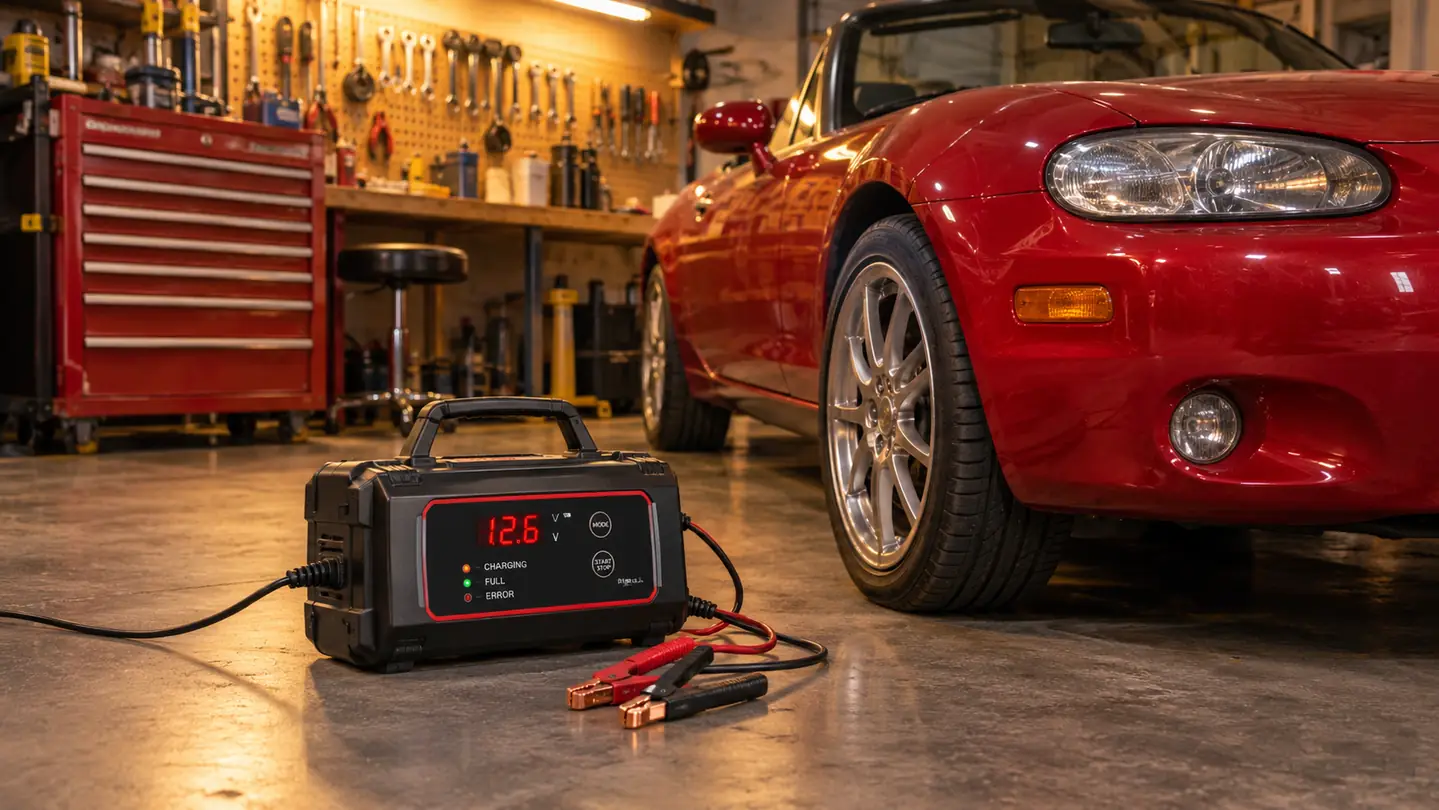
Before I bought this one I spent a couple of evenings reading about the alternatives, and there are really only three categories worth thinking about. A basic trickle charger, a higher amperage smart charger, and a jump pack. Each solves a different problem and only one of them solved mine.
A basic trickle charger is the simplest way in, and it will keep a healthy battery topped up for years. What it will not do is bring a discharged battery back in a reasonable time, and most of them only speak 12 volt, which leaves the mower and the 6-volt stuff out. The GENIUS5 covers 6 and 12 volt, AGM, gel, SLA, VRLA and lithium iron phosphate in one box, which is the reason I went this direction rather than buying two smaller units that each did half the job.
A higher amperage charger is the answer for anybody who works on several vehicles or deals with large batteries regularly. More amps means a faster finish and less waiting around, and if that is your week, buy one. It is not my week. My batteries are small and my problem is time spent sitting still, not charge speed, so paying for amperage I would use twice a year made no sense for the way I actually work.
A jump pack is a different tool entirely and I already own one, which is the honest reason I did not consider it here. If you do not have one, a jump pack belongs in the truck regardless of what charger you buy. It is the only one of the three that gets you moving when the battery is flat and you are already late for something.
What I Liked
- Charges both 6-volt and 12-volt batteries, so it covers the mower and the truck with one unit
- Handles flooded, AGM, gel, SLA, VRLA and lithium iron phosphate packs
- Integrated thermal sensor adjusts the charge for garage temperature
- Compact footprint at roughly 3.4 by 4.6 by 8 inches
- Listed to CEC, FCC and UL standards with a 3 year limited warranty
- Works as a maintainer, which is what most weekend cars actually need
Where It Falls Short
- 5 amps is the ceiling, so a deeply drained large battery takes many hours
- Battery clamps only, so you open the hood every time
- Will not revive a battery that has already failed
- Not a jump starter, despite what some buyers seem to expect
- More charger than you need if all you want is a slow top-up on a healthy battery
Who This Is For
This is for the person with a vehicle that sits. A weekend car, a project car, a tractor, a mower, a motorcycle that only comes out in summer. It is also for the person who wants one charger that covers 6-volt and 12-volt and lithium rather than three separate units cluttering the shelf. If you are the kind of owner who wants to hook something up on Sunday night and find a charged battery on Saturday morning, this does exactly that and asks nothing of you in between.
It also suits a beginner well, which I say as someone who learned brakes and oil changes from his dad in a driveway and made plenty of mistakes along the way. There is nothing to configure. The unit does its own thing once it is connected, and the least experienced person in the household can use it without a briefing. That is not true of every tool in my garage, and it is worth saying out loud.
Who Should Skip It
Skip it if you need speed. If your battery is flat at seven in the morning and you need to be somewhere at eight, a 5-amp charger is not going to get you there and neither is any maintainer. That is a jump pack job. Skip it if your battery is already dead and will not hold a charge, because no charger fixes that. And skip it if the only thing you ever do is top up a healthy battery once a month on a car you drive daily, because a simpler trickle charger covers that need and you will not miss anything this one does.
Skip it too if you want a permanent under-hood installation with a connector you plug into. That is a different product category, and buying this one hoping it will adapt is how people end up writing one-star reviews about a charger that is doing exactly what it was built to do.
For a vehicle that sits more than it runs, this is the one I would hand you
5 amps, 6 and 12 volt, lead acid and lithium iron phosphate, integrated thermal sensor, 3 year limited warranty. It has held a spot on my shelf for fourteen months and it is not leaving.
Amazon Check Today's Price on Amazon →