
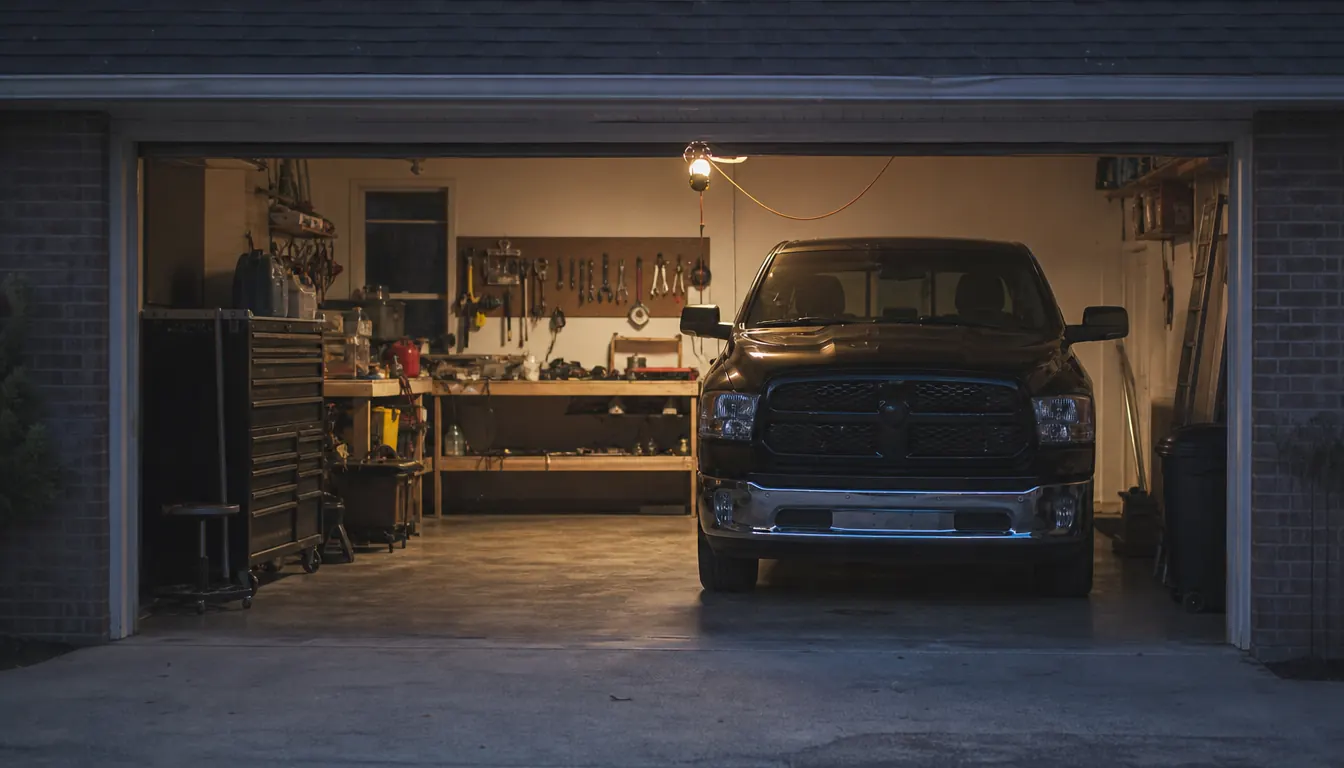
The check engine light in my 2012 Toyota Tacoma came on during a Tuesday morning commute, a little past 168,000 miles, and I did what most people do first. I drove to the parts store and let the counter guy plug in the loaner reader. It handed me P0171, lean condition on bank one, and a printout with a shrug behind it. A lean code can be a vacuum leak, a dirty mass airflow sensor, a tired fuel pump, or a cracked intake boot. Four repairs, four very different afternoons and four very different bills, and the free tool had no opinion about which one I was actually chasing. I drove home no smarter than I left, with the light still glowing at me from the dash.
What I wanted was the conditions at the moment the code set, and a way to watch the engine behave while the truck was moving instead of guessing in a parking lot. So I bought the BlueDriver OBD2 Scanner, the Bluetooth version that runs through the BlueDriver App on your phone. It has been in my one-and-a-half-car garage in Sacramento for months now, working mostly on that Tacoma and occasionally on the 1991 Mazda Miata I keep as a weekend project. The Miata is where this review turns honest, and not in a flattering direction. That part comes later, but it is the reason I am not handing out a perfect score.
The Quick Verdict
Reads and clears far more than a basic code reader and shows you the live data behind the code, with no subscription to renew. It will not talk to anything older than 1996, and your phone is the screen whether you like that or not.
Amazon Check Today's Price →The Free Reader Gave Me a Code. This One Gave Me the Reason.
Freeze frames, live engine data, and the ABS, SRS and TPMS codes a parts-store loaner cannot show you. Plugs into the OBD-II port and pairs with your phone in about a minute.
Amazon Check Today's Price on Amazon →How I've Used It
The first scan happened in my driveway on a Saturday in February, maybe ten minutes after the box showed up. You plug the scanner into the OBD-II port under the dash, open the app, and it pairs over Bluetooth. Mine connected on the first try and asked which vehicle it was talking to. Then I read the stored codes and pulled the freeze frame, which is the snapshot the engine computer saves at the instant a fault sets: speed, load, temperature, fuel trim, all of it frozen at that second. Mine showed the fault setting at a steady cruise, engine already warm, light throttle. That single detail pushed a weak fuel pump down my list and put an intake leak at the top, and I found a cracked rubber elbow in the intake tube that afternoon with a flashlight, a rag, and about fifteen minutes of my life.
Since then it has lived in the glovebox and come out most weekends. It confirmed a misfire that turned out to be one tired coil pack, which meant I replaced a single coil instead of eight spark plugs on a hunch and a prayer. I watched live data on a 104 degree Sacramento afternoon and caught a thermostat opening later than it should, before it could turn into a real problem on I-5 with a load in the bed. Before my last smog test I used it to check the readiness monitors, because a truck that has had codes cleared recently will fail readiness with nothing actually wrong with it. That check alone saved me a wasted Saturday and a second trip across town.
The honest summary after months of this is that I reach for it far more often than I expected, and I trust the codes it reports. What I do not love is lying on cold concrete holding a phone in one hand and a flashlight in the other. That is less a knock on the tool than a description of driveway work in February, but it is the reality of using something that lives on your phone instead of in your hand. My dad did this work with a dwell meter and a lot of patience. I do it with a phone in my pocket and a whole lot less patience, and the results are better than his were.
What It Reads That a Basic Code Reader Won't
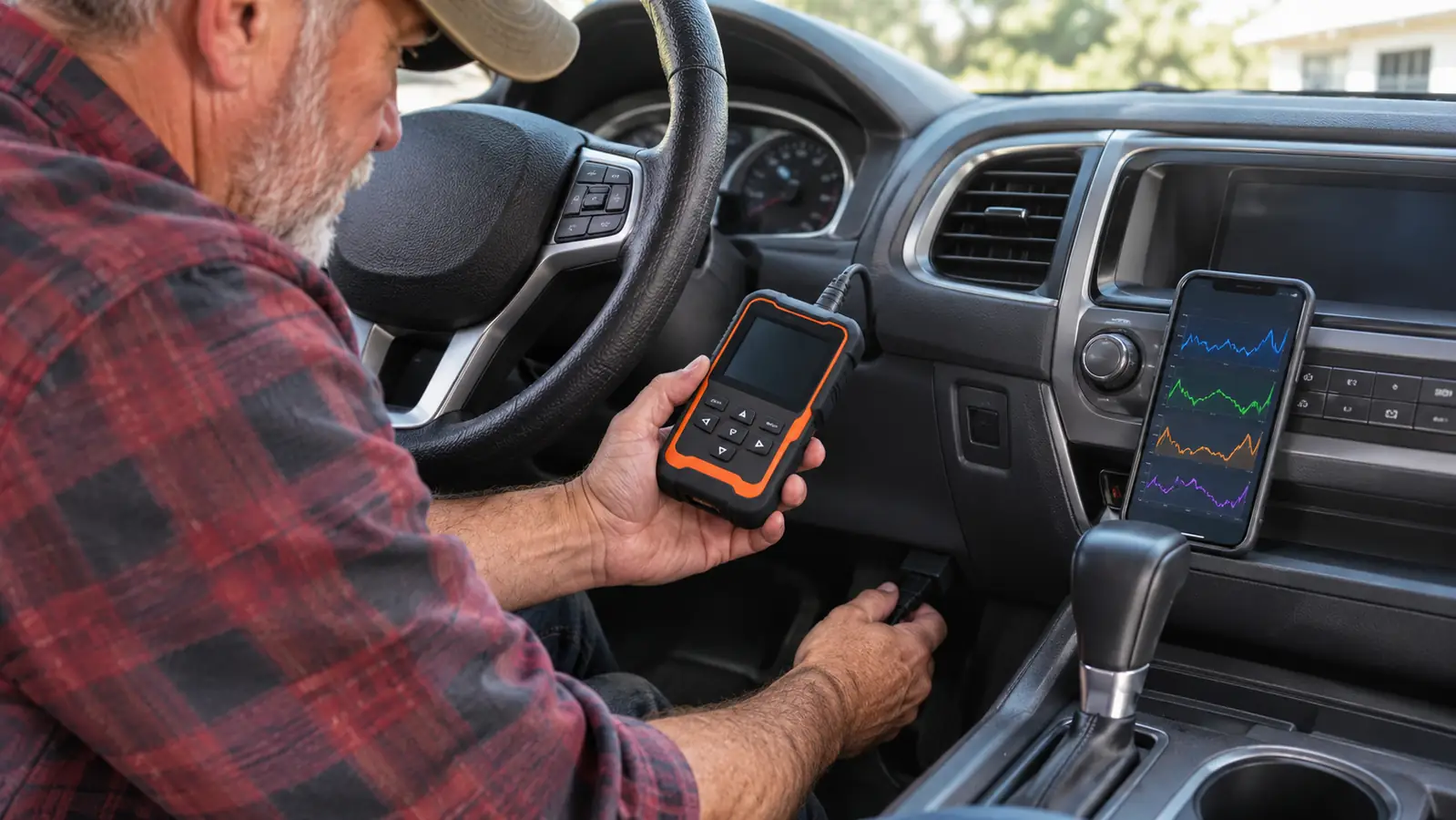
A basic code reader reads the engine codes and clears them. On most cheap units, that is the entire job. The BlueDriver scanner reads and clears those too, but it also reaches ABS, SRS and TPMS on vehicles that support them. On my truck that meant I could look at the tire pressure figures the truck's own system was already working from, instead of kneeling at four tires with a gauge and guessing which one had set the light. It also meant that when the ABS light blinked on during a wet morning and then went out, there was a stored code waiting for me instead of a mystery I could only shrug at.
The bigger difference is Mode 6. Mode 6 shows the results of the self-tests the engine computer runs on itself, including tests that have not failed badly enough to set a light yet. On my truck I could watch the individual cylinder misfire counts and see that one cylinder was noisier than the others weeks before it ever threw a code at me. That is the difference between replacing a coil in your own driveway on a Saturday morning and replacing it on the shoulder of Highway 50 in the rain at six in the evening. Anyone who has done the second one knows exactly what the first one is worth.
The freeze frame deserves its own paragraph, because most people never look at it. When a fault sets, the computer records the operating conditions at that exact second. Read it and you learn whether the problem happens cold or hot, idling or at cruise, under load or coasting downhill. Skip it and you are throwing parts at a car and hoping something sticks. Having those numbers laid out on a screen I can actually read, without a service manual spread open on the fender, changed how I approach a fault. I stopped shopping for parts and started narrowing a list.
Your Phone Is the Screen, and That Cuts Both Ways
There is no screen on the unit and no handheld gadget in the box. The included components are the scanner and access to the app on iOS or Android, and that is the whole kit. Everything you look at lives on your phone. For me that is mostly a win, because the screen in my hand is bigger and brighter than any handheld reader I have owned, and the phone is already mounted in the truck anyway. I am not squinting at a two-line LCD in the dark anymore, holding a flashlight in my teeth like a cave man.
It is a loss in a couple of ways too. When the phone rings, or the battery is low, or you left it on the workbench, you have a plug and nothing to read. I keep a charging cable in the truck now specifically because of that. And the wireless link, while reliable for me, is still a radio connection between a phone and a device sitting in a metal box. Once in a blue moon it drops and you pair it again. Five seconds of annoyance, not a defect, but I would rather tell you than pretend months of use were flawless.
Wireless earns its keep in a way I did not expect. The truck can sit idling in the driveway while I watch fuel trims from the driver's seat, and I have watched live data on a test drive with the phone in a dash mount. A corded reader makes that awkward enough that you stop doing it, and a tool you stop using is a tool you wasted money on. That was the failure mode of the cheap reader I owned before this one. It worked fine. I just never felt like dragging it out.

What It Won't Do
My 1991 Miata is invisible to it. The spec line is gas vehicles from 1996 and newer, plus select light-duty trucks, and the Miata predates that standard by five years. I knew it going in and I plugged it in anyway to see, which is the kind of thing you do exactly once. Nothing happened. The app had nothing to say because there was nothing to say to. If your project car is pre-1996, this is not the tool for it, and no amount of wanting it to work will change that. I still do the Miata the old way, with a timing light and my dad's old vacuum gauge.
It is also not a repair manual and it does not have opinions. It shows you what the computer saw. Deciding that a lean code plus a freeze frame at cruise plus a fuel trim that climbs at idle adds up to a vacuum leak is still your job, or your mechanic's. Anyone who expects the tool to name the broken part will be disappointed, and I have watched that expectation turn into a one-star review on plenty of other products. The honest scope is this: it reads, clears, and monitors. It narrows a search from four possibilities to one, which is most of the battle and none of the repair.
One more expectation to set. This is a reader you buy to figure out what is wrong before you decide which repair to attempt. If you are expecting a device that performs the repair or makes the decision for you, you are shopping in the wrong category. Reading the data and understanding it are two different skills, and this tool only supplies the first one. It made me better at the second one over a few months, but it did not do the work for me, and it never pretended it would.
The freeze frame said the code set at a steady cruise with the engine warm. That one detail moved a fuel pump off my list and put a cracked intake elbow on it. The part cost less than the tank of gas I would have burned guessing.
What I Liked
- Reads and clears codes beyond basic engine faults, including ABS, SRS and TPMS on supported vehicles
- Live data and freeze frames let you see the conditions at the moment a fault set
- Mode 6 results and readiness monitors are there, which matters before a smog test
- No subscription to renew, which is why I picked it over the alternatives I looked at
- Wireless, so you can watch live data from the driver's seat or on a test drive
- Works through an app on iOS or Android, and the manufacturer lists a 180-day money-back guarantee
Where It Falls Short
- No screen of its own. No phone, no readout, and that is the whole design
- Will not read gas vehicles older than 1996, which rules out my Miata entirely
- The Bluetooth link occasionally needs re-pairing, which is minor but real
- It still leaves the actual diagnosis to you, and that is the hard part
Who This Is For
If you do your own maintenance and you have ever stood in a parts store deciding between two possible fixes, this is the tool that ends the coin flip. It suits a driveway mechanic with a 1996-or-newer gas vehicle who wants to see ABS, SRS and TPMS data and not just engine codes, and who does not want another subscription quietly billing them every month. The no-subscription part is the reason I bought it over the other units I was comparing, and months in I still think that was the right call. It is also the reason I would buy it again tomorrow if this one went missing from the glovebox.
The BlueDriver is also the tool I would hand to a neighbor who just moved in with a ten-year-old sedan and a check engine light, because it answers the question they actually have. What is wrong, and do I need to cancel my Saturday. Being able to walk into a shop and say the truck sets a lean code at cruise but not at idle, and here is the freeze frame, changes the conversation from a shrug to a diagnosis. Mechanics are not impressed by a guy who read a forum. They do pay attention to a guy with data and a specific question, and that is worth something even if you never turn a wrench yourself.
Who Should Skip It
Skip it if everything you own predates 1996, if your only question is whether a code exists and whether it can be erased, or if you are working on a vehicle outside the gas and light-duty spec the listing describes. The cheapest reader in a bargain bin will clear a code. Paying for live data and Mode 6 results you never intend to look at is paying for a feature and calling it a result, and I have done plenty of that in my time. Check your own vehicles first. I wish I had checked mine before ordering, though in fairness I knew about the Miata and bought it anyway.
Skip it too if you want a self-contained device with its own screen and no phone involved. That is a legitimate preference, and there are corded tools that do exactly that. My phone is in my pocket in the garage ninety percent of the time, so for me the tradeoff is fine. Yours may not be, and that is worth deciding before you order rather than after.
Months In, It Still Lives in the Glovebox. That's the Review.
Reads and clears more than a basic code reader, shows the freeze frame behind the fault, and never asks you for a subscription. Join the more than 63,000 buyers who rated it on Amazon.
Amazon Check Today's Price on Amazon →