

The Miata would not crank on a Saturday morning in March. No click, nothing. I had let it sit for six weeks while I did brakes on the Tacoma, and the battery in the trunk had quietly given up. So I did what most people do first: dragged out the old charger my dad gave me, hooked it up, and forgot about it for a day and a half. That is how I ended up buying the NOCO GENIUS5.
The GENIUS5 is a 5 amp smart charger, trickle charger and maintainer for 6 volt and 12 volt batteries. Mine lives on the shelf above my workbench now, and it has stayed there through two years of brake jobs, oil changes and long stretches where the little car just sat. Here are ten reasons it earned that spot, written for anyone who keeps a second car or a project vehicle that does not get driven enough.
One evening on the charger beats a day and a half of waiting
The GENIUS5 is rated at 5 amps and an 8 hour charge time, which is a schedule you can plan around instead of a chore that spills into tomorrow.
Amazon Check Today's Price on Amazon →It brings a flat car battery back in about eight hours
NOCO rates charge time at 8 hours, and that is close to what I see in my own garage. I clipped the GENIUS5 to the Miata at 7 on a Saturday evening and the car cranked on its own before I went to bed. The old transformer charger I inherited from my dad took a day and a half and got warm enough that I did not like leaving it unattended. Eight hours is one evening. That is a schedule I can plan around instead of a chore that spills into the next day.
Five amps is the right size for a car battery you actually care about
Five amps will not revive a completely dead battery in an hour, and I am fine with that. What it does is push current at a rate a car battery can absorb without stress. A shop charger that hammers a battery hard has its place, but that place is a service bay where a tech is standing right there watching it. In a home garage the goal is a healthy battery on Monday morning, not speed. Five amps is the sane number for that job.
One unit covers the pickup, the project car and the odd small engine
The GENIUS5 is built for 6 volt and 12 volt lead-acid batteries, including AGM, gel, SLA and VRLA, plus lithium-ion LiFePO4 packs. Practically, that means one box on my shelf covers the pickup, the project car and whatever a neighbor drags over. I do not have to read a label to figure out which charger goes with which battery, and I do not own two chargers anymore. One tool, one shelf, one set of clamps.
The thermal sensor adjusts for a garage that swings from cold to miserable
There is an integrated thermal sensor that adjusts the charge based on ambient temperature. My garage runs cold in January and brutal in August, and a charger that ignores that is guessing. Lead-acid batteries do not want to be charged the same way at 45 degrees as at 100. The sensor does the adjusting so I do not have to stand there and babysit the thing. I plug it in, walk away, and check it the next morning.
It takes up less shelf space than a paperback
The unit measures 3.43 inches deep, 4.61 wide and 7.95 tall. That is roughly a fat paperback standing on end, and it fits on the shelf above my workbench next to the brake fluid without shoving anything aside. NOCO also says this generation is 34 percent smaller and delivers over 65 percent more power than the one it replaced. I never owned the older one, so I will take that on faith. I can vouch for the footprint.

It holds a car that sits for weeks instead of letting it drift down
The Miata sits for weeks at a time. That is the whole problem with a weekend car, and it is why the battery died in the first place. A maintainer holds a battery at full charge instead of letting it slide while the car waits. I hook it up, leave it, and the car is ready when I have a free Saturday. No jump pack, no charger-and-prayer routine, no pulling the battery out and hauling it into the house.
Eight hours on the GENIUS5 against a day and a half on the old charger, and the Miata cranked on its own before I went to bed.
Lithium support means it covers more than car batteries
Lithium support opens up more than cars. The compatible list runs from cars, trucks and SUVs to motorcycles, ATVs, boats, RVs, scooters, lawn mowers and tractors. I have used mine on a riding mower and on a friend's ATV battery, and both charged without drama. If you have a garage full of small engines and one car you actually care about, this covers the whole shelf with one tool instead of three.
The clamps make a solid connection without a fight
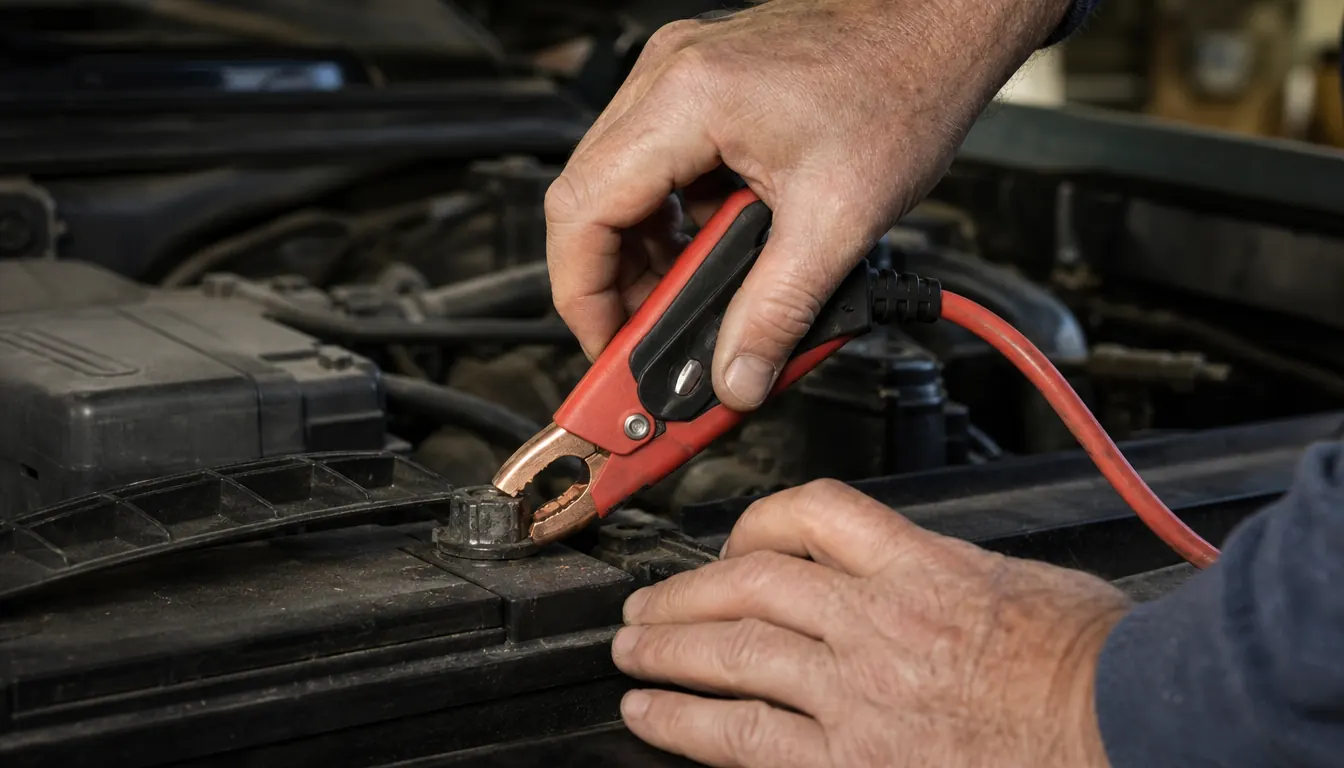
The connection is made with battery clamps, which is what I want in a home garage. Clamps mean I can reach a battery tucked under a hood or buried in a trunk without hunting for an adapter. Red to positive, black to negative, then check that both are biting metal and not paint or corrosion. I learned that one the hard way years ago, when I clamped onto a painted bracket and got nothing for twenty minutes of my life I will not get back.
It runs off the same wall outlet as everything else in the garage
Input voltage is 120 volts, so it plugs into the outlet near my bench like any other tool. No dedicated circuit, no special wiring, no electrician. I use a heavy extension cord when the car is parked on the far side. It also carries CEC, FCC and UL listings, which is the paperwork I want to see on anything that sits plugged in overnight while I am asleep upstairs. That part matters more to me now than it did ten years ago.
The three year limited warranty means I stopped babying it
The warranty is three years limited. What matters more is that the spec sheet matches how I actually use the thing, which is a lot of short charging sessions and long stretches of maintaining. I stopped worrying about whether I was shortening its life. It sits on a shelf, gets plugged in when a battery needs help, and has not given me a reason to think about it since. That makes for a boring review, and boring is exactly what you want from a charger.
What I'd Skip
Two things I would skip the GENIUS5 for. If you need to jump-start a car right now, this is not that tool. It charges over hours, and no amount of wishing changes the math. Keep a jump pack in the trunk for emergencies and let the charger do its slower job at home. Also skip it if the battery in question is already five years old and testing poorly. A maintainer keeps a healthy battery healthy. It does not resurrect one that has been dying for a year.
The other thing I would skip is leaving it connected to a battery you already know is failing. I did that with an old mower battery and it just kept the thing limping along at half charge for a month while I told myself it was fine. Replacing the battery was the honest fix. A charger is a charger, not a cure, and pretending otherwise is how you end up stranded in a parking lot in July.
Put it on the shelf and stop thinking about your battery
Five amps, 6 volt and 12 volt coverage, an 8 hour charge time and a 3 year limited warranty. The GENIUS5 handles the part of car ownership nobody enjoys.
Amazon Check Today's Price on Amazon →