
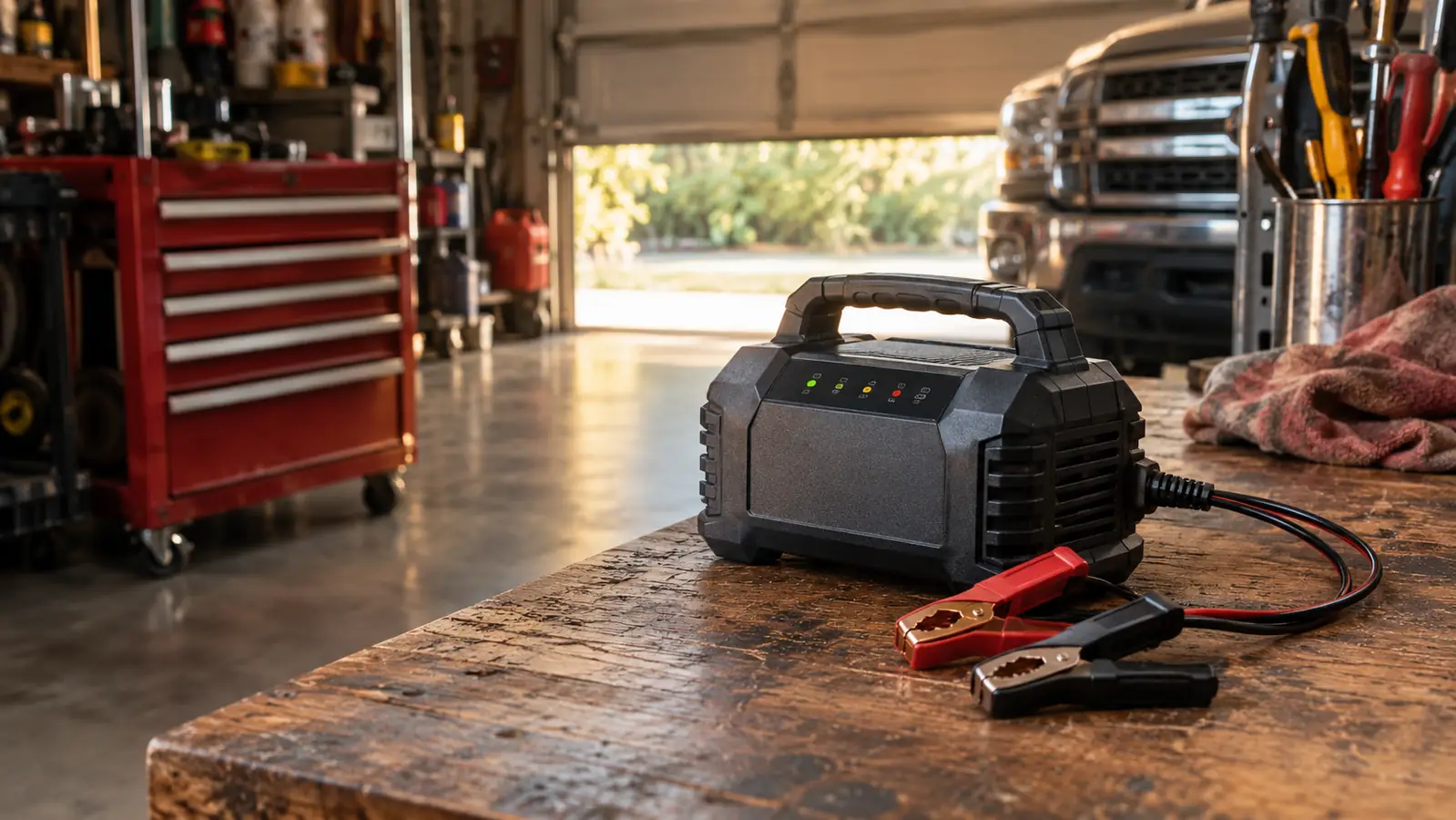
Short answer first, because that is what you clicked for. If you want one box on the workbench that can rescue a flat battery and then sit on it all winter, the NOCO GENIUS5 is the one I reach for. If your car already starts every morning and you only want to keep a healthy battery topped up, the Battery Tender Plus does that narrower job with less to think about and takes up less shelf.
I am not a professional mechanic and I will not pretend to be one. I am a county water department supervisor in Sacramento who learned this in my dad's driveway, doing brakes and oil changes as a teenager. My daily driver is a 2012 Tacoma with about 168,000 miles on it. My weekend project is a 1991 Miata that has been apart more often than it has been together. The garage is a one-and-a-half-car space with a rolling tool chest, a workbench along the back wall, and a sealed concrete floor. Both of these chargers have sat on that bench.
| NOCO GENIUS5 | Battery Tender Plus | |
|---|---|---|
| Charge rate | 5 amps, enough to recharge a drained truck battery overnight | About 1.25 amps, built to maintain rather than to rescue |
| Battery coverage | 6-volt and 12-volt lead-acid in AGM, Gel, SLA and VRLA, plus lithium LiFePO4 | 12-volt lead-acid |
| Temperature compensation | Integrated thermal sensor adjusts the charge to ambient temperature | No equivalent figure published that I could find |
| Footprint | 3.43 by 4.61 by 7.95 inches | Smaller and lighter, easy to carry or stash |
| What you have to know first | Whether the battery is 6-volt or 12-volt, and that the chemistry matches | Nothing. If it is a 12-volt lead-acid battery, connect it |
| Long winter storage | Handles it, with headroom left for a recharge in spring | Handles it, and has been doing exactly that for decades |
| Best for | A garage with more than one battery or more than one chemistry | One car, one battery, a twice-a-month routine |
What Five Amps Versus One and a Quarter Actually Means
The headline number is charge rate, and it settles most of this comparison. The GENIUS5 puts out 5 amps. The Battery Tender Plus puts out around 1.25 amps. Almost everything else you will read about these two follows from that gap.
Think of amps as gallons per minute and the battery as a bucket. If the bucket is nearly full, a slow trickle is exactly right, and 1.25 amps will top it off without any drama. If the bucket is empty, you want the bigger hose. A healthy truck battery is roughly 60 to 70 amp hours. Divide that by 5 amps and you are near 14 hours of ideal charging before you count inefficiency and the slower finish. Divide the same battery by 1.25 amps and you are past 50 hours. That is the difference between an overnight job and something you forget about until Wednesday.
NOCO lists an 8-hour charge time for the unit. Read that as a small-battery figure, not a truck figure. It lines up with a motorcycle or a lawn mower battery. It is not a promise that a fully drained truck battery is finished before breakfast.
Here is what the math looked like in practice, because a ratio on paper is easy to shrug at. The Miata's battery is a small one, and small batteries are where the two rates separate fastest. I left the parking lights on over a weekend in April and came out to a car that clicked instead of cranked. The GENIUS5 had it back to a reading I was happy with by the next morning, somewhere around fourteen hours after I clipped it on. The same battery on the Battery Tender Plus would have been a two-day wait, and I know that because I tried it the first time and gave up on day two and drove the truck instead.
The second number is coverage. The GENIUS5 is built for 6-volt and 12-volt lead-acid batteries, including AGM, Gel, SLA and VRLA, plus lithium-ion LiFePO4 packs. The Battery Tender Plus is a 12-volt lead-acid unit. For most people with one daily driver, that difference stays invisible. It stops being invisible the day a 6-volt tractor battery or a lithium pack shows up, because the smaller unit cannot take that job at all.
The third is temperature. The GENIUS5 carries an integrated thermal sensor that adjusts the charge based on the ambient temperature around it. Sacramento gives that sensor plenty to do. My garage is over 100 degrees in August and near freezing on a January morning, and a battery does not want the same voltage at both ends of that range.

How I Ran Them Side by Side
Nothing scientific here. I am one guy with two cars and a multimeter. What I did was honest, though. I let the Tacoma sit for three weeks in November without starting it, which is easy when the Miata is the fun one, and then I put the Battery Tender Plus on it for two days. Voltage came up, truck started. That is the job, done.
The numbers, since I wrote them down, because a volt or two sounds like nothing until you are standing in a cold garage listening to a starter motor. Before the November test the Tacoma read 11.9 volts across the terminals. After two days on the Battery Tender Plus it read 12.6, and the truck cranked like it had not sat at all. I chalked the date and the outside temperature on the whiteboard above the bench, 58 degrees that afternoon, mostly so I would stop arguing with myself about whether the thing had actually done anything.
Then I ran it again in February. The Tacoma had sat for four weeks and the garage never got above about 45 degrees the whole time. It read 11.7 volts, lower than the November starting point even though I had started from a longer sit. I put the GENIUS5 on it overnight, clamps on the terminals, cord run along the wall and clear of the door track, and by morning it read 12.6. It fired on the first crank. Two data points, two seasons, two different states of discharge. That is not a lab test and I will not dress it up as one. It is the test a person actually runs in a real garage.
What I watched for was heat. A charger working hard gets warm, and a warm charger on a concrete floor in a hot garage is worth paying attention to. Neither unit gave me trouble. I still would not leave either one plugged into a coiled extension cord reel, and I would not leave a cord lying across a walking path.
Where NOCO GENIUS5 Wins
It wins on range. Five amps means the same box that maintains a battery in February can also bring one back in an afternoon in July. That is the entire argument for owning a charger instead of a maintainer. You buy one thing, you learn one thing, and it covers the flat battery and the stored battery without you having to go shopping again.
It also wins on what it will talk to. Six-volt and 12-volt, four lead-acid chemistries, and lithium LiFePO4. If your garage holds more than one kind of battery, that coverage saves you from buying a second device. It also wins on temperature compensation. The GENIUS5 lists an integrated thermal sensor that adjusts charging to ambient temperature. I could not find an equivalent published figure for the Battery Tender Plus, so I will not claim it lacks one, only that NOCO is the one telling you about it.
Where Battery Tender Plus Wins
It wins on size, and it wins on having almost nothing to decide. It is a small, light box that disappears on a shelf. If you want to carry it to a neighbor's house or tuck it in a trunk for a car show weekend, it goes without complaint. The GENIUS5 measures 3.43 by 4.61 by 7.95 inches. That is compact for a 5-amp charger and still bigger than the Battery Tender.
It also wins on the thing that makes people actually use a maintainer. A 12-volt lead-acid unit with one job has very little to get wrong. You do not have to sort out whether the battery in front of you is 6-volt or 12-volt, and you do not have to think about chemistry at all. For a lot of people that simplicity is the feature. The best maintainer is the one you bother to hook up in November, and the Battery Tender Plus is easy to bother with.
And there is a case I keep coming back to. If you have one car and it lives outside, the routine that keeps a battery alive is fifteen seconds of clipping a small box onto a terminal once a fortnight through the winter. Anything that adds a decision to those fifteen seconds gets skipped. I have skipped it myself, more than once. A unit that asks one question, and asks it in a way you already know the answer to, gets used more often than a cleverer one sitting in a drawer next to the charger you meant to read the manual for.
If It Has to Charge as Well as Maintain, This Is the One
5 amps, 6-volt and 12-volt, lead-acid and lithium LiFePO4, with an integrated thermal sensor and a 3-year limited warranty. One box for the flat battery and the stored one.
Amazon Check Today's Price on Amazon →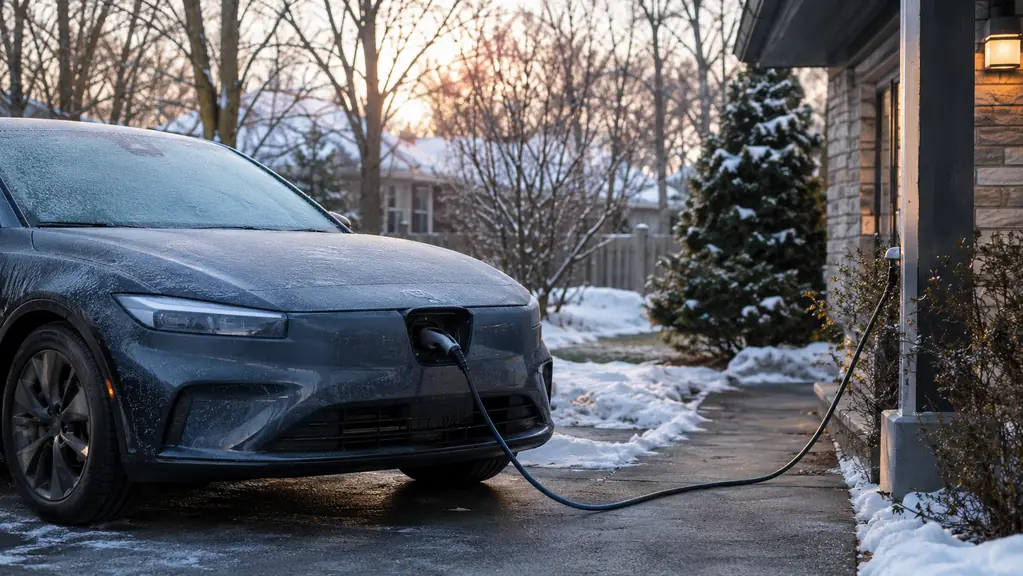
The Two Questions People Actually Ask
Can it stay connected all winter? Yes, that is the whole point of the maintainer half of the GENIUS5, and the Battery Tender Plus is built for exactly the same duty. The practical cautions are identical for both. A loose connection, a cord run where somebody walks, or a battery sitting in standing water are problems that no electronics inside the housing will solve for you. Check the connection, keep the cord clear of the floor traffic, and leave the area ventilated.
Will a bigger charger cook a small battery? This is the question that pushes people toward the maintainer. Five amps is fine for a car battery and it is more than a tiny mower battery wants, but the rating is a ceiling, not a constant blast held open. Both of these are aimed at the same target battery. One simply has headroom for the days when that battery is deeply discharged and you need it running tomorrow.
The Mistake I Made With Both of Them
Let me be specific about mine, because this is the part that costs people money. The Miata's battery went flat in the spring of 2022 after I left the trunk lid resting on the latch for a week and the trunk light finished the job. I clipped a charger on, saw the indicator settle into its finished state, took it off, and the car started. Two days later it did not. I put it back on for another week. Then another. It kept coming back to a happy-looking voltage and kept folding the instant I put a load on it. That battery was five years old and done. I replaced it, and the replacement has held through two winters on the same charger.
The second thing I got wrong was trusting the status. A charger telling you it finished is a summary, not a diagnosis. What I trust now is a multimeter reading at rest, an hour after the charger comes off, and then a load test. If you take one thing from this comparison, take that. The charger is the easy part of the job.
A charger can walk a battery back to 12.6 volts. It cannot put a dead cell back.
What I Liked
- 5 amps covers recharging and maintaining, not just one of the two
- Handles 6-volt and 12-volt lead-acid in AGM, Gel, SLA and VRLA, plus lithium LiFePO4
- Integrated thermal sensor adjusts the charge to garage temperature
- 3.43 by 4.61 by 7.95 inches, small enough for a crowded bench
- 3-year limited warranty, and it meets CEC, FCC and UL
Where It Falls Short
- Bigger and heavier than a plain maintainer, so it is not a glovebox item
- More to sort out than a 12-volt-only unit if all you own is one car
- The listed 8-hour charge time is a small-battery number, not a truck number
- It will not rescue a battery that has already lost a cell
Who Should Buy Which
Buy the NOCO GENIUS5 if you own more than one battery, if anything in your life runs on 6 volts or on lithium, or if you have ever needed a charger rather than a maintainer. It covers both jobs. For a garage holding a daily driver and a project car, that is the entire case in one sentence. It is also the one I would hand to somebody who plans to own exactly one charger for the next ten years.
Buy the Battery Tender Plus if your situation is narrow and you already know it. One car, one 12-volt lead-acid battery, no interest in lithium or 6-volt anything, and a routine that involves connecting it every few weeks through the winter. In that case the extra capability of the GENIUS5 is headroom you will never call on, and the smaller unit is easier to store and easier to live with. There is no shame in buying the simpler tool for the simpler job.
One Box That Covers the Flat Battery and the Stored One
The GENIUS5 does 6-volt and 12-volt, lead-acid and lithium, at 5 amps, with a thermal sensor and a 3-year limited warranty. See today's price and whether it earns bench space in your garage.
Amazon Check Today's Price on Amazon →Whatever you end up buying, put it on the battery before the first cold morning, not after. Batteries do not fail in July. They fail on the morning you need them most, and the charger already sitting in your garage is the only one that helps.