

The Miata sat for eleven weeks. I know it was eleven because I keep a yellow notepad on the workbench and I wrote down the date I parked it. A 1991 car with a lazy alternator will not hold a charge through a Sacramento winter of sitting, and by the third no-start I was tired of dragging the jump pack out at seven in the morning just to move a car twelve feet out of the garage. Batteries do not fail dramatically. They fail quietly, in the cold, on a morning you actually needed the car. I wanted mine looked after instead of rescued.
That is how the NOCO GENIUS5 ended up on a shelf above my rolling tool chest. It is a 5 amp smart charger that doubles as a maintainer, and it works on both 6 volt and 12 volt batteries, lead acid and lithium. I have run it for months now on the Tacoma, on the Miata, and on a small engine battery that came through the garage in the spring. What follows is what it actually did, where it got on my nerves, and who I think should spend the money.
The Quick Verdict
It does the one job that matters, which is leaving a battery healthier than it found it, and it does it without asking you to think. It is slow on purpose and it charges one battery at a time. For a two vehicle garage with one car that sits, that is the right trade.
Amazon Check Today's Price →The charger that ended my eleven week no-start
The GENIUS5 is a 5 amp unit that handles 6 volt and 12 volt, lead acid and lithium, and it is backed by a 3 year limited warranty. Today's price is on the listing.
Amazon Check the NOCO GENIUS5 on Amazon →How I've Used It
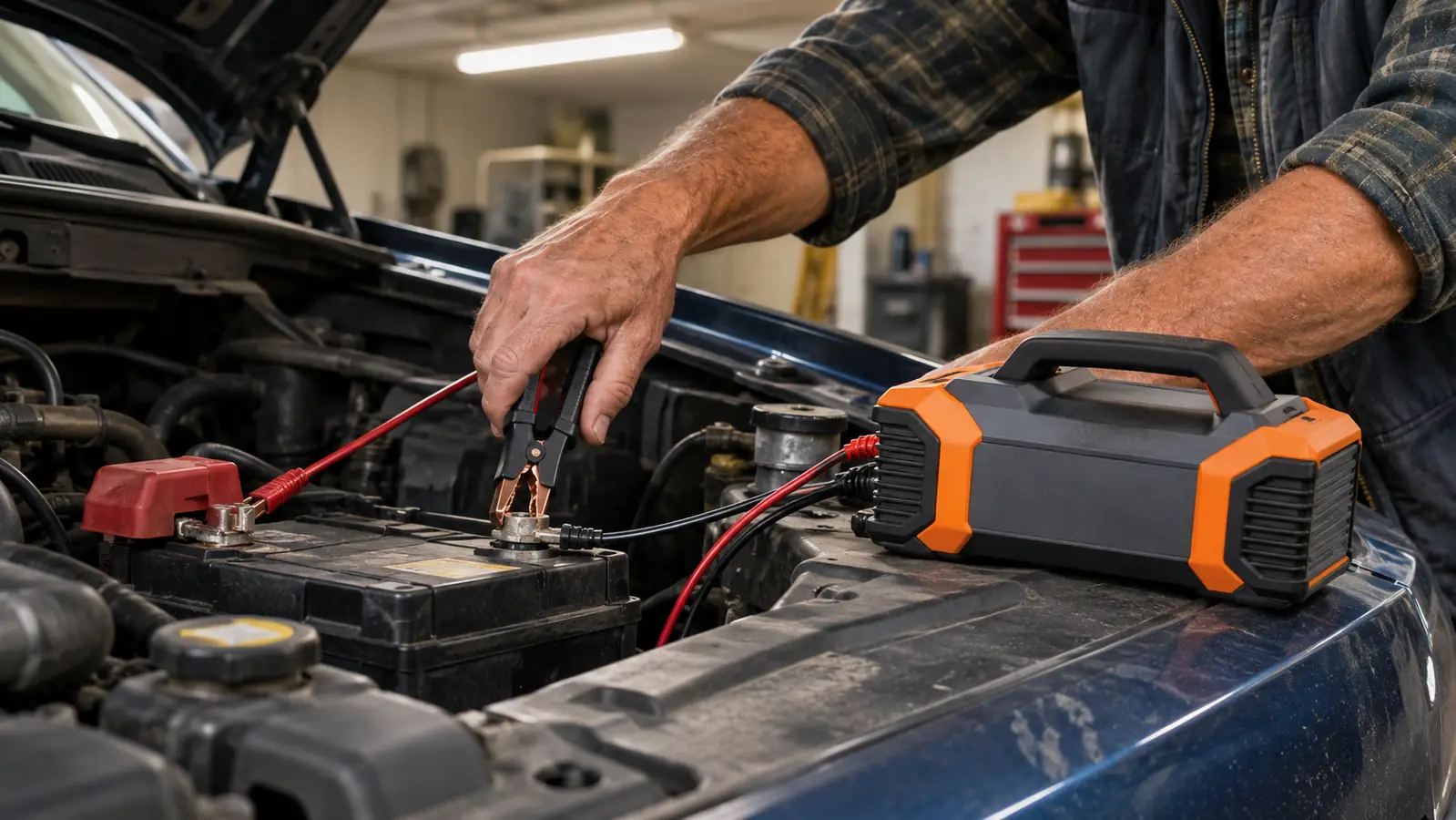
Connection is as simple as it should be. The unit uses battery clamps, so I clip red to positive and black to negative, then run the cord to a 120 volt outlet on the garage wall. There is no menu to walk through and no sequence to memorize before the thing will work. On the Miata I clip straight to the posts because the battery lives in the trunk and the cables reach without a fight. On the Tacoma I do the same under the hood with the prop rod in place, because I have leaned over enough batteries in my life to know that a face full of acid is a terrible way to spend a Saturday.
Before I bought this I tried the lazy version first. Every Sunday I would start the Miata and let it idle for twenty minutes, then shut it off feeling virtuous. It worked for about three weeks and then the battery was flat anyway, because idling does not put back what a cold start takes out of it. Then I tried pulling the negative cable and walking away for the season. That stopped the drain and also stopped the clock, the radio presets, and my patience for resetting all of it every spring. Both of those were me avoiding the obvious.
The habits around it matter more than the hardware. I crack the garage door when anything is charging, I do not smoke out there, and I check that the clamps are biting metal and not a plastic cover before I walk away. My dad drilled that into me while we were doing brakes when I was fifteen, and it has not stopped being true. The GENIUS5 does not need babysitting, but a battery is a chemical box that can vent. Treating it like a phone on a nightstand is how people get hurt.
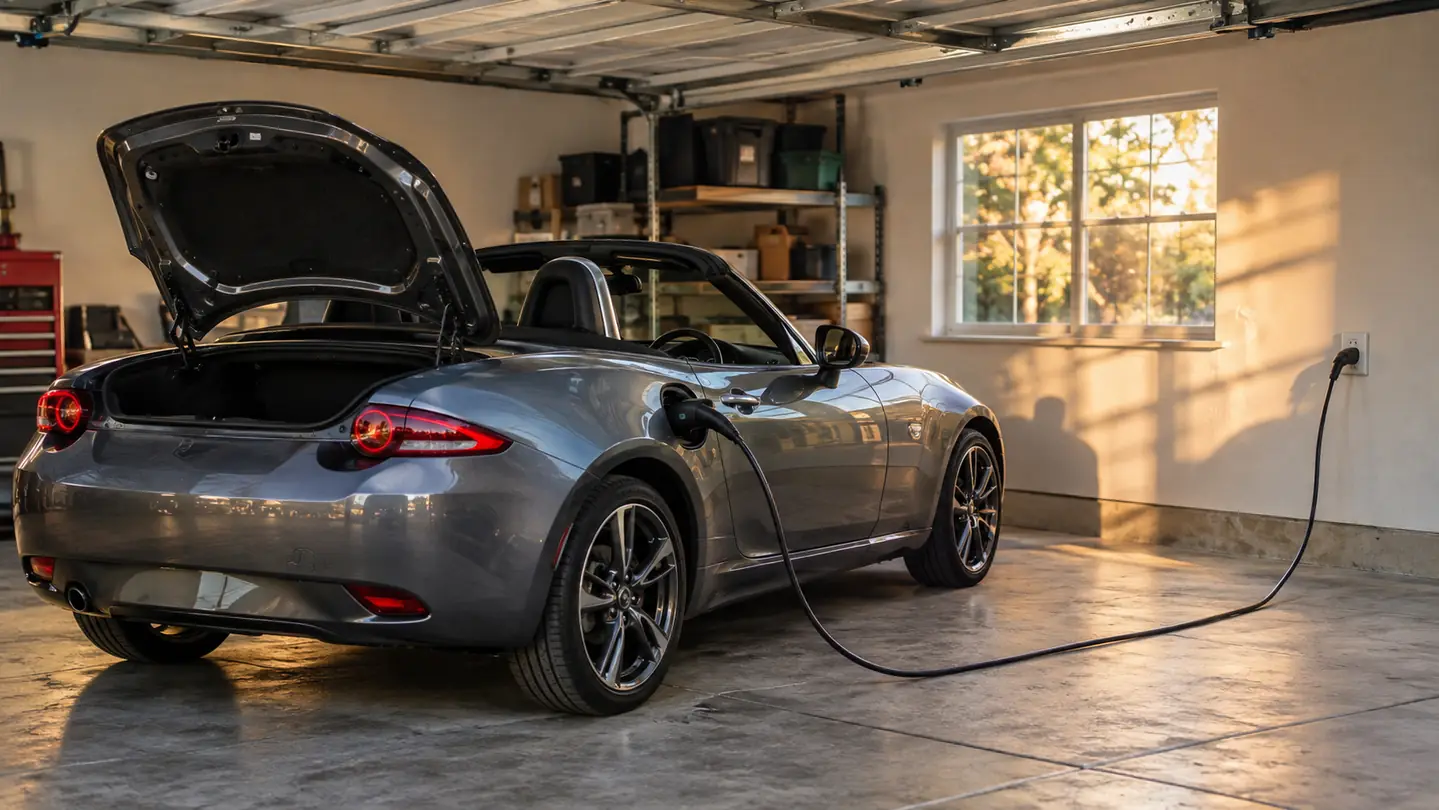
The first real test was the Miata after those eleven weeks of sitting. NOCO lists an eight hour charge time for the unit and that is roughly what I saw. I hooked it up on a Friday evening and by Saturday morning the starter spun the engine like the car had been driven the day before. No drama, no smell of hot plastic, no clicking from a solenoid with nothing behind it. That single overnight session is the whole reason I stopped resenting a car I only drive on dry weekends.
Since then it has been maintenance duty far more than rescue duty. The Tacoma gets driven enough that its battery stays up on its own, so most months the charger lives on the Miata. When I know the car is going to sit, I clip it on for one night and pull it off the next morning. I also ran a mower battery through it after a spring no-start, same clamps, same process, no adapter to hunt down in a drawer. That routine has held for a full season without a single dead battery in the garage.
What Five Amps Actually Means in a Garage
Five amps is not a fast charger and it is not pretending to be. The number that matters is what it does to the battery over hours, not minutes. A bigger charger will bring a flat battery back in a couple of hours, and if that is all you need, fine. But fast charging is also where batteries get hot, and heat is what kills them. At 5 amps the GENIUS5 has time to bring a battery up without cooking the plates inside it.
The tradeoff is patience. If you flatten a battery completely, plan on the eight hours NOCO lists, and plan on it being overnight. That is not a hardship in a home garage because you were going to sleep anyway. It is a hardship if you were counting on driving the car in an hour, and in that case I reach for a jump pack first and let the charger do the slow work afterwards. Buying this as an emergency jump starter is buying the wrong tool.
The other thing 5 amps buys you is a small box. The case measures 3.43 inches deep, 4.61 inches wide and 7.95 inches tall, which is roughly the footprint of a hardback book. Mine sits on a shelf above the tool chest and I forget it is there until I need it. A charger that lives on the floor gets kicked, tripped over, and eventually unplugged by accident. A charger that lives on a shelf gets used, and that is most of the battle with battery maintenance.
For a sense of the footprint, the shelf above my tool chest is about fourteen inches deep and it already holds a box of latex gloves and a roll of shop towels. The charger fits beside them with room left over, which surprised me. The borrowed charger I used before this one was roughly twice the volume and lived on the floor by the side door, where I tripped over its cord twice in a single month and stepped on the clamps once in the dark. Small matters more than it sounds like it should.
The Thermal Sensor Earned Its Place in July
There is an integrated thermal sensor that adjusts the charge based on ambient temperature. I did not think much about that line until August, when my garage hit the kind of heat that makes a wrench uncomfortable to hold bare handed. A charger that ignores temperature is guessing. This one reads the room and adjusts, and the practical result for me was that the unit never got more than warm to the touch on an afternoon when the concrete itself was hot enough to radiate at you.
The afternoon I remember was in late July, with the garage door closed all day and the thermometer on the back wall reading 104 by four o'clock. I hooked the Tacoma up out of curiosity more than need, then put the back of my hand on the case every half hour while I sorted sockets and put away the tools from a brake job. Warm the whole time, never hot, and no smell of warm plastic. I have owned a dumb charger that you could smell working from across the room.
The same sensor matters in January, in the other direction. Cold batteries accept a charge differently than warm ones, and a charger that pushes the same current on a forty degree morning that it pushes on a ninety degree afternoon is doing the battery no favors. I am not going to pretend I measured any of this with instruments, because I did not. What I can tell you is that every battery I have run through this thing has come back to full and stayed there, through a hot summer and into a cold snap, without the sluggish crank that tells you a battery is being slowly ruined.
Six Volts, Twelve Volts, and the Chemistry Question
The unit handles both 6 volt and 12 volt systems, and NOCO lists support for lead acid in AGM, gel, SLA and VRLA form along with lithium ion LiFePO4. That covers everything in my garage and almost certainly everything in yours. The Tacoma runs a standard 12 volt lead acid battery and so does the Miata. The value of the wider list is that you are not buying a charger that becomes useless the day a vehicle shows up with a different battery chemistry in it.
It also means the same box will do a boat battery, a motorcycle, an ATV, a tractor or a lawn mower. I have only tested the car side and the small engine side myself, but the clamps do not care what the battery is bolted into. If your garage has more than one battery in it, that flexibility is most of the argument for owning a charger instead of borrowing your neighbor's twice a year and hoping he is home.
The unit is listed as meeting CEC, FCC and UL and it carries a 3 year limited warranty. I have not had to use the warranty, so I cannot tell you how that process goes in practice. I can tell you that a 3 year window on a device that lives in a garage and gets plugged in unattended overnight is the number I would want to see before I trusted it enough to leave the house.
Where the GENIUS5 Got on My Nerves
It charges one battery at a time. That sounds obvious right up until you own two vehicles that both sit. There are weekends when I want the Miata topped up and the Tacoma looked after on the same day, and the honest answer is that one of them waits until Sunday. If your garage holds three batteries that all need attention in the same week, you will feel this in a way I only occasionally do.
To be fair about it, the rotation is not a big deal most of the time. My routine is the Miata on Friday night and the Tacoma on Saturday night if it needs it, and neither has needed two nights running. But there was one Saturday in March after a cold stretch when both were low, and I ended up out there at ten at night in a hoodie moving clamps from one car to the other with a flashlight in my teeth. That is the real cost of one channel, and it is worth knowing before you buy.
It also will not hand you a number. There is no app, no scheduling, no report on your phone telling you what happened overnight. You clip it on, you plug it in, and you come back to a battery that is either ready or it is not. I have gotten used to that and mostly prefer it, because I do not need another device asking for my attention. But if you want state of charge as a percentage on a screen, this is not the unit that gives it to you.
And it needs a wall outlet. That is fine in a garage and less fine in a storage lot. If the car is parked somewhere without power within cord reach, this charger cannot help you, and you are back to a jump pack or a solar maintainer. It sounds obvious, but a lot of people buy a charger before they walk out and look at where it is actually going to plug in.
What I Liked
- Brought an eleven week dead Miata battery back in one overnight session
- 5 amps is gentle enough to leave connected without cooking the battery
- Handles 6 volt and 12 volt, lead acid in AGM, gel, SLA and VRLA, plus lithium LiFePO4
- Integrated thermal sensor adjusts the charge to garage heat and cold
- Small footprint at 3.43 by 4.61 by 7.95 inches, so it lives on a shelf
- 3 year limited warranty, listed as meeting CEC, FCC and UL
Where It Falls Short
- One battery at a time, so a two vehicle garage means a rotation
- Slow by design, plan on the 8 hour charge time for a fully flat battery
- No app, no scheduling, no state of charge number anywhere
- Needs a 120 volt outlet, so it is no help in a storage lot
Eleven weeks of sitting, one overnight session, and the Miata cranked on the first turn of the key. That is the entire argument for the GENIUS5.
Who This Is For
This is for the person with a vehicle that sits. A weekend car, a truck that only works on Saturdays, a boat, a mower, anything with a battery that goes weeks between runs. It is also for the person who has already replaced a battery earlier than they should have and quietly suspects that sitting is the reason. If you can reach a 120 volt outlet and you can leave a charger connected overnight, the GENIUS5 covers the whole job for a two vehicle garage, one battery at a time. If you are weighing it against a smaller maintainer, the real question is whether you ever need to charge a flat battery or only top up a healthy one. The smaller unit maintains. This one also recovers, just slowly.
Who Should Skip It
Skip it if you need two batteries charged at once, because it will not do that. Skip it if the car lives on the street with no outlet within reach. Skip it if you want a screen full of numbers, because that is a different product at a different price. And skip it if you are expecting a fast charger that rescues a dead battery in an hour so you can make an appointment. The GENIUS5 is a maintainer that can also charge, and the charging half is patient on purpose. If you need speed, buy speed. If you need a battery that is still healthy next spring, this is the right shape of tool.
If your weekend car sits more than it drives, this is the fix
The NOCO GENIUS5 handles 6 volt and 12 volt, lead acid and lithium, and it will hold a sitting battery through a winter of neglect. Today's price is on the listing, and the 3 year limited warranty covers the part that lives in the heat.
Amazon Check Today's Price on Amazon →