
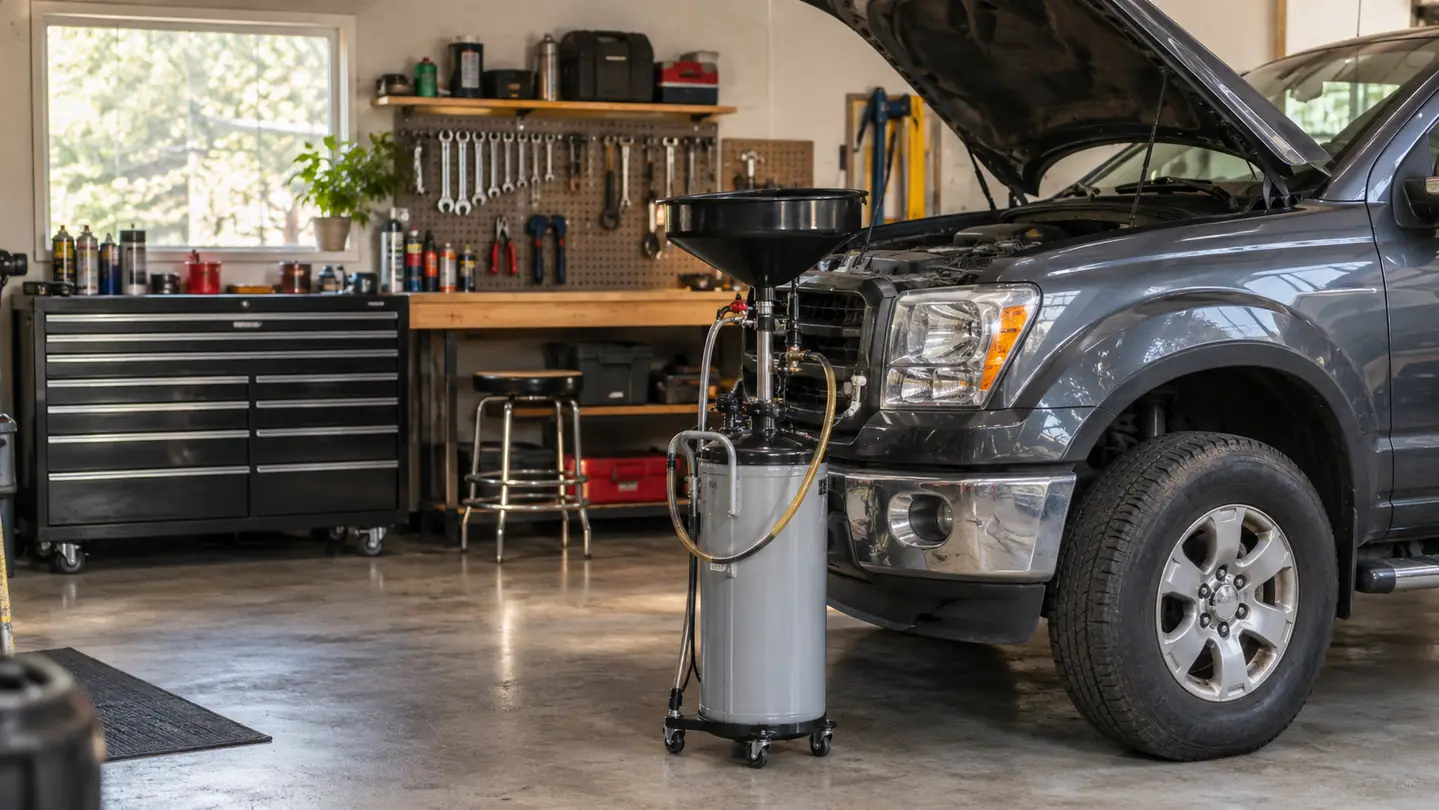
I pushed the Tacoma about 900 miles past its oil change interval last spring, and it wasn't the oil that slowed me down. It was the jack. My garage is a one-and-a-half-car space with a rolling tool chest and a workbench along the back wall, and there is room to open a door or roll out a creeper, but not both at once. Walking the floor jack out, finding a clean spot on the frame rail, and getting two stands under the truck took longer than the drain itself ever did.
So I changed the method instead of the schedule. The EWK 6.5L Pneumatic/Manual Oil Extractor pulls the oil out through the dipstick tube with the vehicle sitting flat on the ground. No jack, no stands, no creeper, no drain plug washer to fish out of a pan of black oil. I have run it on the Tacoma at around 168,000 miles and on my 1991 Miata project car, and a routine change now fits into the hour before dinner instead of eating a whole Saturday morning.
What follows is the order I actually do it in, including the two steps I got wrong the first time. If you have never done an oil change yourself, none of this requires a lift or a strong back, and that is the entire point.
Drain It From the Top, With the Car Still on the Floor
The EWK 6.5L holds a full change from a V6 pickup in a single pull, runs on the hand pump or on shop air, and ships with two extended suction tubes for reaching the bottom of the pan.
Amazon Check Today's Price on Amazon →Step 1: Warm the Oil, Then Shut the Engine Off
Cold oil moves like cold honey. Warm oil carries the suspended grit with it and moves out of the pan in a fraction of the time, which is why I warm the engine before anything else comes out of the toolbox.
I start the truck, let it idle for about 15 minutes, and shut it off. That is the whole warm-up. No highway run, no revving in the driveway to hurry it along. The oil needs to be warm enough to flow, not hot enough to be a hazard.
Two things I check before I reach for a hose. The exhaust side of the engine bay is still hot enough to take skin off, so I keep my forearms and the suction tube well away from it. And warm is the target, not hot. If a drop of water sizzles when it lands on the valve cover, I go do something else for 20 minutes. Hot oil moving through a hose that you are holding in a bare hand is how a 20 minute job turns into an urgent care visit, and I have watched a friend learn that the hard way. I learned the other half of that lesson in January, when I got impatient and started pulling after five minutes of idle. The oil came out in slow ropes instead of a stream, and the whole job stretched to 40 minutes. Fifteen minutes of idle is the number that has worked every time since.
Step 2: Park Flat and Match the Tube to Your Dipstick
Flat matters more than people expect. On ramps, the oil pools at the back of the pan and the tube ends up sitting in air. I park on the sealed concrete, set the parking brake, leave the transmission in park, and chock a rear wheel out of pure habit from years of working under cars.
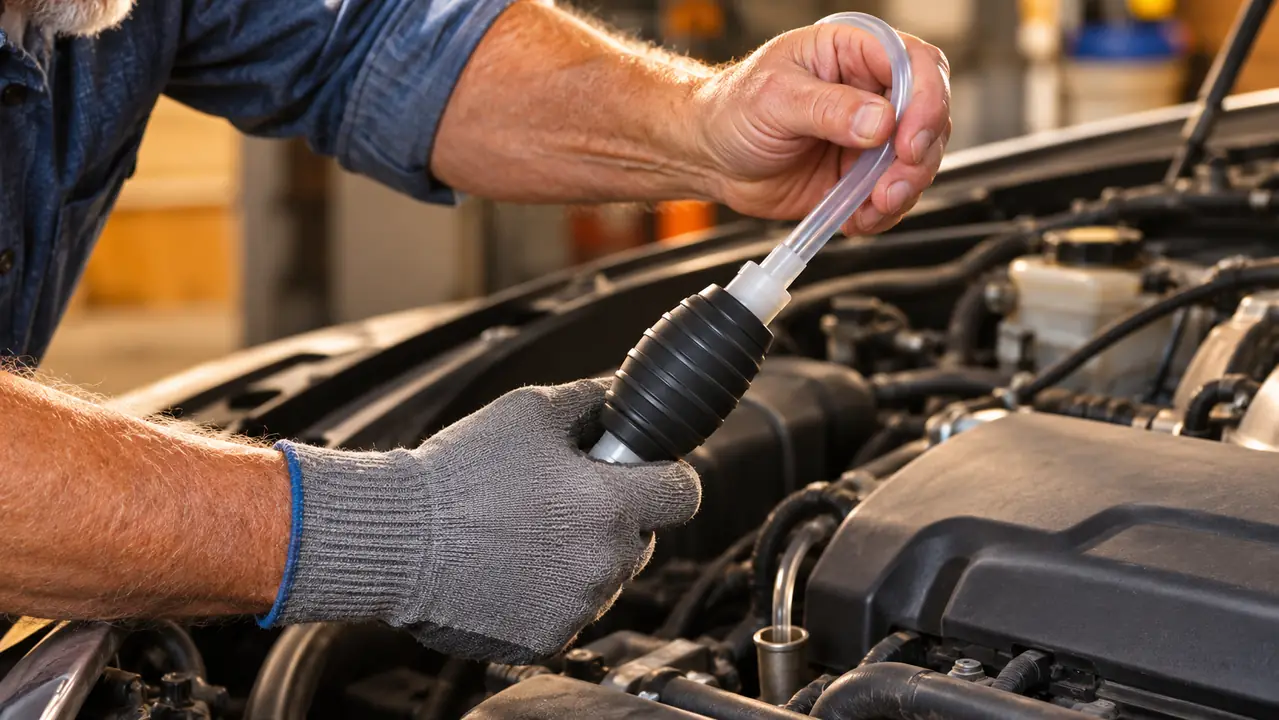
The EWK unit stands 22.05 inches tall and weighs 6.42 pounds empty, so it sits on the floor beside the front fender without threatening to tip when you tug on the hose. Pull the dipstick, wipe it on a rag, and read the level before anything else happens. That reading is your baseline for later in the job. Then look at how far the dipstick went in and how thick it is, because the suction tube has to make the same trip down the same hole. On the Tacoma the dipstick runs close to two feet and the tube follows it down past the exhaust manifold, so I feed it in short increments and keep my knuckles clear. The Miata is the opposite problem: a short tube with a hard bend about halfway down, and the first time I rushed it the tube stopped several inches short and pulled almost nothing.
The two extended suction tubes are the ones you will use most. Pick the one that slides into the dipstick tube with a little clearance around it. Feed it down slowly and straight until it stops, or until you feel it touch the bottom of the pan. If it hangs up on a bend, pull it back an inch, twist slightly, and try again. Do not push. A tube jammed past a restriction is a two person problem, and the second person is never happy about being called out to the garage.
Step 3: Choose Manual or Air
The extractor runs two ways and both are genuinely useful. In manual mode you pump the handle by hand to build vacuum in the reservoir, then let it pull. It is quiet, it does not need the compressor, and on a cool morning it is the mode I reach for first.
Pneumatic mode is the fast one. You connect shop air, and the unit is rated for an operating pressure of 40 to 170 PSI. My small garage compressor runs a regulator comfortably inside that window and empties the Tacoma's pan noticeably quicker than the hand pump does. If I am doing both vehicles back to back on a Sunday, I use air for both and stop thinking about it.
Two habits worth keeping. Keep the regulator at the low end of that range the first time you use air, and stay under the 170 PSI ceiling no matter how impatient you are. It is also worth draining the water trap on your compressor before a job like this, because moisture riding along with the oil helps nobody. My first try at pneumatic mode, I had the regulator set near the top of the range because faster seemed better. The hose jumped, the tube sucked itself flat against the side of the pan and stalled, and I spent ten minutes chasing a flow that kept breaking. At the low end it runs smooth, and I have not touched that regulator since.
The Tacoma takes about 5.5 quarts. The 6.5 liter reservoir swallowed the whole change in one pull, and I never put a jack under the truck.
Step 4: Pull the Oil and Stay With It
The first pull on the Tacoma moved about 5.5 quarts into a 6.5 liter reservoir, so there was headroom left and no risk of topping out the tank before the pan ran dry. The Miata's 1.6 liter engine does not come close to filling it, which makes that car a short job in every sense.
The whole operation is a study in watching and listening. A steady flow through the tube means oil. When it starts to gurgle and spit, the tube has broken the surface and is pulling air. That is your cue to slide it down half an inch, or move it to a different low spot in the pan, and let it run again. The two extended tubes reach deep into the reservoir, and repositioning is what gets the last half quart out instead of leaving it behind with the sludge.
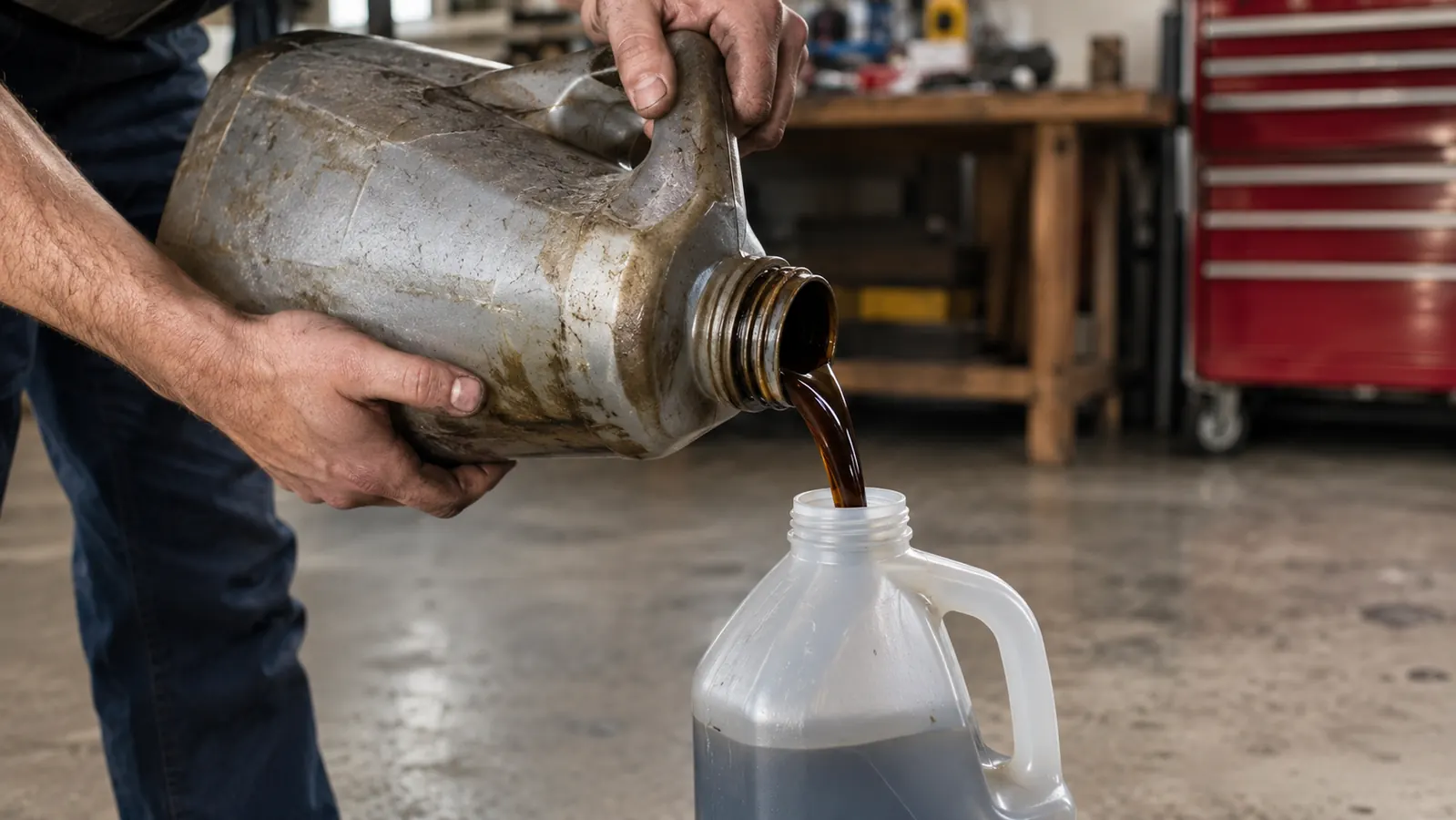
Measure what came out. If the owner's manual says 5.5 quarts and you pulled 4.5, something is off. Either the tube never reached the bottom, or the engine was low going in. That number is the most useful free diagnostic in the whole job, and it is why I write the volume and the date on the side of the jug with a marker before I take it to the county collection site on my way to work.
Step 5: Filter, Refill, and Reset the Reminder
An extractor does not change your oil filter for you, and the filter is still the part most people forget. On the Tacoma it is reachable from the top of the engine bay with the hood up. On the Miata it takes a reach behind the intake side, and I lay a rag underneath because some oil always comes out when the filter breaks loose. Since nothing is jacked up, the only oil I am catching is from the filter, so it is a two rag job instead of a full drain pan. I use a cap style filter wrench on both cars, and I check that the new filter's rubber gasket is seated and wiped with a film of fresh oil before it goes on. Hand tight, then a quarter turn. The one time I skipped the oil film, the gasket stuck to the block at the next change and I lost 20 minutes scraping it off.
Refill with the amount the manual specifies, run the engine for a minute, shut it off, wait five minutes, and check the dipstick. Top off to the upper mark. Then reset the maintenance reminder. On the Tacoma that is a sequence through the trip meter button, and it lives in the owner's manual, not in my memory, which is why the manual stays in the glovebox where it belongs.
Empty the reservoir into a sealed container the same day. Do not let a full extractor sit in the corner of the garage for a month. Lids work loose, tanks get knocked over, and used oil on a sealed concrete floor is both a slipping hazard and a mess you will be cleaning up with oil absorbent while you say things you would rather your neighbor not hear.
Where This Method Stops Working
This approach has limits and it is better to hear them before you plan a Saturday around it. Some engines do not give a straight path down the dipstick tube, and a tube that cannot reach the bottom of the pan cannot pull the oil out of it. EWK lists the unit as not compatible with the Mercedes W212 E350 or the C218 CLS 350, which is a good reminder to check your own model before you commit to changing your routine.
The extractor is also not a sludge inspection tool. Pulling from the top means you never see the drain plug or the bottom of the pan, and on a high mileage car you just bought, the plug is where the surprises live. My compromise is to extract for routine changes and pull the drain plug every fourth or fifth one, which keeps the threads exercised and lets me look at what is sitting at the bottom. And it is built for engine oil. Gasoline and other highly volatile fluids are off the list entirely, no exceptions.
What Else Helps
Nitrile gloves, a funnel with a long neck, a headlamp, and a dedicated drain jug with a screw cap. The gloves matter because warm oil goes straight through a cotton rag and onto your hands, and the headlamp matters because dipstick tubes on a transverse engine are always tucked under something. Keep the owner's manual out on the workbench for the capacity number and the reminder reset sequence, and keep a torque wrench on the shelf for the changes where you do pull the plug.
One more habit that has saved me twice: log the date, the mileage, and the volume extracted on the jug or the filter box. Six months later, when you are standing in the garage trying to remember whether the last change was before or after the road trip, that scribble answers the question in two seconds and keeps you from guessing at an interval that matters more than most people think.
Do the Next One With All Four Wheels on the Ground
Manual pump or shop air, 6.5 liters of capacity, two extended suction tubes, and a full V6 pickup change in a single pull. Check the dipstick routing on your own engine first, then check today's price.
Amazon Check Today's Price on Amazon →