
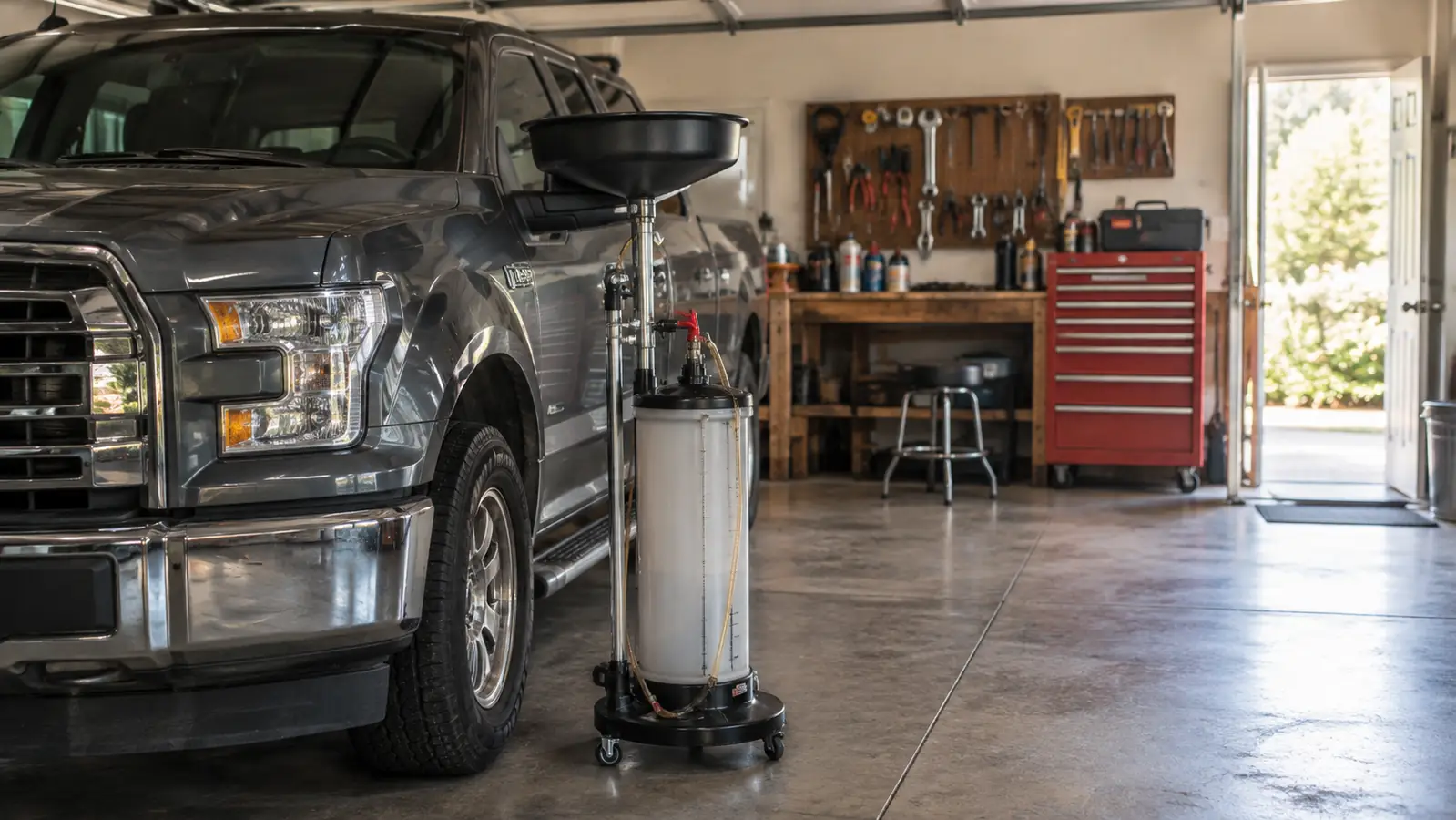
I bought the EWK 6.5L oil extractor in March, mostly because I was tired of sliding under the pickup on a cold garage floor. That truck has about 168,000 miles on it now, which means the drain plug has been out and back in more times than I can count, and the last few changes left me with a forearm slick to the elbow and a drip pan I had to scrub in the utility sink.
The Miata is the worse of the two. It sits low enough that I have to jack it and set stands just to reach the plug, and I have never once gotten through that job without a splash on the sealed concrete. So when I read that the EWK pulls oil up through the dipstick tube without lifting the car at all, I ordered one. Since then I have run it through three full oil changes, two on the pickup and one on the small convertible, plus a couple of short test pulls. Months later, here is the honest version.
The Quick Verdict
Pulls a full five-quart sump through the dipstick tube in a single pass and works on a hand pump when there is no air line in reach. Emptying the reservoir is the part you have to learn to live with.
Amazon Check Today's Price →Change the oil without lying on the concrete
The EWK 6.5L runs on a hand pump or an air line, and the two extended suction tubes reach the bottom of the pan. Check today's price and the current review count on Amazon.
Amazon Check Today's Price on Amazon →How I've Used It
The first pull was the pickup. I warmed the engine for about ten minutes, shut it off, and let it sit while I found the dipstick. The four cylinder in that truck holds a little over five quarts, so the 6.5 liter reservoir takes the whole sump with room to spare. That matters more than it sounds. A smaller extractor forces you to stop halfway, empty a warm reservoir, and start over.
I used manual mode first because my compressor is a small pancake unit under the workbench and I did not feel like dragging it out. You work the pump handle with one hand and steady the tube with the other. It took about twelve minutes to pull everything, which is slower than a drain plug, but I never got under the truck and I never touched a wrench.
The second pull I tried pneumatic. You connect the unit to an air line and let the venturi do the work. The rated operating pressure is 40 to 170 PSI, and my little compressor sits comfortably inside that range. That pull took closer to four minutes, and I spent most of it standing there listening to the tube gurgle. If you already own air, you will not go back to the handle.
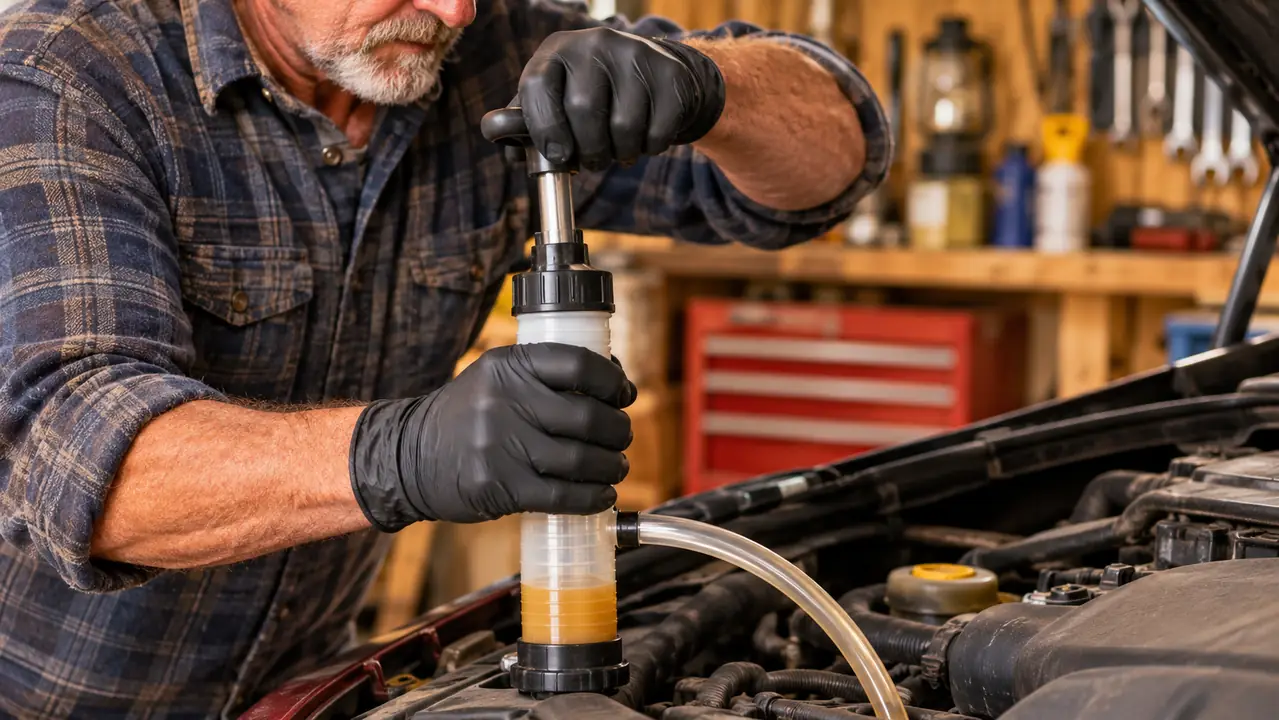
The Miata was the real test because the dipstick tube on that car is narrow. I fed one of the supplied extended tubes down until I felt it reach the pan, and it pulled the full four quarts without air locking once. The unit ships with two extended suction tubes, and the point of the extra reach is that you are not leaving an inch of dirty oil sitting in the bottom of the reservoir.
The second pickup change came around in early October, and by then I had a routine. I pulled the dipstick, wiped it on a blue shop towel, and set the extractor on a square of cardboard beside the front tire so any drip landed on cardboard instead of concrete. I ran the tube down until I felt the pan, gave it one small pull back to make sure it was not resting on the bottom, and started pumping. Five and a half quarts came out in about eleven minutes. Then I changed the filter, poured the new oil in, and checked the level twice because the first reading after a refill is never trustworthy.
Five and a half quarts came up the dipstick tube in one pass, and I never once laid down on the concrete.
What 6.5 Liters Actually Buys You
Capacity is the spec people skim past. Most four cylinder cars hold four to five quarts, and most V6 and small V8 engines hold five to seven, so 6.5 liters covers the majority of what a home mechanic will touch. It covers my pickup with room to spare and it covers the Miata twice over. If your sump is bigger than that, you will be stopping to empty midway, and the job gets old fast.
I measured every pull with a marked jug the first three times, and the numbers are worth writing down. The pickup gave up a little over five quarts. The Miata gave up four. That is nine quarts of capacity used across two vehicles, which means neither one ever came close to the 6.5 liter ceiling. The headroom is the point. A buddy of mine has a four liter unit and he has to stop, empty, and restart on his V6, which turns a fifteen minute job into a thirty minute one with a warm reservoir in his hands.
There is a second benefit that only shows up after you have done this a few times. Because the reservoir is not full at the end of a change, you have somewhere to put the oil that comes out of the filter housing when you tip it. I used to balance that filter on a scrap of cardboard and hope. Now it drains into the extractor and the cardboard goes in the trash.
The tradeoff is physical size. The unit measures 8.27 by 8.27 by 22.05 inches and weighs 6.42 pounds empty, which makes it a tall, narrow piece of equipment. In a one-and-a-half-car garage where the workbench is already crowded, 22 inches of height is real estate. Mine lives upright in the corner next to the tool chest, and I had to move a parts bin to make that spot.
A full reservoir is a two-handed lift, and you do not want to be carrying it across a clean floor. I empty mine into a sealed jug right where I did the change, then carry the jug. That is a small workflow adjustment, and it took me one messy afternoon to figure it out.
Pneumatic Mode vs Manual Mode
Pneumatic is faster and it is not close. The venturi pulls a steady vacuum and the oil moves in one continuous climb up the tube instead of the pulse you get from a hand pump. For a two-vehicle household doing spring and fall changes, that difference is the whole reason to own the thing. The EWK handles both modes without a change of setup, so you are only ever deciding whether to reach for the air hose.
I run my compressor at about 90 PSI for this, which sits in the middle of the 40 to 170 PSI range and keeps the little pancake tank from cycling every thirty seconds. At that setting the pull is steady, and the oil climbs the tube in one long column rather than the chug you get from the handle. The first time I tried it I had the regulator turned down near 40 and the pull was sluggish, so I nudged it up and the difference was immediate. Listen to the tube. When the pitch changes and the flow turns to sputter, you are basically done.
Manual mode is the reason I would still buy it if I had no compressor. You are the vacuum source, so the pull is slower and your arm gets a workout, but it works anywhere. If you change oil at a storage lot, at a relative's house, or in a garage with no air line, you still get a clean change out of it. There is no power cord and nothing to plug into a wall.
The one thing to know is that neither mode likes cold oil. On a cold morning the pump moves noticeably slower and the tube gurgles for longer. Ten minutes of idling before you pull makes both modes behave, and it is the single biggest variable in how long the job takes.
The Mistakes I Made on the First Pull
The first mistake was pulling on a stone cold engine, which doubled the time. The second was not measuring what came out. If your spec says five and a half quarts and you pull four and a half, you stopped early or you left oil in the filter housing, and you want to know that before you pour new oil in. I keep a marked jug and check the volume now.
The phone call mistake cost me a fender wipe and twenty minutes with a rag and a bottle of bug and tar remover, which is not how I wanted to spend a Saturday. Now the tube goes straight from the dipstick to the reservoir holder and the phone stays in the house. The other habit I picked up is laying a folded shop towel under the reservoir before I start, because a full reservoir that gets bumped is a lot easier to deal with when the towel is already there.
The third was leaving the tube resting against the fender while I answered the phone. Warm oil dripped down the tube and onto the paint. Route the tube over a shop rag, not over the car. The fourth was emptying into an open drain pan, which splashed. The reservoir pours more predictably through a wide funnel set in a sealed jug.
None of these are the extractor's fault, which is why I mention them. The tool does its job. The learning curve is in the workflow around it, mostly in what you do with 6.5 liters of warm used oil when the pump stops.
Where It Falls Short
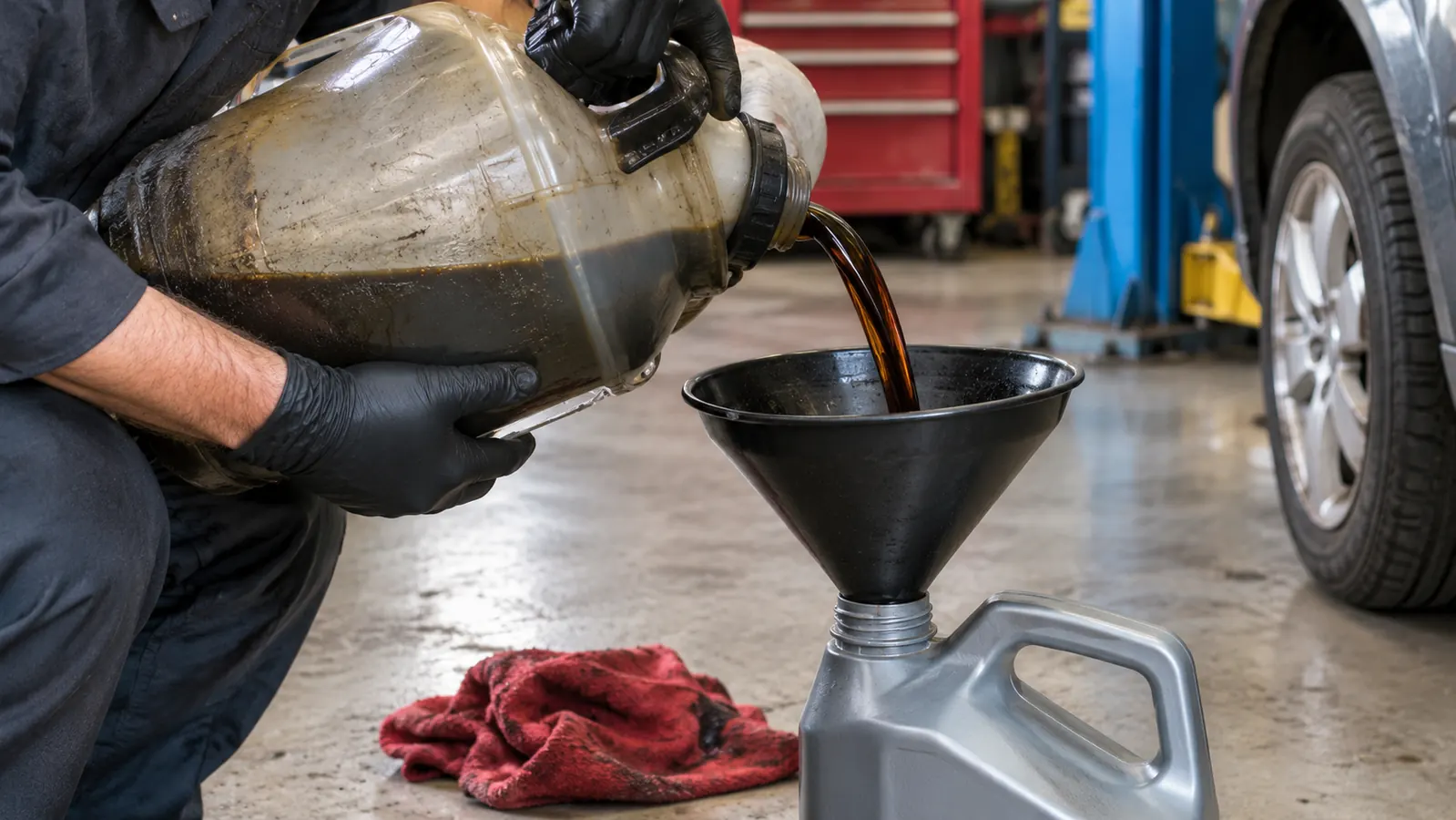
Emptying is the weak point, full stop. Pumping the oil out is clean and quick. Getting it from the reservoir into a jug without a drip takes a funnel, a steady hand, and a reservoir that is not too warm to hold. On a full 6.5 liters that is the slowest part of the whole job, and it is the step that decides whether you keep reaching for this thing or go back to the drain plug.
One more thing about the emptying. The reservoir mouth is wide enough that a funnel sits in it without being held, which helps, but you still want the jug below the reservoir and not beside it. I pour in two stages and cap the jug between them.
The suction tube curls. It has memory from the package and it wants to spiral inside the dipstick tube instead of going straight down. Feed it in slowly and hold it straight, or it will stop short and you will think you hit the pan when you did not. This got easier after a few uses, but the first time it cost me ten minutes of confusion and one restart.
Two cautions worth repeating from the listing. It is not compatible with the Mercedes W212 E350 or the C218 CLS 350, so check before you buy if that is your car. And it is not for gasoline or other highly volatile fluids. Used motor oil and similar fluids are the job. Do not get creative with it and do not leave it sitting loaded with solvent.
The body is translucent, so you can watch the oil climb the side. The molded volume marks are coarse, though, so use your jug for the real measurement rather than reading the level off the reservoir.
What I Liked
- Pulls a full five-quart sump through the dipstick tube in one pass
- Pneumatic mode finishes a change in a few minutes
- Manual mode needs no compressor, no cord, and no outlet
- Two extended suction tubes reach down to the pan
- 40 to 170 PSI operating range fits a small home compressor
- No drain plug wrench, no crush washer, no pan to scrub
Where It Falls Short
- Emptying 6.5 liters of warm oil is the messiest step of the job
- 22.05 inches tall, so it needs corner or shelf space
- The suction tube curls and has to be fed in slowly
- Not for gasoline or other highly volatile fluids
- Not compatible with Mercedes W212 E350 or C218 CLS 350
Who This Is For
This is for the home mechanic with one or two vehicles, no lift, and a garage floor they would rather not lie on. If you do your own oil twice a year and you are tired of jacks, stands, and a drip pan, the EWK earns its space. It is also a good fit if your car has a cartridge filter on top of the engine, because then you never go underneath at all and the whole job happens standing up.
It suits someone who already owns a compressor but would still use the tool without one. And it suits anyone with a bad back or sore knees, which at 52 I am starting to understand. The difference between a change done standing and a change done on a creeper is not a small one, and it is the reason mine stays on the shelf instead of the return pile.
Who Should Skip It
Skip it if you have a lift or a pit. The drain plug is faster when the car is already in the air and you gain nothing. Skip it if your sump holds more than 6.5 liters, because you will be stopping to empty halfway through. Skip it if your car is one of the two Mercedes models the listing calls out, and skip it if you are looking for something to pump gasoline or solvent.
And skip it if you want a tool that empties itself. The reservoir has to be poured out by hand every time, and if that sounds like the exact chore you were trying to avoid, a drain plug and a good drip pan are still the simpler answer. No tool removes every step. This one just moves the work to a place where you are standing.
Three oil changes in, I would buy it again
The EWK 6.5L turns an oil change into a job you do standing up, on a hand pump or an air line. Check today's price and current availability on Amazon.
Amazon Check Today's Price on Amazon →