
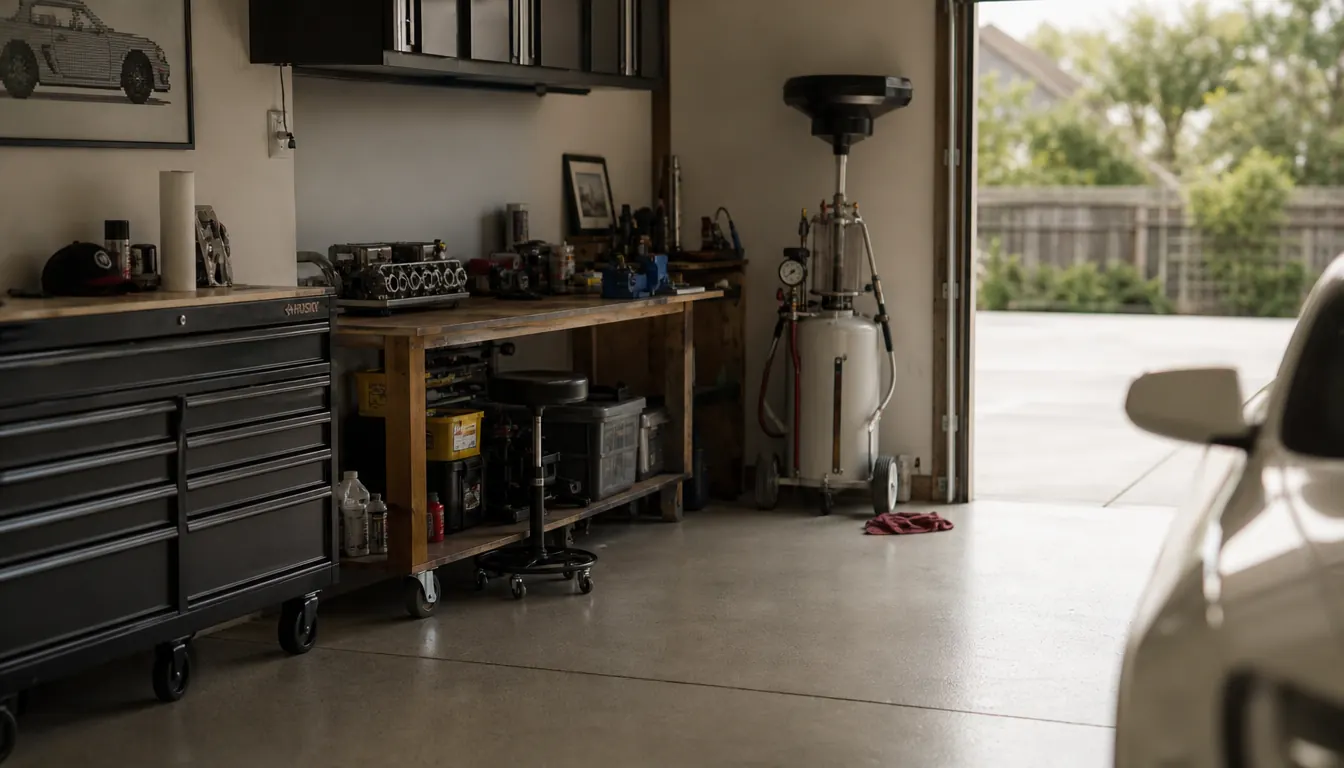
I have changed oil the old way for most of my life. My dad handed me a drain pan and a box end wrench when I was fifteen, and I have been sliding under vehicles ever since. So when I finally bought the EWK 6.5L Pneumatic/Manual Oil Extractor, I was not trying to retire the drain plug. I wanted something for the Tacoma on a hot Sacramento afternoon, when the garage floor is warm and the last thing I want to do is fight a drain bolt with a crushed washer. About a year later, both tools are still on the shelf. They just do different jobs, and knowing which job belongs to which tool is the whole comparison.
Here is the short answer. For a routine oil and filter change on a truck or a small car with a dipstick tube you can reach, the EWK extractor wins on mess, on setup, and on how your knuckles feel afterward. The traditional drain plug still wins on pulling the last of the sediment out of the pan, on storage, on letting you read what the oil is telling you, and on any vehicle the extractor is not cleared for. It is not a universal replacement. It is a very good first tool for somebody who changes oil twice a year and dreads it, and a useful second tool for somebody who already owns a drain pan they trust.
| EWK 6.5L Extractor | Drain Plug Change | |
|---|---|---|
| Getting under the vehicle | Nothing to lift. Oil travels up the dipstick tube. | Jack, jack stands, and a crawl under the pan. |
| Draining speed once started | Manual pumping is the slow part, air mode closes the gap. | Gravity drains a warm engine in a few minutes with no pumping. |
| The last of the sediment | Two extended tubes reach deep, but not into every low corner. | The plug is the lowest point, so the dirtiest oil leaves first. |
| Mess on the floor | Oil goes into a sealed tank and stays there. | Pan, splash, and the usual drip on the subframe. |
| Whole change in one container | The 6.5 liter tank holds a full change with room to spare. | The pan fills and gets poured into a jug mid drain. |
| Reading what came out | You see the oil in the tank, not the stream or the plug. | You watch the flow and check the plug for metal fuzz. |
| Threads and washers | The drain bolt never comes out, so it cannot be cross threaded. | Every change is another chance to crush a washer. |
| What it can be used on | Not for gasoline or volatile fluids, and not for the Mercedes W212 E350 or C218 CLS 350. | Works on anything that has a drain plug. |
| Where it lives between changes | 22.05 inches tall and 6.42 pounds, so it wants a shelf. | A pan hangs on a hook and you forget it exists. |
| Best for | Routine changes on a dipstick equipped daily driver. | Diagnostic changes and vehicles the extractor is not cleared for. |
Where the EWK Extractor Wins
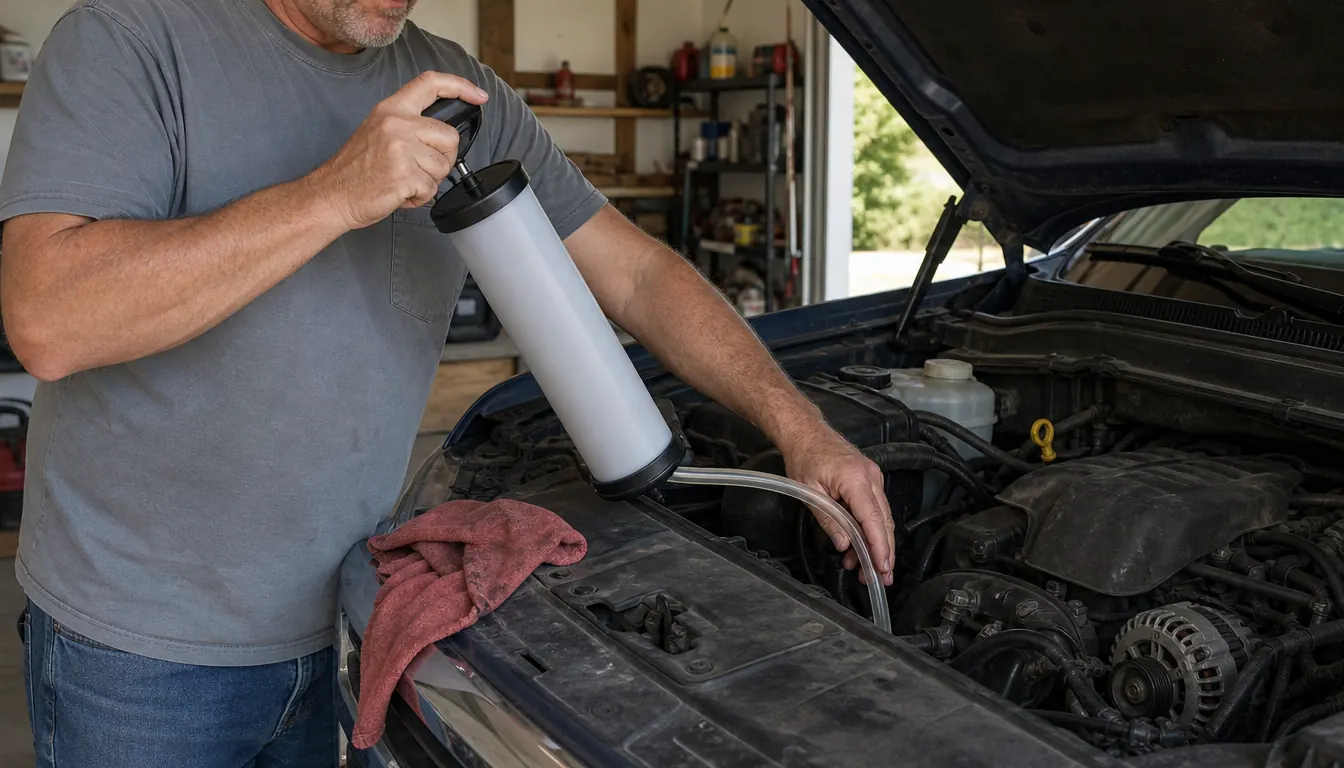
The biggest win is that I never lift the truck. The suction tube goes down the dipstick tube, the oil comes up into the tank, and I stay upright the entire time. No jack, no jack stands, no cardboard on the floor. I still use stands every single time a wheel comes off, and I am not telling anyone to skip them for work that puts them under a vehicle. That is the point. An extraction does not put you under the vehicle at all, and under the vehicle is where I have made my worst mistakes over thirty five years of doing this.
The second win is containment. A drain pan catches most of the oil. The rest ends up on the subframe, in the splash tray, or on the floor when the plug comes out faster than you braced for. With the extractor, oil leaves the engine, goes into a sealed tank, and stays there until I carry it to the recycling center. My garage has a sealed concrete floor with one old stain from 2019. Since I started extracting, it has not picked up a new one, and I have not once had to hunt for the cat litter. The last drain plug change I did on the Tacoma was in March, on a Saturday, and I remember it because the plug came out at an angle and sent a ribbon of black oil across eight inches of floor toward the tool chest. I was on my back with a rag in one hand and a wrench in the other, and there was nothing I could do but watch it spread. That is not a disaster. It is just the kind of small mess that makes a person put off the next change by a month.
The third win is that you get two ways to run it. Manual mode is a hand pump, quiet, no compressor, and it is what I use most weekend mornings. Pneumatic mode runs on shop air at 40 to 170 PSI and it is meaningfully faster, which is what I switch to when both vehicles are due on the same day. Two extended suction tubes come in the box, and the longer one is what lets me get near the bottom of a deeper sump instead of sipping from the top. The 6.5 liter tank also holds the Tacoma's full change with room to spare, so I am not stopping halfway to empty it.
The Miata is where I noticed it most. It sits low enough that ramps are a whole production, and my garage is a one-and-a-half-car space with a rolling tool chest on one side and a workbench along the back wall, so getting a jack under the front crossmember means clearing floor space first. With the extractor I open the hood, feed the tube down the dipstick hole, and pump. Twenty minutes of actual work instead of an hour of setup and cleanup. That single change is the reason the project car gets its oil changed on schedule now instead of whenever I feel ambitious.
Where the Drain Plug Still Wins
Gravity is honest. A drain plug sits at the lowest point of the pan, and when you pull it, everything that will flow, flows. A tube reaches where the tube goes, which is deep, but not necessarily into every low corner of a sloped pan. On the Miata, with a shallow pan and the plug at the back corner, the difference is small enough that I do not think about it. On an engine with a proper sump well below the tube's reach, you can leave a film of the dirtiest oil behind, and that film is the part carrying the metal fuzz. I measured this once, roughly, on the Tacoma. I extracted the pan dry, then pulled the plug anyway over a clean pan and let it sit for a few minutes. What came out was not much, maybe a quarter of a cup, but it was noticeably darker and slightly thicker than what was already in the tank. On a healthy engine that is a rounding error. On an engine that is already using a little oil between changes, it is the difference between a fresh fill and a fresh fill diluted with the worst of what was in there.
The second thing the old way gives you is information. I watch the first few seconds of the stream. I wipe a finger around the plug and check for grit and for the gray paste that means something is wearing. I caught a failing part early that way once, and it is a check I cannot repeat through a tank, even one with a translucent finish. If part of your reason for changing your own oil is diagnostic, the drain plug still hands you more to look at.
The third thing is simple compatibility. The extractor is not compatible with the Mercedes W212 E350 or C218 CLS 350, and it should not be used with gasoline or other highly volatile fluids. That is not a flaw, it is the manual, but it does mean the answer to whether you can use it on everything in your driveway is no. A drain plug works on anything that has a drain plug. Storage is the other honest tradeoff. The unit is 22.05 inches tall and weighs 6.42 pounds, so it wants a shelf or a corner of its own. A drain pan hangs on a nail and you forget it exists.
One thing nobody mentions about extractors is that you have to clean them. After I empty the tank I run a little fresh oil through the pump and the tubes, then hang the tubes so they drain. It takes five minutes and it keeps the pump from gumming up between changes. That is five minutes the drain plug method does not ask of you. I still think the trade is worth it, but if you are the kind of person who will not do the rinse, buy something simpler and save yourself the shelf space.
My garage floor has one old stain from 2019. Since I started extracting, it has not picked up a new one.
What I Liked
- No jacking or crawling for a routine change
- Sealed tank keeps oil off the subframe and the floor
- Manual hand pump or pneumatic mode at 40 to 170 PSI
- 6.5 liter tank holds a full change on a truck or a small car
- Two extended suction tubes reach deeper into the sump
Where It Falls Short
- Leaves a bottom film that a gravity drain would pull out
- Not for gasoline or highly volatile fluids
- Not compatible with the Mercedes W212 E350 or C218 CLS 350
- 22.05 inches tall and 6.42 pounds to store between changes
- Needs a five minute rinse after each use
Your Next Oil Change Without a Jack or a Drain Bolt
The EWK extractor pulls oil up through the dipstick tube in manual or air powered mode, holds the whole change in a 6.5 liter tank, and keeps the floor dry. Check the current listing for fitment before you buy.
Amazon Check the EWK Extractor on Amazon →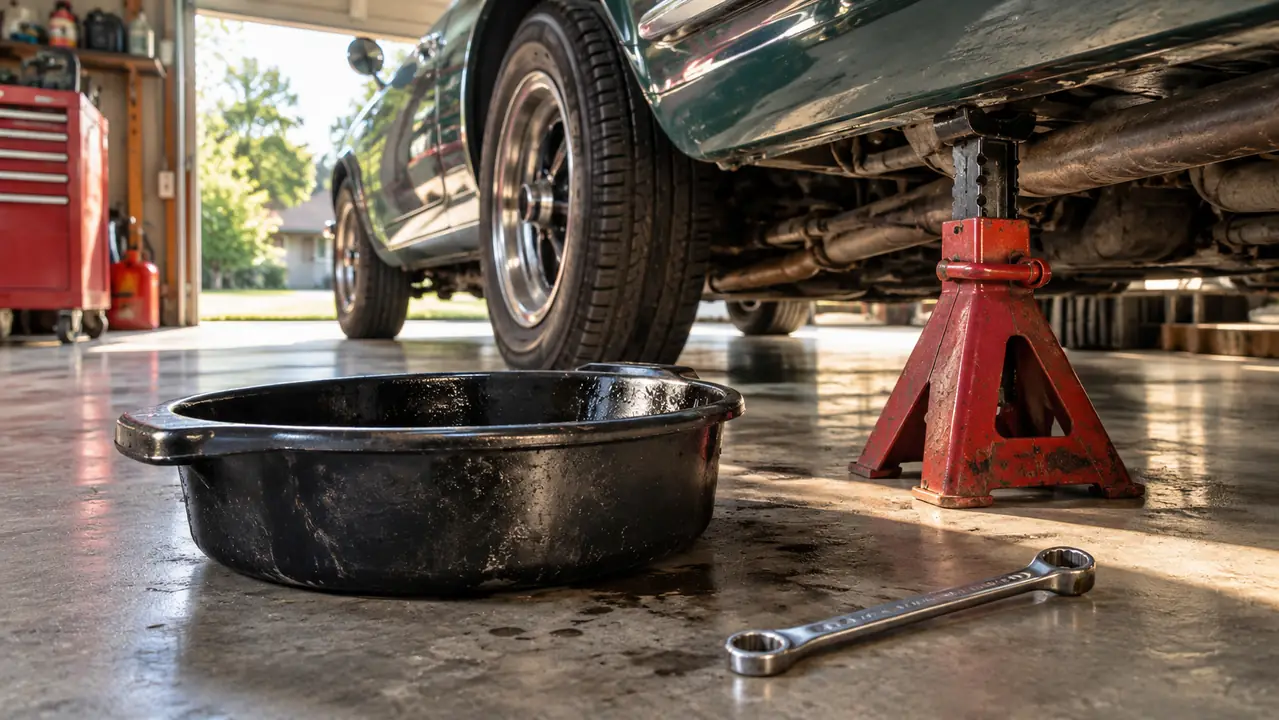
Who Should Buy Which
Buy the EWK extractor if you own a dipstick equipped daily driver, you change your own oil because you want it done right rather than because you enjoy the process, and the crawl under the pan is the part you put off. It is also the right pick if you have a low car you would rather not jack, or a garage floor you are proud of. Two changes a year is enough to make it worth the shelf space. That is roughly the point where the setup time you save starts to matter more than the room it takes up. My own math is simple. The Tacoma gets two changes a year and the Miata gets one, so three extractions annually. Each one saves me maybe forty minutes of jacking, crawling, pouring, and wiping. That is two hours a year I get back, which is not a lot on paper, but it is two hours I spend upright instead of on my back on cold concrete.
Stay with the drain plug if you drive something the extractor is not cleared for, if you want to inspect the plug and the stream every time, or if your pan is shaped so that the last half inch of old oil genuinely matters to you. It is also the right call if you already have a system that works and you are not looking for another tool to store. There is no prize for owning both. Plenty of people do this for forty years with a pan and a wrench and never feel like they are missing anything.
If you are in between, the honest test is this. How many times a year do you actually change your own oil, and how much of the reluctance is the crawl? Twice a year on a daily driver is squarely extractor territory. Once a year on a car you barely drive, and you may as well keep the pan. Frequency is the whole equation, and it is the only number that matters here.
What I'd Tell You Before Your First Extraction
Warm the engine first, but not hot. Warm oil flows, and the whole job gets shorter. What you do not want is oil at full operating temperature coming up a tube while you are holding it. I let the truck idle for five minutes, shut it off, and give it another ten. Second, make sure the tube is actually at the bottom of the pan and not coiled up in the dipstick tube. You will hear the difference when the pump starts pulling oil instead of air. Third, keep pumping until you see bubbles, then give it another minute, because the last bit comes slowly. One mistake I made the first time: I shoved the tube down fast and it curled and came back up the dipstick funnel instead of dropping into the pan. The pump ran for thirty seconds and produced nothing but a hiss. Feed the tube slowly, a few inches at a time, and you will feel it drop when it clears the last bend. On the truck the dipstick tube takes a bend about halfway down, and rushing it is the only way I have ever gotten it wrong.
Then measure what came out. If the manual says the engine holds a bit over five quarts with a filter and you pulled four, stop and figure out why before you pour new oil in. An extractor makes it easy to skip that check because nothing is splashing on your arm, and skipping it is how I ended up a quart short the first time. When you are done, pour the tank into a sealed jug the same day. Oil that sits in a tool in the corner of the garage eventually gets knocked over, and that is a mess nobody wants to clean up on a Tuesday night.
The Tool That Made Me Stop Dreading Oil Changes
Manual or pneumatic, 6.5 liters of capacity, and no jack stands required for a routine change. Check the current listing on Amazon for fitment and details.
Amazon See the EWK 6.5L Oil Extractor on Amazon →