
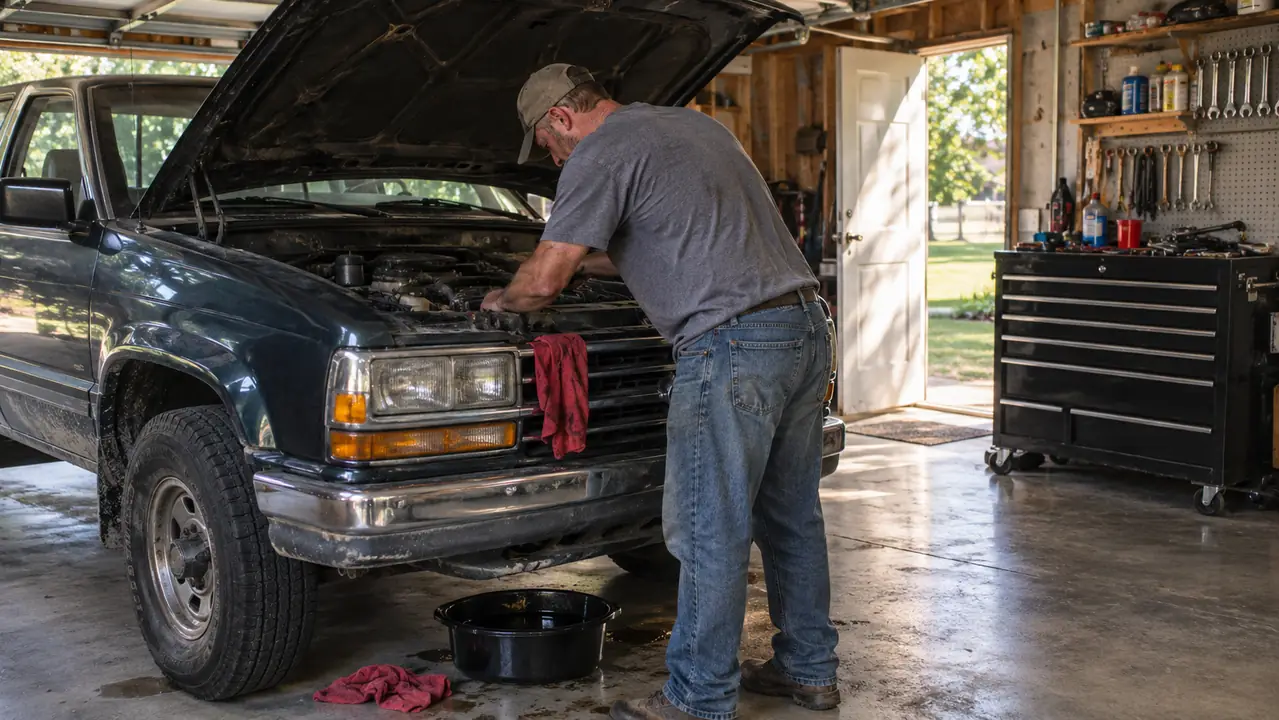
Nobody warns you that the messiest part of an oil change is not the drain plug. It is everything around it. The catch pan that never sits quite under the stream. The funnel you knock over with your elbow. The rag that ends up glued to your forearm. I have done that dance in my garage in Sacramento more times than I can count, first helping my dad do brakes and oil changes as a teenager, and now on a 2012 Toyota Tacoma with about 168,000 miles on it plus a 1991 Miata that spends most of its life under a cover.
So when I kept running into the EWK 6.5L Pneumatic/Manual Oil Extractor, I was curious for a slightly lazy reason. I wanted to skip the mess. What I got was something more useful and more limited than the listing photos suggest, and that gap is what this review is about. This is not a piece about how the EWK extractor changed my life. It is a piece about what it does well, where it quietly stops working, and who should not buy one at all.
The Quick Verdict
A genuinely useful tool that removes most of the mess from an oil change, on the condition that your engine has a dipstick tube reaching the sump and you accept that the filter still lives underneath.
Amazon Check Today's Price →Skip the pan, not the filter
The EWK 6.5L pulls oil up and out through the dipstick tube, so you never lie under a dripping drain plug. Read the fitment notes on the listing before you order, especially if you drive a Mercedes.
Amazon Check Today's Price on Amazon →What the EWK 6.5L Extractor Actually Is
It is a container with a pump. That is the honest starting point, and it is not a knock. The tank holds 6.5 liters, which covers the oil capacity of most four-cylinder and V6 engines with room left over, and it measures 8.27 by 8.27 by 22.05 inches. Picture something tall and narrow rather than a wide flat pan. Empty, it weighs 6.42 pounds.
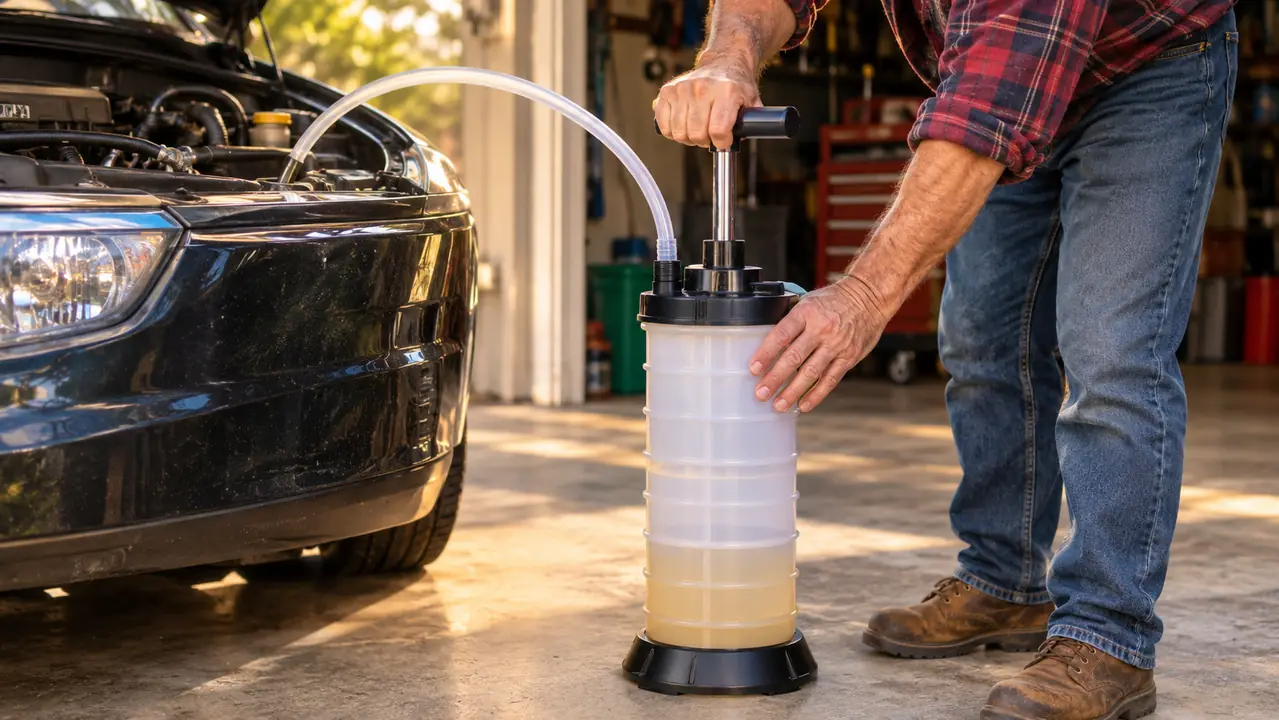
You have two ways to create the vacuum that pulls the oil out. Manual mode means you work a pump handle by hand. Pneumatic mode means you connect the unit to an air compressor running between 40 and 170 PSI and let the air do the work. Either way, oil comes up through a tube you feed down the dipstick hole. EWK ships two extended suction tubes with it, meant to reach deep into the reservoir rather than skimming the top.
A drain pan does the same job with more capacity and no moving parts. I own one, and I still bought the EWK. The difference is what happens after the oil is out. With an open pan you are balancing a wide container of hot oil, trying to tip it into a jug without sloshing it over the lip, and you always lose a little onto the floor. With a sealed tank you pick the whole thing up by the handle and empty it in one motion. That is the trade you are making. Not capacity, not speed, just the fact that the oil goes into one closed container and stays there until you decide to deal with it.
The claim that matters is the one right in the listing: extract oil through the dipstick without lifting the car. That claim is true, and it is also conditional. The conditions are where buyers get surprised, so let me get to those quickly instead of burying them under three paragraphs of praise.
How I've Used It in My Own Garage
My routine now starts with a five mile drive. Cold oil moves like syrup through a narrow tube and you will stand there pumping until your shoulder gives out. Oil at operating temperature flows. I pull into the garage, shut the engine off, and let it sit a couple of minutes so the worst of the heat soaks back out of the oil. Still warm, no longer burn-your-forearm hot. That last part matters. I have the scar to prove I learned it the hard way on a different job.
The Miata is the easier of the two, oddly. It sits low enough that getting a jack under the front crossmember is a small production, and the extractor means I skip that entirely. The last change on it was a Saturday in March. I drove twelve miles to get the oil properly hot, pulled back into the garage, and had the sump empty in about eleven minutes of steady pumping with a coffee going cold on the workbench. Twelve miles was not a number I picked for fun. It is roughly the run to the hardware store and back, which is where I was actually going that morning, so the warm-up cost me nothing. Then I spent forty minutes on the filter, reaching down past the intake with a strap wrench and skinning two knuckles in the process. That ratio is the honest story of this tool. The oil part gets short. The rest of the job does not.
Then I feed the tube down the dipstick tube until it stops, pinch it at the top to mark the depth, and pull it back out to check. If the tip comes back clean, it is not sitting in oil. Usually that means it has rested on something inside the pan. I slide it back in with a slow twist until I feel it drop the last inch. When it is seated right, you know.
Then I pump, or I hook up the compressor and walk away. In manual mode I work the handle steadily for a few minutes to build the vacuum, the oil starts climbing the tube, and after that I am mostly waiting and listening. In pneumatic mode the same thing happens faster and I use the time to lay out the new filter and get the drain pan positioned for the filter swap. That is the real rhythm of the job. The extractor buys you time, not a whole different afternoon.
The extractor pulled just under what the manual says the sump holds, on both vehicles. That is the only test that actually matters, and it passed.
What Nobody Tells You About Pulling Oil Through a Dipstick
The tool has one hard requirement that no product photo communicates: your engine needs a dipstick tube that runs down near the bottom of the sump. Plenty of engines do. Some do not. EWK states plainly in the listing that this unit is not compatible with the Mercedes W212 E350 or the C218 CLS 350. If you own either, read that twice, because no amount of technique will fix it. The tool simply will not do the thing you bought it to do.
There is a second condition, less obvious. The tube you feed down has to reach the low point of the pan. On an engine where the dipstick stops high, or where a baffle sits in the way, you will get most of the oil and not all of it. The only honest way to check is arithmetic. Look up the sump capacity with a filter change, measure what came out, compare the two. If the numbers are close, you are fine. If you come up short every single time, that engine wants a drain plug and no amount of wishing changes it.
Here is how that arithmetic went on my Tacoma. The book calls for a bit over five quarts with a filter change, which works out to something like 5.2 liters. The first time I used the extractor I measured 4.9 liters out and called it close enough. The second time I got careless about tube depth and only pulled 4.2, which is the day I started marking the tube with a strip of tape. Now I check the tip before I start pumping, and the number comes back within a few ounces of the book every time. That is the whole verification method. Two numbers that should match, and nothing needed beyond a measuring jug. If you are not willing to do that check, you are trusting the tool on faith, and faith is a bad way to find out that old oil is still sitting in the bottom of your pan.
The third thing nobody mentions is that this is not a universal fluid pump. EWK warns against gasoline and highly volatile fluids, and that warning deserves respect rather than a shrug. Engine oil is the job. Anything that flashes off and throws vapor does not belong inside a vacuum container in a garage where the water heater is ten feet away.
And the last one is patience. Even in pneumatic mode, thick oil moving through a narrow tube is slow. The tool is not weak. The fluid is thick and the tube is small. Expect to wait, and do not stand there convinced the thing is broken because the level is not visibly dropping in the first minute.
Manual Mode and Pneumatic Mode Are Two Different Tools
I bought this partly because it can run without a compressor, and that matters more than it sounds. If your compressor is buried behind a stack of lumber, or you do not own one, manual mode means the job still happens instead of getting postponed for the fourth weekend running.
Here is the honest comparison from my own use. Manual mode is quieter, there is nothing to tangle, and you can do it in a driveway with no power at all. It is also physical work and you feel it in your shoulder by the end. Pneumatic mode is noticeably quicker and frees your hands, but it needs air in the 40 to 170 PSI band. A little tire inflator is not going to drive it. Check your regulator before you connect anything, because guessing at pressure is how people break tools and scare themselves.
My habit now is pneumatic at home and manual when I am helping a neighbor in a driveway with no air. Both modes work. Neither one is a gimmick, which is honestly not something I expected to write when I saw two modes listed on the box.
Where It Genuinely Falls Short
The oil filter still exists. On some engines you can reach it from above, and the extractor turns the whole job into something you could do in a collared shirt. On others you are still on your back under the car with a wrench, and once you are down there, the case for never touching the drain plug gets thinner. This is the biggest thing the extractor does not fix, and any review that skips it is selling rather than telling.
On the Tacoma the filter sits on the driver's side of the block, angled so that oil runs down your wrist the moment it breaks loose. I have tried reaching it from above and I have tried from below, and below is faster even with the truck up on stands. So on that truck the extractor saves me the drain plug and nothing else. On the Miata it saves me the jack. Two vehicles, two different amounts of value, one tool. That is worth knowing before you order, because how much this thing is worth to you depends entirely on which car you are pointing it at.
You also lose your look at the drain plug. A magnetic plug tells you things for free. Fine paste on the magnet is normal wear. A chip or a shaving is not, and that is information you only get when you pull it. With an extractor you never see it. On a high mileage engine like mine, I still pull the plug every few changes just to look, and I sleep better for it.
Storage is more annoying than I expected. At 22.05 inches tall it does not tuck onto a shelf the way a flat drain pan does, and because it is a container that has held dirty oil you do not want it loose on the workbench next to your good tools either. Mine lives upright against the wall beside the compressor, standing on a square of cardboard I cut to catch the drip that always comes off the end of the tube. It clears the shelf above it by about an inch, which was luck rather than planning on my part. If your garage is tighter than mine, measure before you order. This is not something you can shove in a drawer and forget.
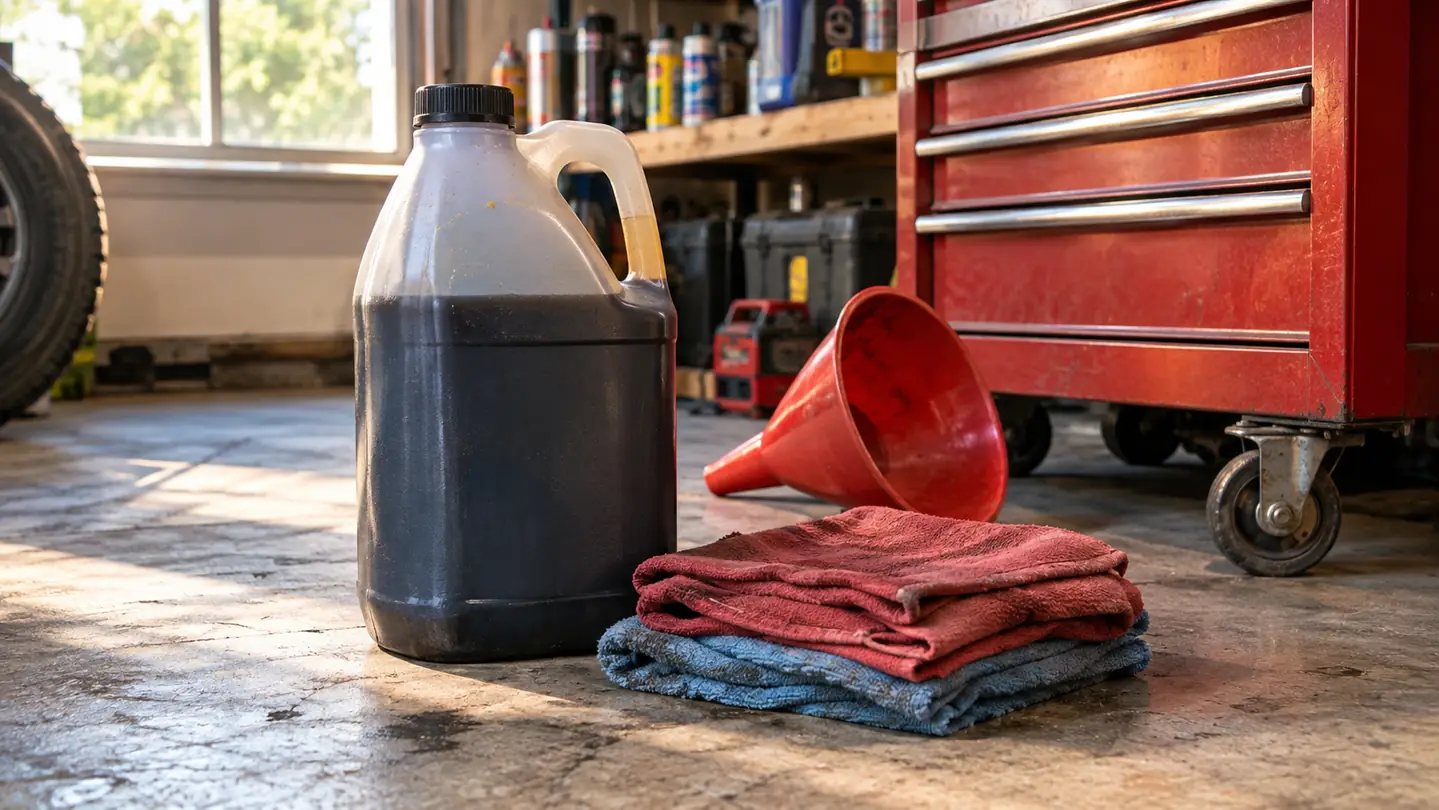
And you still have to get rid of the used oil. Six and a half liters is heavy in a way that surprises you the first time, and the recycling center wants it in something that does not leak on the drive over. I use a five gallon jug with a screw lid and make the run every third or fourth change, usually a Saturday morning before they get busy. Sort that schedule out before you start, not after, when you are standing there holding a full container with nowhere to put it.
What I Liked
- Pulls oil through the dipstick tube with the car on the ground, no jacking and no crawling underneath
- 6.5 liter tank covers the sump on most four-cylinder and V6 engines with capacity to spare
- Manual pump mode works in a driveway with no compressor and no power
- Pneumatic mode at 40 to 170 PSI is fast enough to make a change feel routine
- Two extended suction tubes reach deeper into the reservoir than a single short tube
Where It Falls Short
- Does not work on every engine, and EWK names the Mercedes W212 E350 and C218 CLS 350 as incompatible
- Engines whose dipstick stops short of the sump will only give up part of their oil
- You never get a look at the drain plug or its magnet, which is real diagnostic information
- 22.05 inch height makes it awkward to store in a small garage
- Cold oil makes it painfully slow, so the job depends on a warm engine
- The oil filter still has to come off from underneath on plenty of vehicles
Who This Is For
You have a dipstick tube that reaches the sump, you change your own oil, and the part you dread is the plug, the splash and the pan. This tool removes most of that. It suits someone with a gravel driveway who does not love lying on it, someone with a low car that is a nuisance to get a jack under, and someone maintaining three or four vehicles for a household. If you already own a compressor, pneumatic mode turns the whole thing into a ten minute stop between other jobs, and that is where the EWK unit earns its shelf space.
It also suits the owner who wants to stay clean and keep the driveway free of stains, and who is honest enough to admit that a clean driveway means the job actually gets done on schedule instead of getting pushed back another month.
Who Should Skip It
Skip it if your engine appears on the incompatible list, and check that before you order rather than after it arrives. Skip it if your dipstick stops well short of the sump, because you will spend money to do a partial job and then go back to the plug anyway. Skip it if you want eyes on the drain plug at every change, since the entire point of this tool is that you never go near the plug.
And skip it if you were hoping to never get under the car again. On plenty of engines the filter is still down there, and what the extractor makes clean is the oil part, not the whole job. That is a fair trade. It is just not the trade the photos are selling.
If your dipstick reaches the sump, this is the cleanest oil change you'll do
Warm the engine, feed the tube, and let the EWK 6.5L do the part you actually hate. Check the fitment note on the listing first, then check today's price.
Amazon Check Today's Price on Amazon →