
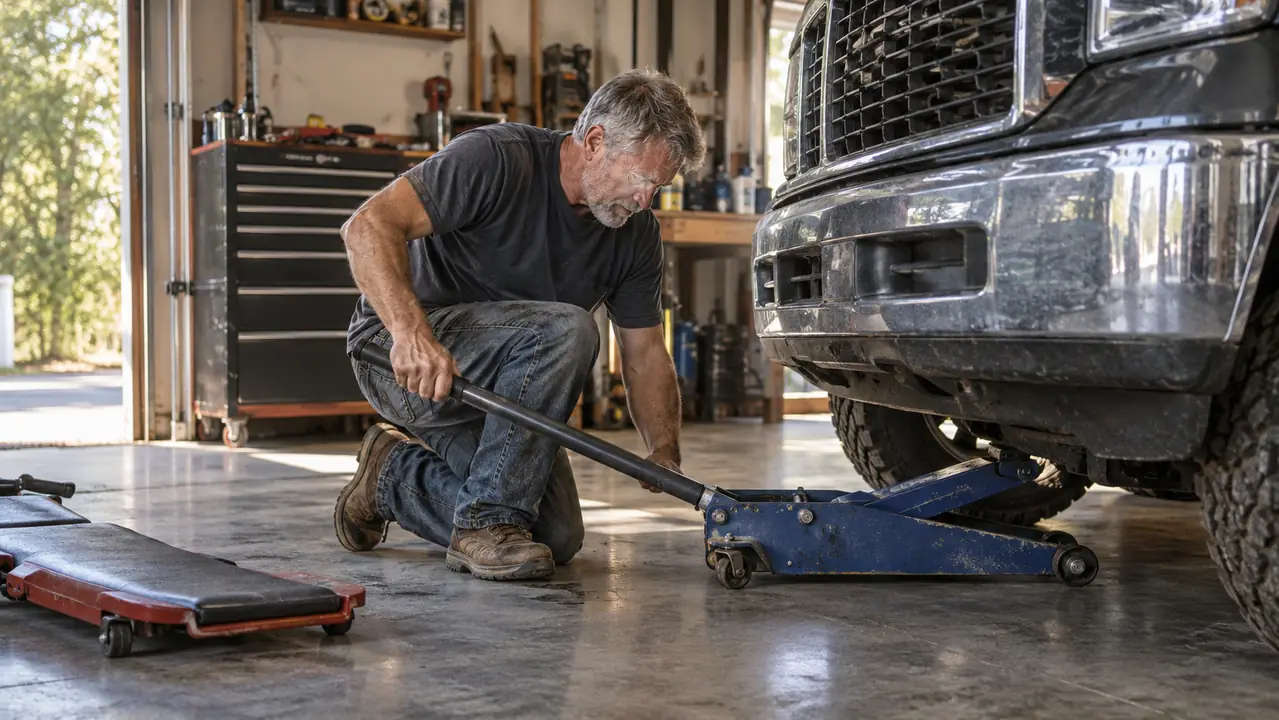
The first floor jack I ever owned was a steel dinosaur. Dragging it across my one-and-a-half-car garage took two hands and a bad attitude, and by the time I had it under the front of the truck I was already tired of the job before the job had started. I gave that jack away years ago. These days the one I reach for lives against the side wall on a hook, and when a neighbor asks me what to buy, the two names that come up are the ARCAN 3-Ton Aluminum Low Profile Floor Jack, model A20019, and the VEVOR 3-ton low-profile jack that turns up cheaper in every single search result.
Here is the short answer. The ARCAN is the better jack for anyone who works on their own vehicle more than a couple of times a year, and especially for anyone who has to move the jack around the garage to do it. It weighs 56 pounds, it is built on an aluminum frame, the saddle starts at 3.75 inches and lifts to 18 inches, it carries a 3-ton (6,000 lb) rating, and it comes with a 1-year warranty. The VEVOR is the better buy if the jack is going to live in one corner of the garage, come out twice a year for a tire rotation, and you would rather keep the difference in your pocket. Both are 3-ton jacks. Both will get a car in the air. The decision comes down to how often you lift, how far you have to carry the thing, and what surface you are working on.
| ARCAN A20019 | VEVOR 3-Ton Low Profile | |
|---|---|---|
| Upfront cost | Costs more | Costs less, and it is not close |
| Weight | 56 lb aluminum, one hand or two fingers on the handle | Steel frame, noticeably heavier to drag across a garage |
| Capacity | 3 ton (6,000 lb) | 3 ton (6,000 lb) class |
| Getting under a low car | Saddle starts at 3.75 in | Low-profile steel design, similar approach angle |
| Maximum lift | 18 in, enough to reach the frame rail on a stock pickup | Shorter working range, fine for cars and most SUVs |
| Stored footprint | 30 x 13.5 x 8 in, slides onto a shelf or hangs on a hook | Bulkier, and it usually ends up living on the floor |
| Abuse tolerance | Aluminum can dent, so keep it on concrete | Steel shrugs off gravel, door lips and curbs |
| Frame material in a damp garage | Aluminum does not rust when a wet car drips on it | Steel starts to corrode where the coating chips |
| Warranty | 1 year, in writing | Depends on the listing and the seller, so read it first |
| Best for | Someone who wrenches often and moves the jack between cars | Occasional use on a tight budget |
Where the ARCAN Wins
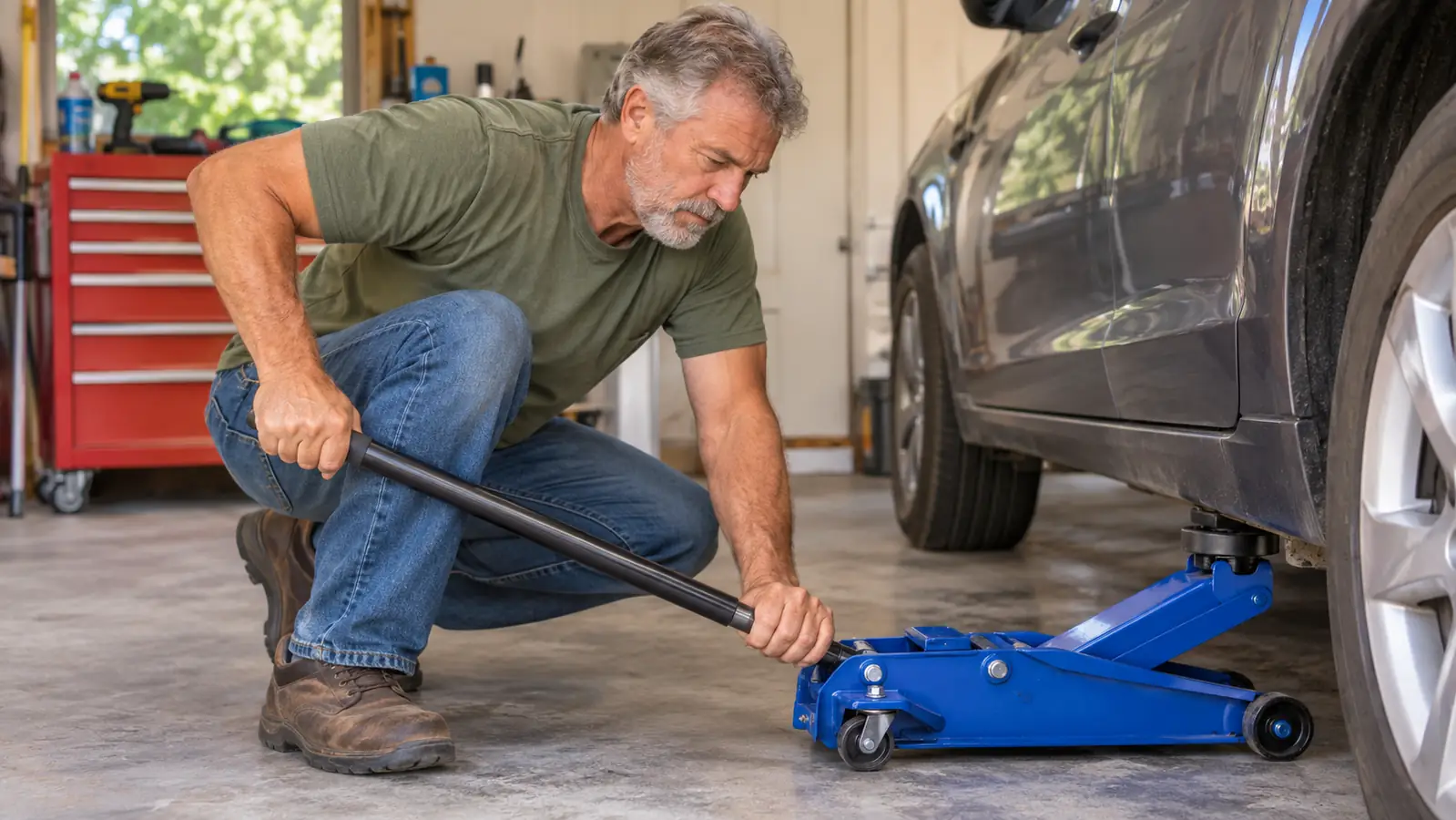
The aluminum frame is the whole reason this jack exists, and it is the reason I would hand it to a beginner without a second thought. Fifty-six pounds is light enough that I can pick it up with one hand, walk it four steps from the wall to the front of the Miata, and set it down without bracing myself. I timed that walk once, mostly out of curiosity. From the hook to the saddle touching the subframe was under ninety seconds, and that included nudging a box of shop rags out of the way with my foot. The old steel jack took closer to five minutes and a swept path first. The jack measures 30 by 13.5 by 8 inches, so when the job is done it goes up on a hook or slides onto the shelf under the workbench instead of sitting on the floor where I trip over it every time I walk past. Compare that to any steel 3-ton jack and the difference is not subtle. You feel the weight in your shoulders before you feel it in your hands, and you start choosing jobs based on whether you feel like dragging it out.
The second thing the ARCAN gets right is the range. The saddle starts at 3.75 inches, which is low enough to slide under the rocker panel on the Miata without driving it up onto blocks first. It lifts to 18 inches, which is enough to reach the frame rail on the truck without maxing the jack out and leaving yourself no margin. In between, the reinforced lift arm and its torsion control keep the load steady as it comes up, so the saddle does not wander while you are watching it instead of watching your fingers. ARCAN also builds in bypass and overload valves so the jack stops itself instead of over-extending, and that is the sort of feature you only notice on the day it saves you. The 1-year warranty is not generous, but it is written down, which is more than you can say for a lot of listings in this price bracket.
Where the VEVOR Wins
Now the other side, because there is a real case for the VEVOR and pretending otherwise would be dishonest. It costs less, and for a lot of people that is the entire decision. If your jack is going to sit in the same corner of the same garage, roll two feet to the same lifting point, and go back to the corner, then you are not paying for portability. The aluminum body on the ARCAN is money spent on a problem you do not have. A steel jack in that role does the job it was built for, and it does it for less.
Steel also takes a beating that aluminum does not. If you work on a gravel driveway, if you have a lip at the garage door you have to drag the jack over, or if you are the kind of person who bumps the frame into the pinch weld while you are lining up, a steel jack forgives all of it. Aluminum can dent, and once it dents you are working with a jack that is no longer flat on the floor. I keep mine on sealed concrete for exactly that reason. That is a genuine advantage for the VEVOR and I am not going to talk my way around it. The trade is weight and rust. Steel is heavier to move, and it starts to corrode the first time the coating gets chipped, which in a garage where a wet car drips on the floor happens sooner than you would expect. I watched that happen on the steel jack I owned before this one. The finish flaked near the front wheel after two wet winters, and by the third spring there was a ring of rust around the bare spot. It never failed on me, but I stopped trusting it, and a jack you do not trust is a jack you stop pulling out.
If you want the jack you can carry with one hand and hang on a wall hook, this is the one
The ARCAN A20019 is a 3-ton (6,000 lb) aluminum jack with a 3.75-inch low-profile saddle, an 18-inch maximum lift, and a 56-pound body. It is the jack I leave out instead of buried, because moving it is not a chore.
Amazon Check Today's Price on Amazon →What 56 Pounds and 18 Inches Actually Mean in a Garage
Numbers on a listing page do not tell you what a jack is like to live with, so here is the practical version. My garage is one and a half cars wide, with a workbench along the back wall and a rolling tool chest on the left. There is not a lot of open floor. A jack that has to be dragged is a jack that makes me postpone the job, and I know that about myself because I did it for years. The ARCAN gets lifted off its spot, carried four steps, and set down. That sounds like a small thing. Last October I did front pads and rotors on the Miata on a Saturday, and I had the car in the air, on stands, wheels off, and the first caliper unbolted before the coffee I carried out with me went cold. With the steel jack, that same job used to eat the whole morning before I had a wrench in my hand. It is the difference between pulling the wheels on a Saturday morning and telling myself I will get to it next weekend.
The height range matters just as much as the weight. The Miata sits low enough that half the jacks I have owned will not go under it without ramps, and ramps on a car that low are their own small adventure. A 3.75-inch starting height solves that problem outright. The truck sits high enough that a short jack runs out of travel before the saddle ever touches the frame, and that is where the 18-inch maximum earns its keep. One jack covers both vehicles, which is the entire point of owning one jack instead of two. When I was shopping, that overlap was the thing that pushed me off the cheaper option.
The weight rating is more than either of my vehicles needs, and that is fine. A 3-ton (6,000 lb) capacity under a Tacoma and a Miata gives you margin, and margin is what you want when you are lying on your back with a car above you. You are not buying capacity for the vehicle you own today. You are buying it for the day the bed is loaded with landscaping rock, or the day a neighbor rolls in with something heavier than either of your cars. The ARCAN and the VEVOR both carry the same 3-ton rating, so this row is a wash, and I would rather tell you that than pretend otherwise.
A 3.75-inch saddle gets under the low car, 18 inches reaches the frame on the truck, and 56 pounds means I actually bother to move it.
The Safety Part Nobody Puts in a Comparison Table
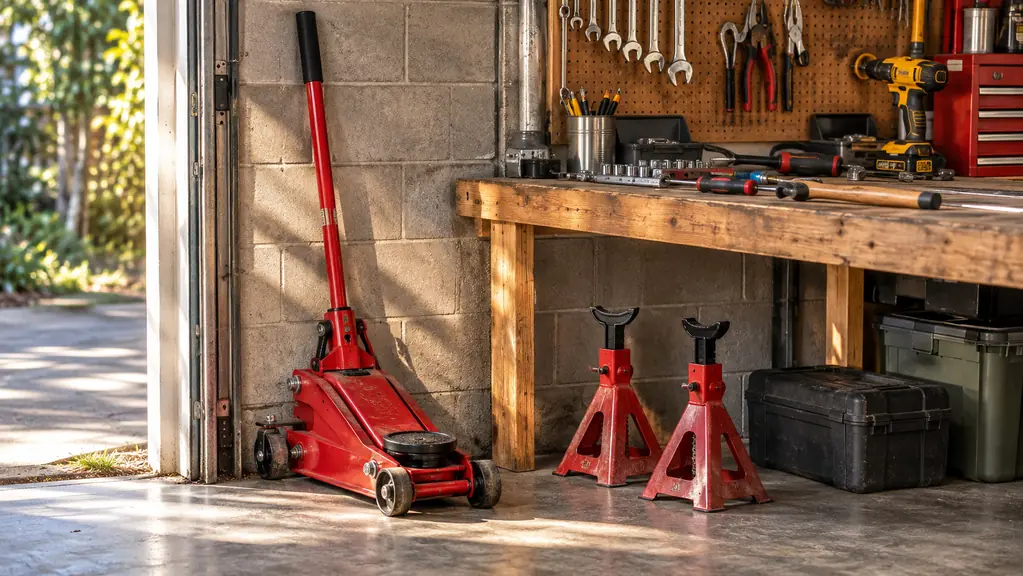
Neither of these jacks is a substitute for jack stands, and I say that in every one of these write-ups because it is the part that actually hurts people. A floor jack lifts. Jack stands hold. Get the vehicle up, set the stands under the frame or the pinch welds the manual tells you to use, lower the jack until the weight is resting on the stands, and then leave the jack in place underneath as a backup. Chock the wheel on the opposite corner. Work on concrete, not asphalt, because asphalt softens in the afternoon sun and a stand foot will sink into it while you are under the car. My own routine is to set each stand, then push the car sideways with one hand to check for rock before I lower the jack. Twice I have found a stand foot sitting on a seam in the slab instead of flat on it, and both times it was because I set it in a hurry.
The overload and bypass valves on the ARCAN are worth understanding rather than just ticking off a spec sheet. They keep the jack from pushing past its limit, and they give you a controlled descent instead of a drop when you open the release. That does not make it safe to work under. It makes it less likely to fail while you are using it the way it is meant to be used. The same logic applies to the VEVOR. A cheaper jack rated for 3 tons, used on level concrete with stands set behind it, is safer than an expensive jack used carelessly on a slope. The tool is the smaller half of the equation.
Who Should Buy Which
Buy the ARCAN if you work on your own vehicles regularly, if one jack has to serve two very different cars, or if you have to carry the jack any distance at all. The 56-pound aluminum body, the 3.75-inch starting height, the 18-inch reach, the 30 by 13.5 by 8 inch footprint and the 1-year warranty add up to a jack that is easy to live with in a garage that is already full. That is the decision I made in my own garage, and it is why the ARCAN is the one hanging on the wall instead of buried under a shelf.
Buy the VEVOR if the jack is a tool you pull out twice a year, if it lives on the same slab of concrete every time, and if the savings matter more to you than the weight. It is a 3-ton jack and it will lift whatever you put it under. Just plan on moving it with two hands, keep an eye on the finish wherever it chips, and put the money you saved toward a good pair of jack stands and a set of wheel chocks, because those matter more to your safety than the jack does. Either way, you are ahead of the guy using the factory scissor jack on a sloped driveway.
One jack, two vehicles, and it hangs on a hook when the job is done
3-ton (6,000 lb) capacity, a 3.75-inch low-profile saddle, 18 inches of maximum lift, and 56 pounds of aluminum. Check the current price and the warranty terms on the listing before you commit.
Amazon Check Today's Price on Amazon →