
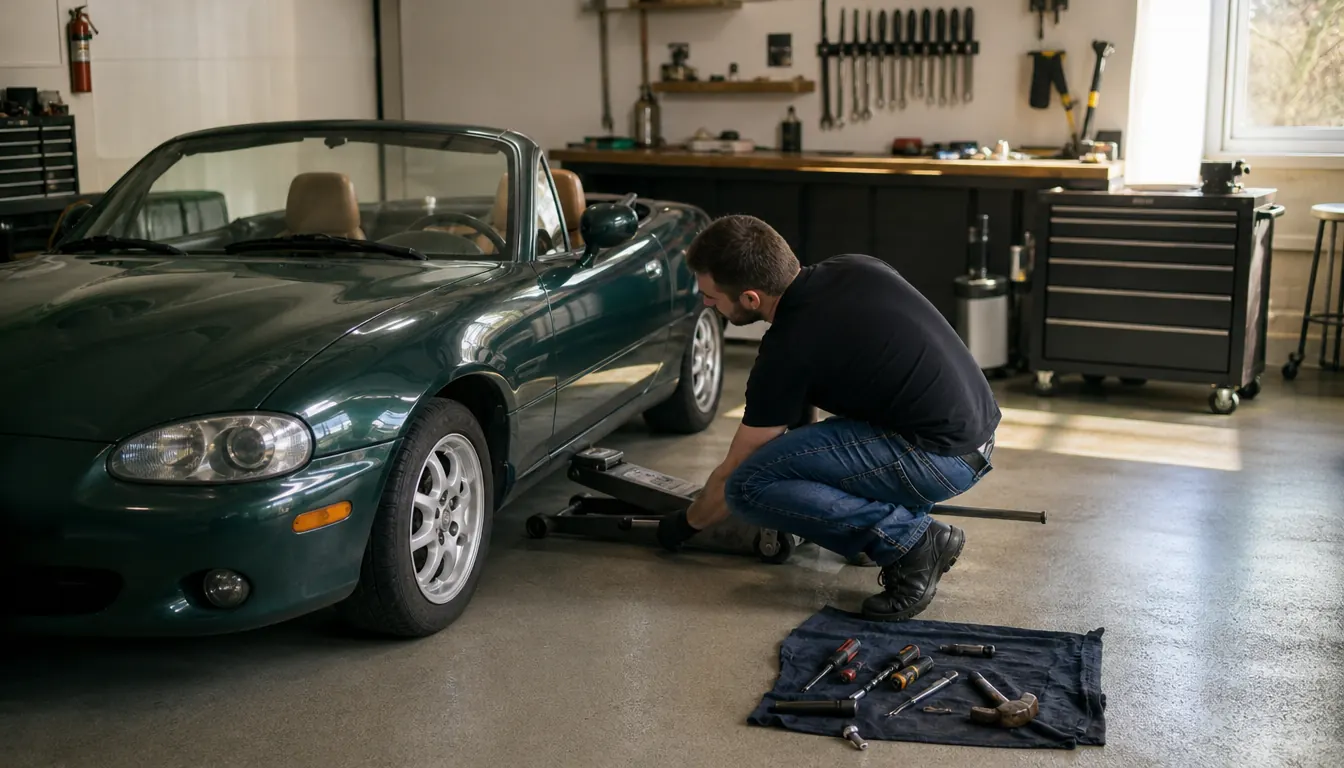
My 1991 Mazda Miata sits low enough that a normal floor jack will not slide under the front crossmember. For two years I drove that car up onto a pair of stacked 2x6 boards first, every single time, because that was the only way to get a jack underneath it. It was a stupid workaround and I knew it was a stupid workaround. I finally bought the ARCAN 3-Ton Aluminum Low Profile Floor Jack, model A20019, and the boards went out to the scrap pile that same weekend.
I have run it for months now in my one-and-a-half-car garage in Sacramento, on the Miata and on the 2012 Toyota Tacoma that is closing in on 168,000 miles. Here is the short version: it does the low-car job I bought it for, it handles the truck without drama, and there are three things about living with it that still irritate me every time I drag it across the concrete.
The Quick Verdict
The low profile and the 6,000 lb rating cover both a lowered car and a light truck. It is heavy to move and the warranty is short, but nothing else in my garage does both jobs.
Amazon Check Today's Price →The jack that actually fits under the car you own
3.75 inches at the saddle, 18 inches of lift, 6,000 lb capacity, 56 pounds of aluminum. Check the current price and the fitment notes on the listing before you commit.
Amazon Check Today's Price on Amazon →How I've Used It
The Miata is the hard case. Its front crossmember sits low and the pinch welds along the rocker panels are the kind of thing you damage exactly once before you get careful about where the saddle lands. At its lowest setting the ARCAN jack slides under the front of that car with room to spare, which means I can reach the crossmember without driving onto anything first. That one change turned a ten-minute chore into a two-minute one, and I stopped putting off oil changes on the car I actually enjoy driving.
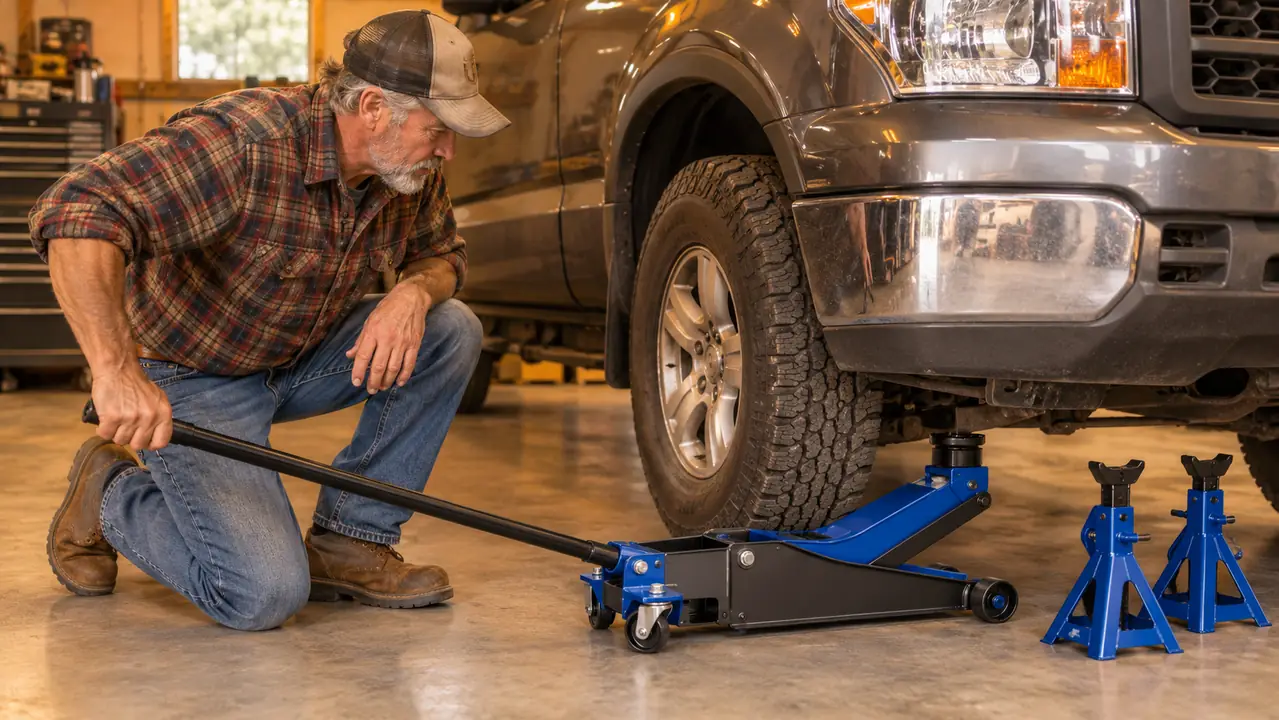
The Tacoma is the other end of the job. It is a 2012 with about 168,000 miles on it, and it spends a lot of its life hauling lumber and bagged concrete for projects around the house, so brakes and front-end work come up more often than they did when it was newer. I lift from the frame, set jack stands, lower the jack, and then push and shove the truck before I go anywhere near it. The jack has enough travel to get the frame high enough for stands in one go, and the saddle stayed put on the rail every time I raised it.
Last November I did the front brakes on the truck, and that job is the clearest example of what the extra travel buys. I set the jack under the frame rail, raised it until the front end was high enough for my tallest pair of stands, and still had handle left to give. On the old jack I used to run out of height and shim it with a scrap of 2x8, which is a genuinely bad habit and one I am not proud of. Setting the stands at their top notch with the jack still climbing is a much calmer way to spend a Saturday morning.
Between the two vehicles this thing gets used maybe twice a month, more in the fall when I am getting both of them ready for winter. It lives against the wall next to the tool chest. I have not had to top up the fluid, it has not crept down on me while loaded, and the body has survived being dragged around a sealed concrete floor without me being gentle with it.
What the Low Profile Actually Buys You
The number that matters is the saddle height at rest: 3.75 inches. That is the whole reason this jack is in my garage. Everything else about it is supporting cast. A standard-height jack is closer to five inches at the saddle, and five inches does not clear a lowered car or a car with a deep front air dam. If you have ever shoved a jack at a low car and heard it scrape the bumper cover, you already understand why that inch and a quarter matters.
I measured before I bought, twice, because I did not want to find out the expensive way. With the Miata sitting on the sealed concrete I had roughly four and a quarter inches between the floor and the front crossmember, and a little over five at the rocker pinch weld. A jack with a five-inch saddle is not getting under either one without the car being lifted first, which is a circular problem. This one slides under both, and I checked the number with a tape measure before I committed rather than guessing and hoping.
The other end of the range is 18 inches of maximum lifting height. That is enough to get a light truck frame up onto stands without blocking the jack up on wood, which was the second stupid workaround I used to put up with. ARCAN builds this as one jack that covers both ends of the range instead of two jacks for two cars, and for a small garage that is the entire argument.
The tradeoff is honest and worth saying out loud. A jack that starts at 3.75 inches has more distance to cover before it reaches a high lifting point, so on the truck you are working the handle more strokes than you would with a taller jack. It is not difficult, it is just more pumping. If you only ever work on a full-size truck, a taller jack will save you some arm work. If you work on anything low, this one is the correct shape.
Capacity, Stability, and the Reinforced Lift Arm
The rating is 6,000 pounds, which ARCAN lists as 3 tons. The front end of a Tacoma is a fraction of that, and the Miata is a fraction of the fraction. That margin is not there so you can be careless. It is there so the jack is not working near its limit on an ordinary job, and so a slightly uneven lift does not turn into a bad afternoon.
Here is the arithmetic that keeps me honest. Lifting one corner of the truck puts a few hundred pounds on the saddle, and lifting the front of the Miata puts less than that. There is a real difference between a jack loafing along at a fraction of what it can hold and one straining near its limit, where every little wobble gets amplified through the arm. I have lifted the truck with one rear wheel still on the ground and a front corner in the air, which is a lopsided load, and it went up without complaint. I would not make a habit of it, but it is good to know where the margin sits.
The lift arm is reinforced, and the listing calls out torsion control as the reason. In practice that means the arm does not twist visibly when you have the truck's front end in the air. I have watched a cheap jack lean under load and it makes you rush, and rushing around a raised vehicle is how people get hurt. This one goes up square and stays square, which lets me take my time setting the stands properly.
The footprint is 30 inches long by 13.5 inches wide by 8 inches tall, and it weighs 56 pounds. That footprint is why it feels planted rather than tippy, and it is also why it takes up real floor space against the wall. You are trading storage room for stability, and in a garage my size that trade is worth making. In a garage half this size I might feel differently.
The Hydraulic Valves, in Plain English
ARCAN lists bypass and overload valves as part of the hydraulic control on this jack. Those are not marketing words, they are safety hardware. A bypass valve gives pressurized fluid somewhere to go once the jack reaches the top of its travel, so you cannot keep pumping and over-extend the ram. An overload valve does something similar when the load exceeds what the jack is built for.
What that feels like from the handle is unremarkable, which is the point. The jack stops climbing when it is supposed to stop climbing. Nothing groans, nothing shudders, nothing sprays. I have hit the top of the travel on the truck more than once because I was not paying attention, and the jack simply stopped rather than making a scene.
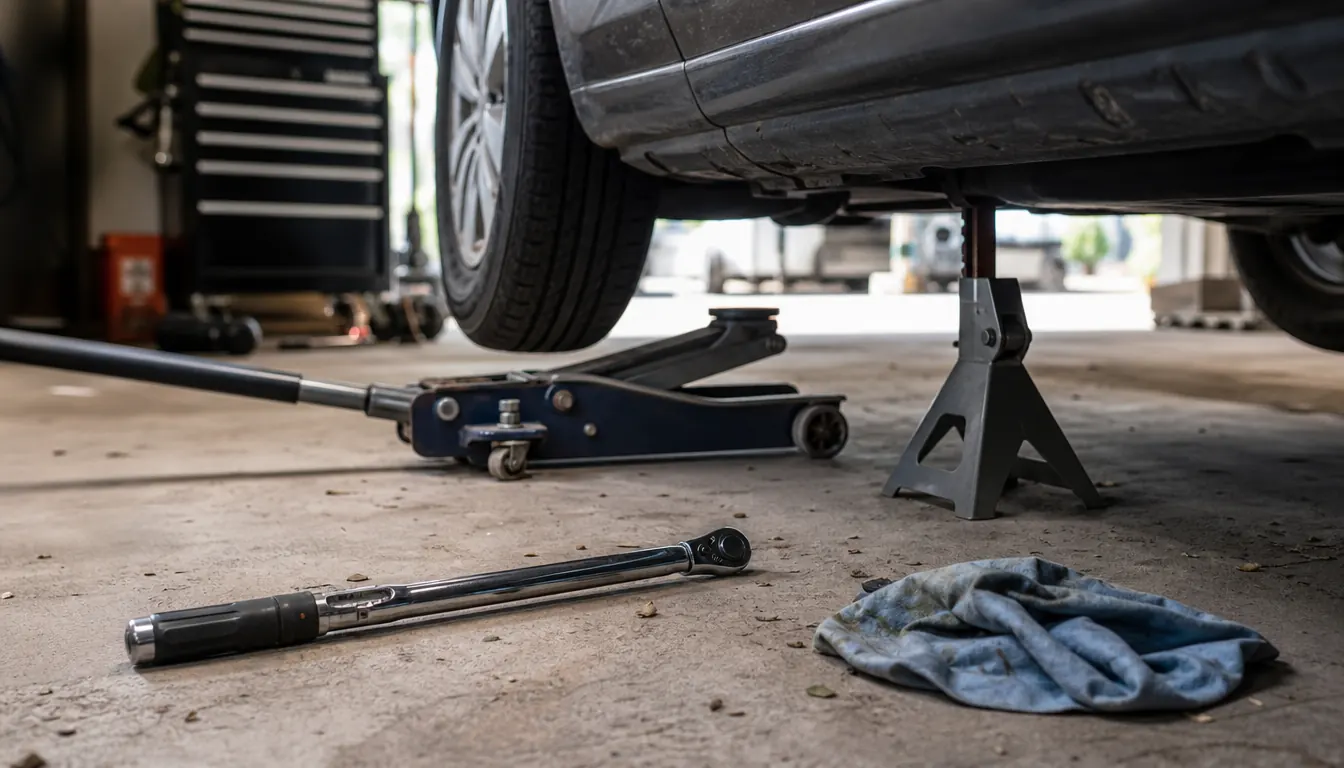
None of that changes the basic rule, and I will say it plainly because my dad said it to me in his driveway when I was fifteen: a jack lifts, a jack stand holds. I set stands every time, I lower the jack onto them, and I shake the vehicle before I put any part of me underneath it. A jack with good valves is a better jack. It is still not a stand.
What I Liked
- 3.75 inches of saddle height clears a genuinely low car without ramps or boards
- 6,000 lb capacity covers a small convertible and a light truck with margin to spare
- 18 inches of maximum height is enough for jack stands under a truck frame
- Reinforced lift arm goes up square and does not twist under load
- Bypass and overload valves stop over-extension instead of relying on the operator
- Aluminum construction keeps a 6,000 lb jack down to 56 pounds
Where It Falls Short
- 56 pounds is manageable in the garage and unpleasant if you have to carry it far
- The 30 by 13.5 inch footprint eats floor space in a small garage
- One-year warranty is short for a tool that lives on concrete
- The low starting height means noticeably more handle strokes on a tall vehicle
- The handle is a separate piece and mine has no clip or holder on the jack itself
Three and three-quarter inches at the saddle is the entire reason this jack is in my garage. Everything else about it is supporting cast.
What Still Bugs Me After Months of Use
Fifty-six pounds does not sound like much until you are the one lifting it. Aluminum makes this jack light for its class, not light. I move it maybe fifteen feet from the wall to the front of the car, and that is fine. If your garage is detached, or your workspace is up a step, or you plan to throw this in a truck bed and drive to a friend's house, you will feel every pound of it and you will think about a smaller jack.
The weight is the one that actually changes how I behave. My bench sits along the back wall and the cars pull in nose first, so the walk from the wall to the front crossmember is short. If it were longer, or if I had to carry this thing down a step into a basement, I would be looking at a different jack. As it is I lift with my legs, set it down, and roll it the rest of the way, which is fine for a tool that never leaves my own garage.
The warranty is one year, which is the shortest part of this whole review. A floor jack is a sealed hydraulic tool that lives on a concrete floor and gets dragged around. I would rather see a longer term on something built to take that abuse. In ARCAN's defense, mine has needed nothing in months of use, but the coverage still feels thin for the category.
The last one is small and I will keep it small. The handle comes off, which is how it should be, but there is no clip or holder on the jack to park it, so mine leans in the corner and falls over roughly once a week. That is a five-dollar fix that ARCAN did not make. It does not affect how the jack lifts, and I am not going to pretend it does.
Who This Is For
This jack is for the person with one garage bay and more than one kind of vehicle to lift. If you have a low car and a truck, or a sedan with a low front end and an SUV, the ARCAN A20019 covers both without you buying two jacks or building ramps out of scrap lumber. That is the exact problem it solves, and it solves it well.
It is also for anyone who has been putting off work because getting the car in the air was the annoying part. There is a real difference between a job you avoid and a job you knock out on a Saturday morning, and most of that difference is how quickly the jack slides under the car. If you are new to working on your own vehicle, this is a forgiving place to start, provided you buy stands in the same trip and learn where the lift points are before you touch anything.
Who Should Skip It
Skip it if everything you work on is lifted or tall. If you are lifting a truck with a suspension lift, 18 inches of maximum height may not get you where you need to be, and you are carrying 56 pounds around for clearance you will never use. A taller standard jack makes more sense for that garage.
Skip it if you are working out of a vehicle rather than a garage. This is a shop tool that wants a flat concrete floor and a place to live. It is not the jack you toss behind the seat for a road trip, and it is not the one you carry up a flight of stairs. And skip it entirely if you are not going to buy jack stands. No jack, this one or any other, is a substitute for stands, and buying this without them is the only genuinely bad decision available here.
One jack for the low car and the truck, if you have the floor space
3.75 inches at the saddle, 18 inches of lift, 6,000 lb capacity, 56 pounds. Read the listing's fitment notes, then buy the stands in the same order.
Amazon Check Today's Price on Amazon →