

Nobody warns you that a 56-pound floor jack turns into furniture. Mine lives against the wall of my one-and-a-half-car garage beside the rolling tool chest, and every time I need to rotate the tires on my 2012 Toyota Tacoma I pick it up, carry it eight feet, set it down, and feel every one of my 52 years.
So let me start where most reviews finish. The ARCAN 3-Ton Aluminum Low Profile Floor Jack, model A20019, is a genuinely good tool that solves a real problem for anyone with a low car. It also has limits the listing does not mention, a warranty that is shorter than you would guess, and one job it cannot do no matter what you spend. I have run this ARCAN jack on both vehicles in my garage for a little over two years, on a sealed concrete floor, through brake jobs, a clutch replacement, and more tire rotations than I can count. This is the version I would give a friend standing in my driveway.
The Short Version
The Quick Verdict
Reaches under a low car, lifts a half-ton pickup, and moves without a second person helping. The 1-year warranty and the 56 pounds are the honest cost of the aluminum frame.
Amazon Check Today's Price →The number that decides everything is 3.75 inches
If your old jack will not slide under the crossmember, no amount of technique fixes it. The ARCAN starts at 3.75 inches and lifts to 18, with 3 tons of capacity behind it.
Amazon Check Today's Price on Amazon →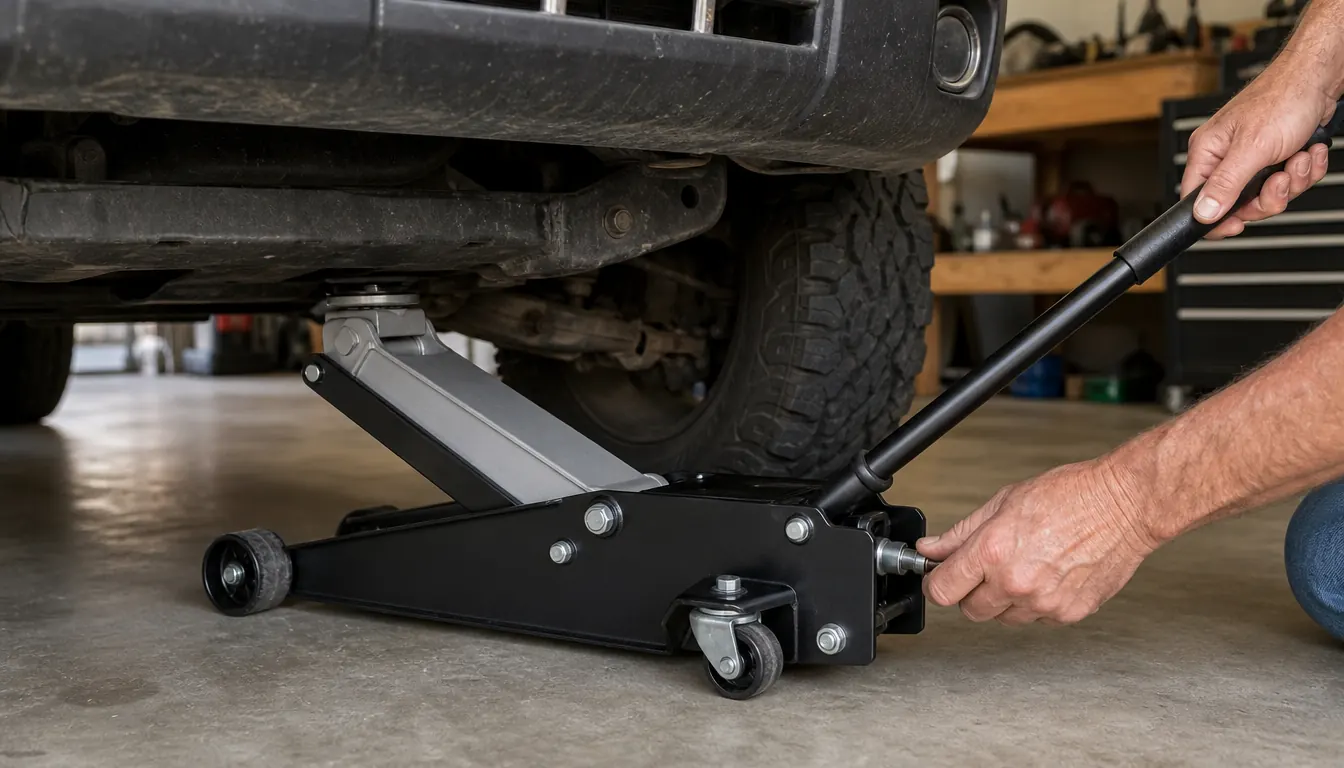
How I've Used It, and What That Actually Proves
My 1991 Mazda Miata is the reason I own this jack. The car sits low enough that my old steel jack would not slide under the front crossmember without me driving the car onto scraps of lumber first. Doing that on a Saturday morning is annoying. Doing it at 52 with a shoulder that has opinions is worse.
The first time the ARCAN went under the Miata, it went under on the first push. No lumber, no ramps, no jacking up the jack. That sounds like a small thing until you have spent a decade working around a tool that did not fit.
April of last year made the case better than I can. I had a brake job queued on the Miata for a Saturday morning, and the forecast said rain by two. My old routine was three pieces of two-by-ten under the front tires, a slow crawl forward, then a prayer that the lumber did not shoot out sideways. I got the car up, and then spent the next ten minutes dragging the steel jack into place at an angle because it would not go straight in. Twenty minutes of setup before the first lug nut came off. With the ARCAN I pull it off the wall, slide it under, and I am turning wrenches in under two minutes. On a morning when you have a hard stop at two o'clock, that gap is the difference between finishing the job and pushing it to another weekend.
The Tacoma is the other half of the job. At around 168,000 miles it is my daily driver, so it takes the miles and the maintenance that comes with them. Tire rotations, brake pads, an exhaust hanger that rusted through somewhere around 150,000. I have lifted that truck's front end dozens of times with this jack and it never once felt like it was working at the edge of what it can do.
That rotation, a low project car and a high-mileage pickup, is the whole of my testing. I am not a shop foreman. I am a county water department supervisor with a one-and-a-half-car garage and a hobby I picked up helping my dad do brakes when I was a teenager. Which means my standards are probably yours: does it fit, does it lift smoothly, does it come back down without drama, and does it survive being used badly once or twice a year.
The Low Profile Claim, Tested
The listing puts the minimum height at 3.75 inches. That number is the whole ballgame with a low car, and it is also the spec most people skip past when they compare jacks on capacity alone.
Here is how I decided, and it is what I would tell you to do before you buy anything. Park the car on the slab, slide a tape measure under the front crossmember down to the concrete, and write the number on the wall with a pencil. Mine came back at a hair over four inches on the Miata, which is why 3.75 got this jack in the door and why the steel one never had a chance. If your number is five inches or more, you have options. If it is three and a half, you do not, and no amount of shoving, tilting, or cursing changes the geometry of the thing. Measure once, write it down, and the decision gets a lot easier.
Three and three-quarter inches is low enough to slide under the side sill of a Miata without touching anything. More importantly, it is low enough that you can put the saddle where the factory jacking point actually is instead of where it happens to be convenient. That distinction matters a lot when you are flat on your back on concrete, deciding whether to trust what you are looking at.
At the other end, the jack reaches 18 inches. On the Tacoma that is enough to get the front wheels clear of the floor with room to work. On a truck with a lift kit, it would not be, and I want to be plain about that before anyone buys this for a lifted rig.
Capacity is 3 tons, or 6,000 pounds. The Tacoma does not come anywhere near that at any single corner, so in practice the rating means the jack is not straining, which is the real reason to buy capacity you do not strictly need.
What the ARCAN Gets Right
The frame is aluminum, and that is the entire reason this jack is 56 pounds instead of the 90 or so a comparable steel jack weighs. Fifty-six pounds is still a real weight. You will notice it when you carry it, and you will notice it more at the end of a long day. But it is light enough to lift off the floor with one hand on the handle and the other under the frame, which is not something I could say about the steel jack it replaced.
The lifting arm is reinforced, and the listing talks about torsion control under load. What that means in a garage is that the arm does not twist when one side of the saddle takes the weight first. I have owned cheap jacks where the saddle rocks a quarter inch before it settles. This one goes up flat, and you feel it in the handle.
The hydraulic side has bypass and overload valves, which is a technical way of saying the jack protects itself. Push past its limit and it bypasses rather than blowing a seal and leaving a puddle on your slab. I have never deliberately tested that, but I have cranked on the handle more than once when I should have repositioned, and the jack is still dry two years on.
Three and three-quarter inches is not a spec anyone brags about. It is the number that decides whether the jack goes under the car or you go find some lumber.
What Nobody Puts on the Box
The warranty is one year. That is the first thing I would tell a friend, and it is the thing I like least about this jack. A floor jack is a simple hydraulic tool that should last a decade of home use. One year of coverage tells you something about how the manufacturer expects it to be treated.
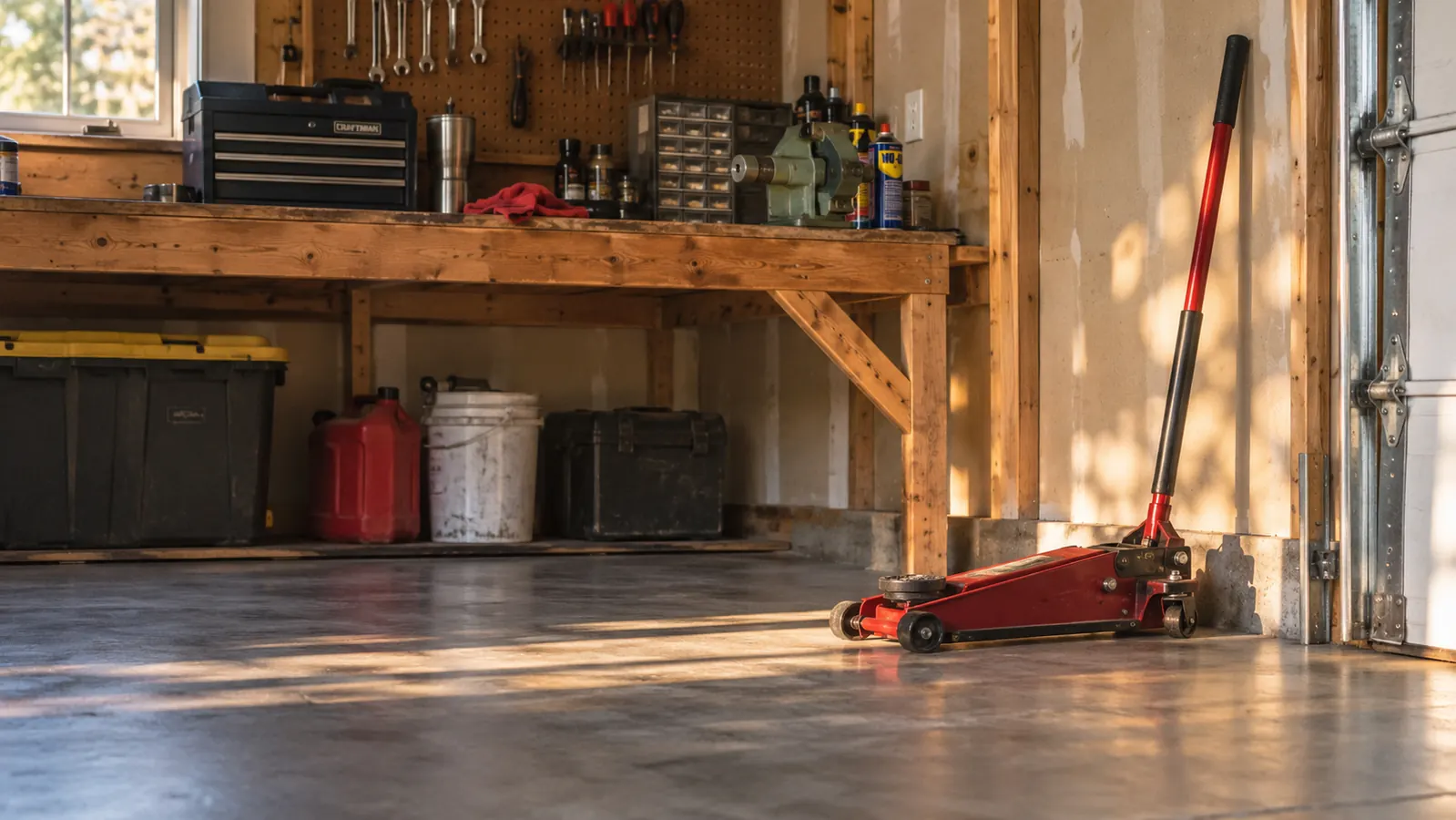
The footprint is 30 by 13.5 by 8 inches. In a one-and-a-half-car garage, that footprint is the difference between a tool that lives on a shelf and a tool that lives on the floor in the way of everything. Mine ends up on the floor, tucked against the wall, because the shelf under my workbench is already full.
I measured that shelf wrong the first time and I would rather you did not repeat it. I ordered the jack, it arrived, and I found out my workbench shelf has about 26 inches of usable depth against a 30-inch footprint. The jack overhung the front edge by four inches and the box would not shut behind it. It has lived on the floor ever since, which is fine for me because my slab is clear on that side, but it is not what I planned when I clicked the button. Take the 30 by 13.5 by 8 number out to your garage and look at it with your own eyes before you order, not the space you wish you had.
In the box you get the jack and its handle. Nothing else. That is fine, but plan where the handle lives, because a loose handle in a garage is a thing that gets kicked across the slab at eleven at night.
And the big one: this is a lifting tool, not a holding tool. Nothing about a 3-ton rating means you should work under a car held up by hydraulics. Jack stands go under the frame before any part of me goes under the frame. That is not a knock on the ARCAN, it is true of every jack ever built, but it is the one line I will not soften.
The other honest note is where the range ends. Eighteen inches is generous for a car and adequate for a stock pickup. It is not a substitute for a tall jack, and stretching it with blocks of wood is how people end up in the emergency room explaining a decision they regret.
What Two Years of Use Actually Looks Like
The jack looks like a jack that has been used. The frame has scuffs from being set down on concrete and one corner carries a mark from the time I dragged it instead of lifting it like I know better. Nothing structural, nothing that bothers me.
Functionally, the things that matter have held. It still rolls under the Miata on the first push. It still travels the full range without the arm binding. It still comes down in a controlled way when I turn the handle, which is the part that separates a jack you trust from one you watch out of the corner of your eye.
One evening last November sticks with me. I had the Tacoma up on stands to chase that exhaust hanger, and I knocked the jack handle off the frame in the dark. No harm done, but it got me paying attention to how the release behaves under a load. I lowered the truck by turning the handle about a quarter turn at a time, letting it come down in three slow stages instead of all at once. That is the whole test with a jack, as far as I am concerned. It is not whether it lifts, because most of them lift. It is whether it comes down like something you control or something that makes the decision for you.
The one thing I pay attention to is hydraulic behavior. A jack that starts sinking under load is telling you something, and it is not asking for a second chance. Mine holds. If it ever does not, it comes out of service that same day, and I would say the same about any jack at any price.
The habit I changed is leaving it under a car for hours while I work. Not because it has given me a reason, but because the habit is worth more than the trust.
Aluminum Versus Steel, and the Other Jack People Ask About
The question I get most is whether aluminum is worth it over steel. The short answer is that aluminum buys you portability and costs you a shorter warranty and a bit more money up front. If your jack stays in one spot forever and never gets carried, steel is still a perfectly rational choice, and I say that as someone who likes this jack.
There is a longer version of that argument for anyone weighing it properly, because the low height matters more than the material for a home garage with a low car in it.
The other comparison that comes up constantly is against the VEVOR 3-ton, which occupies similar shelf space and looks similar on paper. I went through that one side by side, and the honest summary is that they are closer than the prices suggest, with the real differences showing up in how the arm carries a load and how the valves behave at the top of the range rather than in the headline numbers.
What I Liked
- 3.75-inch starting height slides under a low car without ramps or lumber
- Lifts to 18 inches, enough for a stock pickup front end
- 56 pounds, light enough for one person to carry and reposition
- Reinforced lift arm goes up flat with no saddle rock
- Bypass and overload valves protect the hydraulics from a clumsy operator
- 3-ton, 6,000-pound capacity leaves real headroom on passenger vehicles
Where It Falls Short
- One-year warranty is short for a tool meant to last a decade
- 30 by 13.5 by 8 inch footprint still eats floor space in a small garage
- Not enough lift for a lifted truck or a full-size van
- 56 pounds is light for a jack and still heavy at the end of a long day
Who This Is For
This jack is for the person with a low car and one garage bay. If your project car sits close enough to the floor that a standard steel jack will not slide under the crossmember, the ARCAN solves that on the first push and keeps solving it for years. That was exactly my situation, and it is why the thing has stayed on my floor instead of going back to the store.
It is also for the person who has to carry their jack. If it lives on a shelf, gets loaded into a truck bed for a weekend, or moves from one side of the garage to the other several times per job, 56 pounds of aluminum beats the heavier alternative every single time you bend down to pick it up.
Who Should Skip It
Skip it if you work on a lifted truck, a full-size van, or anything where you routinely need more than 18 inches of lift. The ARCAN will not get you there, and forcing it with cribbing is how people get hurt doing something they have done a hundred times.
Skip it if you want long warranty coverage or you are hard on your tools. One year is short, and someone running a jack all day, every day will find the limits faster than I did in two years of Saturdays. And skip it if the jack will sit in one spot and never move, because then you are paying for the aluminum frame and never collecting on it.
If you got this far, you already know whether it fits
3 tons of capacity, a 3.75-inch starting height, 18 inches of lift, and 56 pounds to carry. Check today's price and measure your garage floor before you commit.
Amazon Check Today's Price on Amazon →