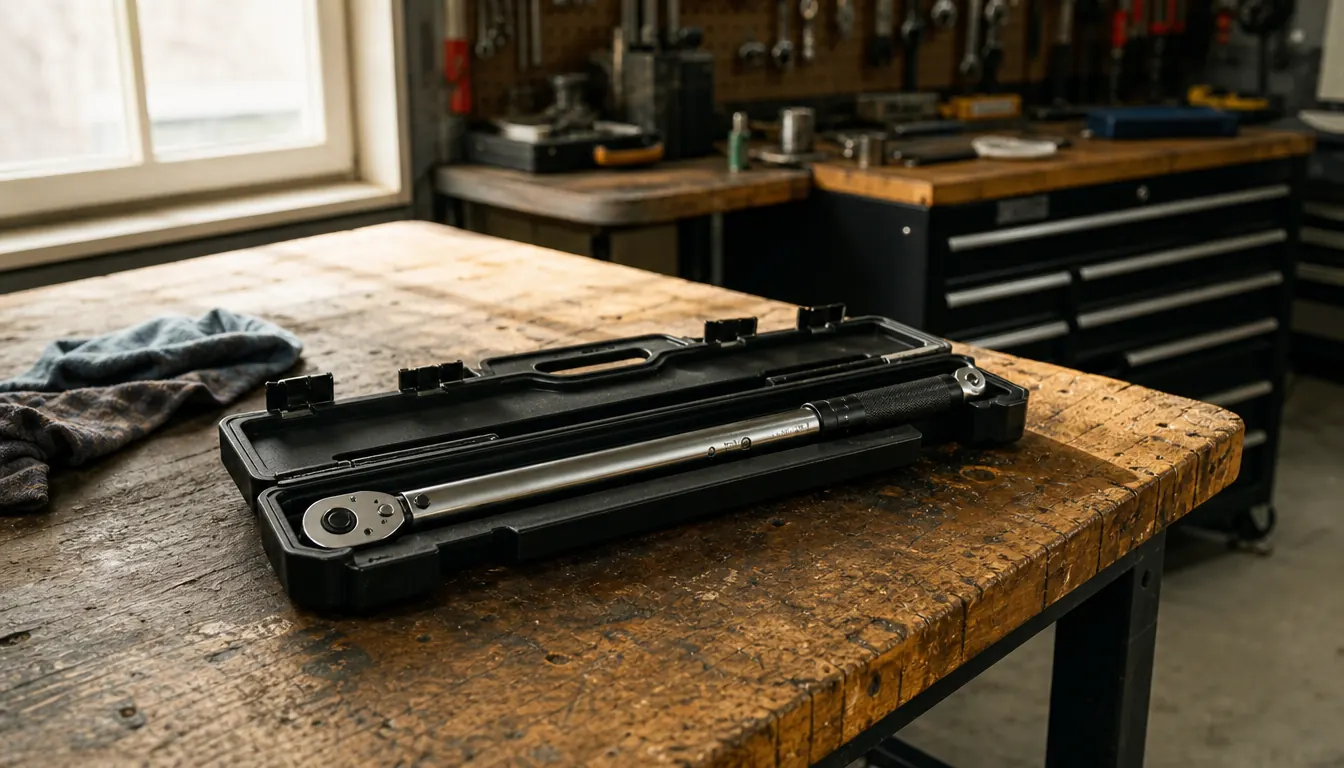
My dad handed me a torque wrench the summer I turned seventeen, after he caught me leaning on a lug wrench with my whole body weight. He did not yell. He made me back all four nuts off and start over, this time with the wrench set to the number printed in the manual. Thirty-five years later I can still hear him say it. Your arm lies. The wrench does not. I have owned three torque wrenches since, and the one that has spent the most time on my garage floor is the EPAuto 1/2-inch drive click type, the 10 to 150 ft/lb model.
This is not a first impressions write-up. I have run the EPAuto through months of Saturday mornings on a 2012 Toyota Tacoma with about 168,000 miles on it and a 1991 Mazda Miata that has been a project car for longer than I care to admit. It is a click type wrench, which means you set the value you want and it makes an audible click when you reach it. The listing gives a range of 10 to 150 ft/lb on the SAE side and 13.6 to 203.5 N/m on the metric side, pre-calibrated to plus or minus 4 percent. It measures 16.25 inches and weighs 3.5 pounds, it is chrome vanadium steel with a satin finish, and it arrives with a plastic storage case and a 5-inch extension bar.
The Quick Verdict
A dependable click wrench for the driveway jobs most of us actually do. Accuracy you can trust at lug nut and suspension torque, a case that keeps it clean, and a couple of ergonomic quirks you learn to work around.
Amazon Check Today's Price →Settle the Argument Your Arm Keeps Losing
The EPAuto 1/2-inch click wrench covers 10 to 150 ft/lb, which is most of what a pickup or a small project car will ever ask of you. Case and 5-inch extension included.
Amazon Check Today's Price on Amazon →How I've Used It
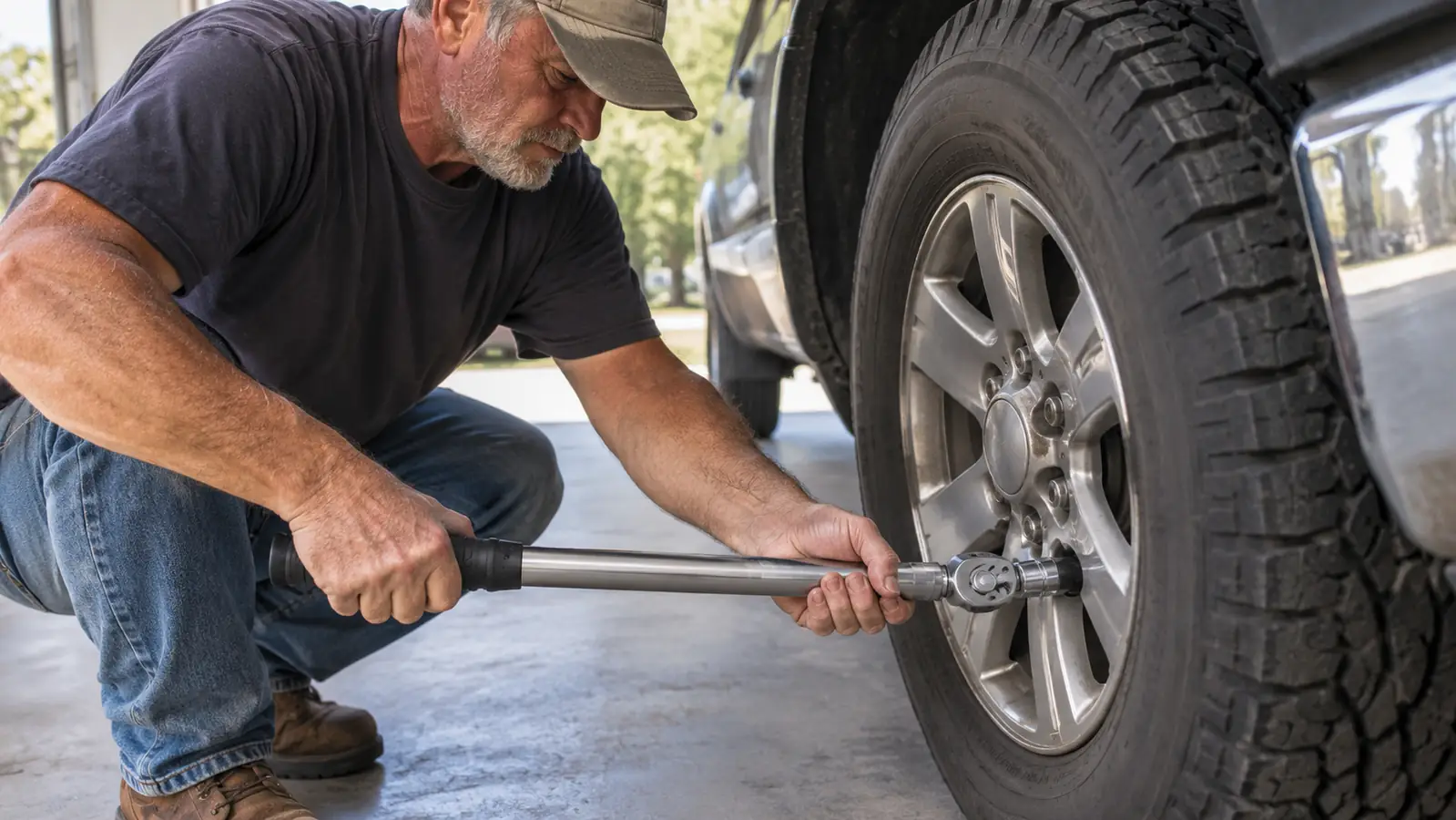
Tire rotations are the bulk of it. The Tacoma comes due every 5,000 miles whether I feel like it or not, and that is 24 lug nuts counting the spare drop, each one pulled to 83 ft/lb. I set the EPAuto once, do all of them, then drop it back down before it goes in the case. It is not exciting work and that is the point. The wrench clicks, I stop, I move to the next nut. When I first started doing this by feel I once stretched a stud on a friend's car and spent an afternoon learning how to press a new one in. Nobody needs that education twice.
The Miata gets the more interesting jobs because the car is 34 years old and half of it has been apart before. Brake caliper bracket bolts, sway bar end links, the bolts on the shock towers when I replaced the struts. All of those land somewhere between 30 and 80 ft/lb, which is smack in the meat of this wrench's range. The 5-inch extension bar that comes in the box has earned its keep on the front calipers, where the bracket bolts sit back behind the wheel well and a bare socket will not clear.
One Saturday last fall I had both vehicles apart at once, which is a mistake I make about once a year. The Tacoma was getting a rotation and the Miata was getting rear pads and rotors. I started on the Miata because the rear caliper bracket bolts sit low and visible, and I thought I would be clever and use a borrowed 3/8 drive wrench so the smaller body would fit the wheel well better. It did fit better. It also could not reach the value the manual calls for on those brackets, so two bolts got half a pull and then I stopped. I put it back in the box and walked over to the chest for the EPAuto. The longer handle made the reach slightly worse and the pull noticeably easier, and every bolt got finished in one pass instead of two.
I have also used it as a teaching tool. My youngest nephew bought a used pickup last spring and asked me to look it over. I handed him the EPAuto, showed him where the spec was in his owner's manual, and let him do his own wheels. He was surprised at how little effort a correct torque takes. That is the whole lesson in one sentence, and it is the one my dad gave me for free in a Sacramento driveway a long time ago.
What the Click Actually Tells You
A click wrench is a spring and a mechanism, and the click you hear is that mechanism releasing at the value you set. The EPAuto is rated to plus or minus 4 percent, which on an 83 ft/lb lug nut is a little over 3 ft/lb of slop. For lug nuts, brake brackets and suspension bolts, that is entirely good enough. Engine builders will want a tighter tolerance and a calibration certificate. The rest of us are trying to stop ourselves from over-tightening, and 4 percent does that.
I checked mine the way a hobbyist can, which is to say without a lab. I picked one lug on the Tacoma, torqued it, backed it off, and did it again three times in a row, listening for where the click landed. Same place every time. That tells you the spring is consistent. It does not tell you the number on the handle is perfect. Those are two different things and I think it is worth being honest about which one you have actually proven.
Here is the comparison that pushed me off the fence. A neighbor of mine has one of the old beam style wrenches, the kind with a pointer that rides against a printed scale. I borrowed it for a front wheel and gave it back. It works, and it has the virtue of never needing a spring reset, but you have to be looking straight down at the scale while you pull. In a wheel well, crouched at an angle with your shoulder against a fender, you are almost never looking straight down at anything. I got two nuts in and quit. The click wrench lets me watch the socket with my eyes and listen for the release with my ears, and those are two jobs a person can do at the same time.
Two habits matter more than the tool. First, never use a click wrench to break a fastener loose. The release mechanism is not built for that and you will knock it out of spec. Second, wind it back down to the bottom of its range when you are done, not up at the setting you just used. A spring left compressed for a year is a spring that forgets. Do those two things and a wrench like this holds its calibration for years.
I torqued the same lug three times in a row and the click landed in the same place every time. That is not a lab certificate. It is the thing you can actually check in a garage.
Living With It in a One-and-a-Half-Car Garage
My garage is a one-and-a-half-car space with a rolling tool chest and a workbench along the back wall, and floor space is the thing I am always short of. The EPAuto lives in its plastic case on top of the chest, which keeps it off the concrete and out of the way. The satin finish on the chrome vanadium steel wipes down easily when it picks up brake dust, which it will. A wrench that lives on a hook gets dirty. A wrench that lives in a case gets wiped once and put away.
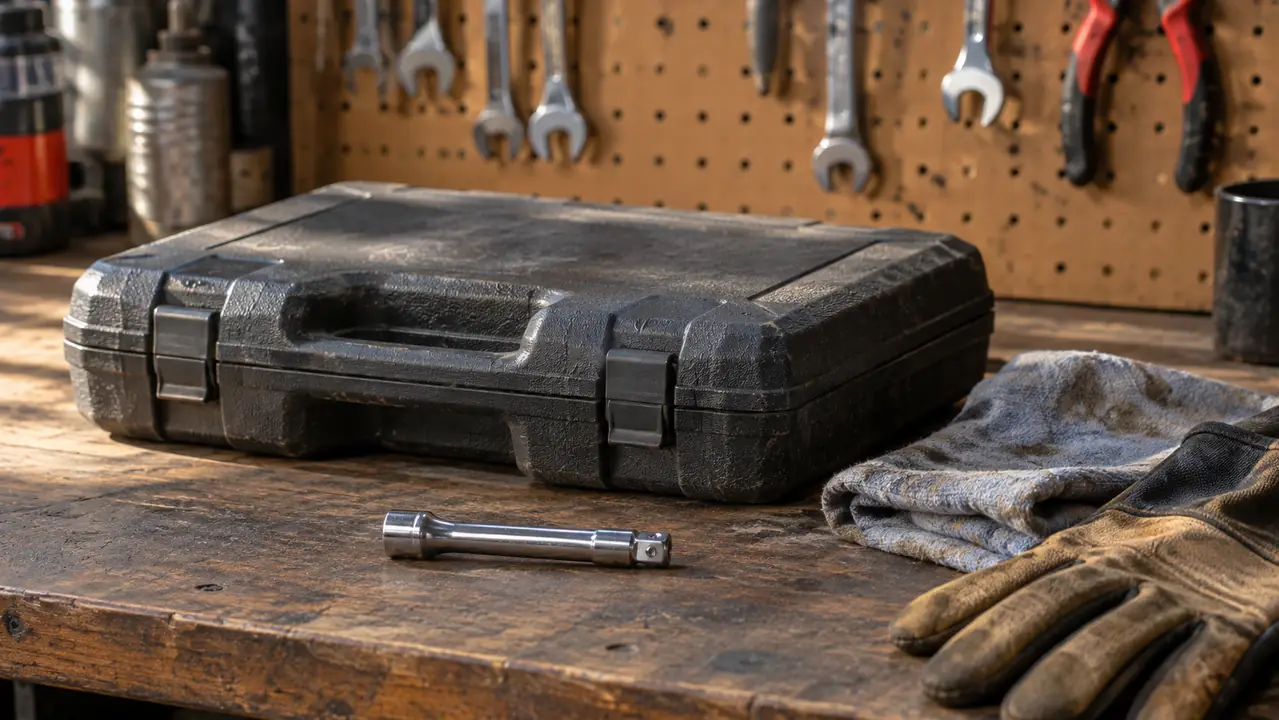
Brake dust is the real test of a finish. After the Miata rear brake job I wiped the handle down with a shop rag and it came clean in one pass, no scrubbing and no grey smear left behind. The satin finish does not hold dust the way a polished tool does, and it does not show every fingerprint either, which matters if you are the kind of person who notices that sort of thing. The case is sturdy plastic rather than a soft bag, and while I would not drop it off a bench it does keep the wrench off the floor and keep the extension bar with the wrench. That means the tool has exactly one home, which is why I can find it. I spent years with wrenches rolling around loose in a drawer and losing ten minutes before every job. A case is a small thing and it is not nothing.
At 16.25 inches and 3.5 pounds it is a substantial tool in the hand. That length is what gives you the leverage to pull smoothly rather than jerk, and smooth is what a click wrench wants. The weight is the trade. It is not the wrench I grab for something small and fussy up near the top of an engine bay. It is the wrench I grab when there is room to swing and the number matters.
The 5-inch extension bar lives in the case with it and has become the piece I reach for first on wheels, because it moves the handle out past the fender and gives my knuckles somewhere to be. That sounds like a small thing until you have barked a hand on a wheel arch at seven in the morning.
Where It Got Awkward
The click is quieter than I expected. In a quiet garage it is unmistakable. With a radio on and an air compressor cycling in the corner, I have pulled through a click and had to back off and redo the fastener. My fix was to stop relying on my ears alone and watch the handle as well. Once you know what you are watching for it is fine, but the first few jobs I did with it I was not sure, and that is not a good feeling on a lug nut.
The other honest gripe is the bottom of the range. Ten ft/lb is the floor, and down near it the wrench feels like it is working harder than the task deserves. The tool is long and heavy and the value is small, so you are applying a delicate pull with a big lever. For anything that actually wants 10 or 12 ft/lb I use a smaller 3/8 wrench and leave this one in the case. If your work is mostly small fasteners, this is the wrong size tool for you.
And there is the discipline item. Because it is a click wrench, it wants to be reset after every use, and I have caught myself putting it away still loaded at 83 ft/lb more than once. That is on me, not on EPAuto. But a tool that punishes forgetfulness is a tool you build a habit around, and habits take a few months to stick.
What I Liked
- Covers 10 to 150 ft/lb, which handles lug nuts, brake brackets and most suspension work on a half-ton pickup or a small car
- Rated to plus or minus 4 percent, and mine clicked at the same point on repeated pulls
- Chrome vanadium steel with a satin finish wipes clean and does not show every fingerprint
- Ships with a plastic case and a 5-inch extension bar that reaches recessed caliper bolts
- The click is definite once you learn to feel for it rather than listen for it
Where It Falls Short
- 3.5 pounds and 16.25 inches make it clumsy in tight engine bay corners
- The click is soft enough to miss with a radio on or a compressor running
- Near the 10 ft/lb floor it feels like more tool than the job needs
- It has to be wound back down after every use, which is easy to forget
Who This Is For
This is for the home wrencher with one or two vehicles who does their own tires, brakes and the occasional suspension part, and who wants to stop guessing. If you own a half-ton pickup and a small project car, the 10 to 150 ft/lb range will cover nearly everything you touch. It is also a good first torque wrench, because the click is easy to understand and the case gives you somewhere to put it, which matters more than people admit when they are starting out. If you have been tightening wheels by feel for twenty years, this is the tool that ends the argument.
Before you buy anything, write down the actual numbers. On the Tacoma that is wheels at 83 ft/lb plus the spare drop, caliper bracket bolts, four bolts per shock tower when I did struts, and the hitch bolts when I added a receiver. On the Miata it is wheels at a much lower figure, brake brackets, sway bar links and the shock tower bolts. Every single one of those sits inside 10 to 150 ft/lb with room on both ends, and that is the test I would apply to your own list. Take the five jobs you do most, look up the specs in your manual, and if they land between about 20 and 140, a wrench in this range is the right shape of tool. If half of them come back in inch-pounds, buy a 3/8 wrench instead and thank yourself later.
Who Should Skip It
Skip it if your work is mostly small fasteners. Valve covers, small brackets and anything spec'd in inch-pounds want a 3/8 or 1/4 drive wrench with a lower range, and using this one down at its floor is fighting the tool. Skip it if you are building engines and need a certificate and a tighter tolerance than 4 percent. Skip it if you are working on heavy equipment or a three-quarter-ton truck where axle nuts run well past 150 ft/lb. And skip it if you want a digital readout that beeps and stores values. This is a mechanical click wrench and it does not pretend otherwise.
One more thing for the beginners, because I was one. A torque wrench does not replace a jack stand. It does not make a stripped thread reappear. It tells you when a fastener has reached the value you set, and that is all it does. The rest of the safety still belongs to you. I say that as a man who once worked under a car held up by a jack alone and got away with it, which is not the same as being right.
Stop Guessing at 83 ft/lb
The EPAuto click wrench covers 10 to 150 ft/lb, arrives with a case and a 5-inch extension bar, and answers the question your arm keeps getting wrong.
Amazon Check Today's Price on Amazon →