
I bought the BlueDriver OBD2 Scanner for one reason. My 2012 Toyota Tacoma had a check engine light on, and I wanted to know whether I was looking at a loose gas cap or a head gasket. That is the honest starting point for most people shopping for one of these. You are not really shopping for a scan tool. You are shopping for an answer. I had already tried the cheap route, a loaner reader from a parts store that handed me a four digit code and a blank stare from the kid behind the counter. So I ordered the BlueDriver and waited by the mailbox like a kid.
Here is the part nobody mentions before you buy one. The answer arrives fast. Interpreting it is the work. Two years later, after using this thing on a 168,000-mile pickup and a 1991 Miata that spends more time on jack stands than on the road, I can tell you exactly what it does well and where it quietly leaves you on your own. This is the review I wish I had read before I clicked buy. Less unboxing, more of what happens in month eighteen.
The Quick Verdict
Reads and clears engine, ABS, SRS and TPMS codes with live data, freeze frames and Mode 6 that actually lead somewhere. The catch is that it hands you evidence, not a diagnosis, and the whole experience lives or dies with your phone.
Amazon Check Today's Price →The Code Reader I Still Reach For Two Years Later
BlueDriver reads engine, ABS, SRS and TPMS codes, streams live data while you drive, and checks smog readiness before you drive to the station. No subscription, and a 180-day money back guarantee if it does not earn its spot in your toolbox.
Amazon Check Today's Price on Amazon →What the BlueDriver Actually Does
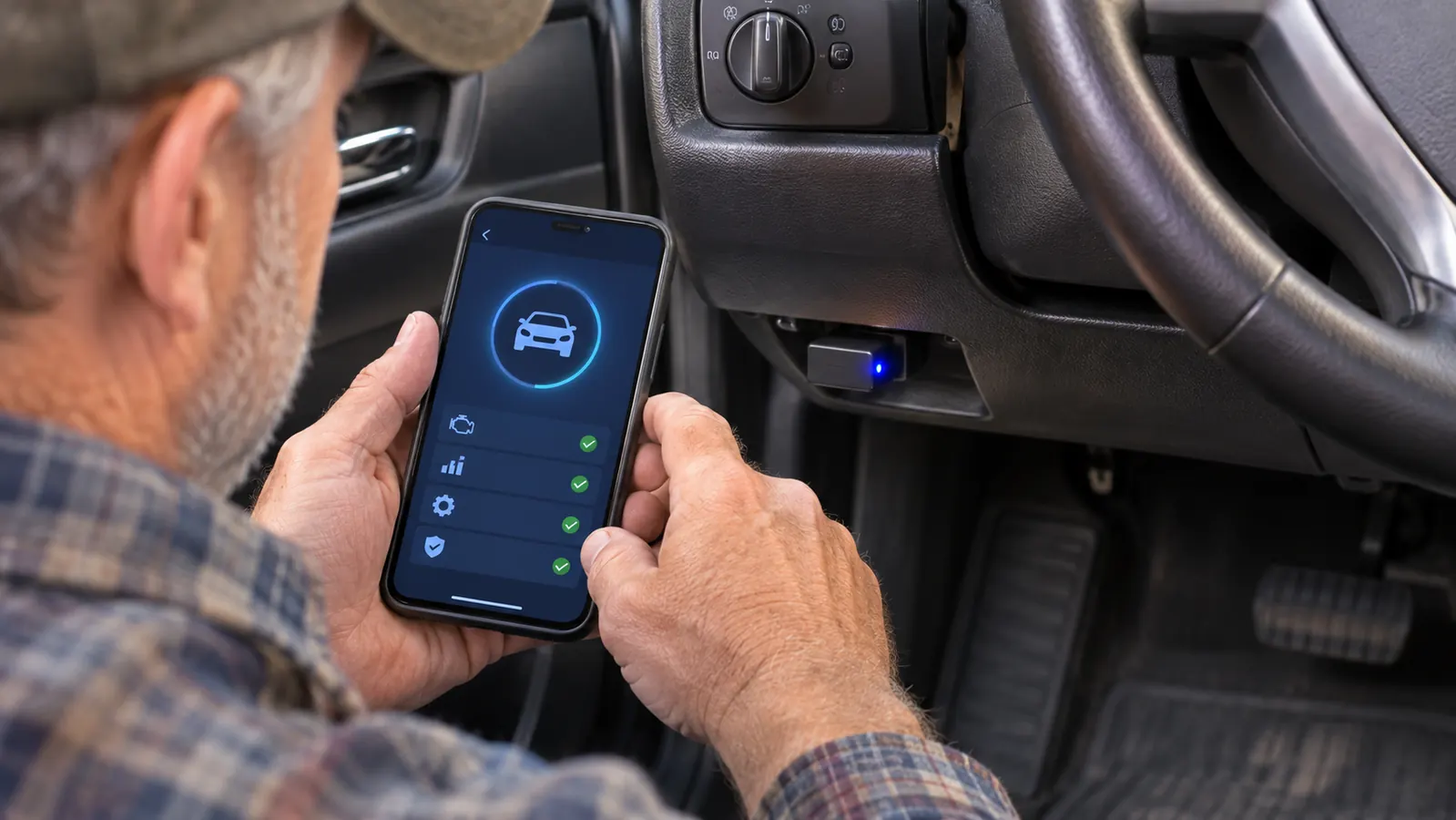
Strip away the marketing and this is a small Bluetooth dongle. It plugs into your vehicle's OBDII port, the trapezoid connector usually tucked under the dash on the driver's side, and pairs with an app on your phone. The app runs on iOS and Android. That is the whole hardware story. There is no screen, no cable, no separate handset to lose behind the seat.
What you get in exchange for that simplicity is a longer list of reads than a basic code reader gives you. It reads and clears engine codes. It also covers ABS, SRS and TPMS, which is exactly where cheap readers stop. It streams live vehicle data while you drive, shows freeze frames, checks smog readiness, and digs into Mode 6 test results. Power comes from the vehicle, so there is nothing to charge and nothing to remember before you leave the house.
Freeze frame and Mode 6 are the two features almost everyone ignores, and they are the two that earn the thing its keep. A freeze frame is a snapshot of what the engine was doing the moment the code set: rpm, load, coolant temperature, speed. That context tells you whether a fault happens at idle or at highway speed under load, and those are two completely different repairs. Mode 6 shows the raw results of the manufacturer's own self tests, sometimes before a code ever trips. If you only ever read the code and close the app, you have paid for a very nice code reader and used about a tenth of it.
How I've Used It in My Own Garage
The Tacoma threw a lean code on bank one somewhere around 160,000 miles. A basic reader would have told me the code and left me standing there, and I would have started replacing parts in order of how easy they were to reach. Instead I opened the freeze frame and looked at the conditions when it set: idle, low load, engine fully warm. Then I watched live fuel trims at idle and again at speed. The trims were ugly at idle and cleaned up as rpm rose, which pointed at a vacuum leak rather than a dying sensor or a weak pump. It turned out to be a cracked vacuum line I could reach with two fingers. That is the difference between a code and a diagnosis, and it cost me an afternoon instead of a parts cannon.
On the Miata, the ABS light came on after a brake job. This is where the ABS and SRS coverage matters, because a plain engine code reader cannot see those modules at all. I pulled the ABS code, checked the wheel speed sensor I had disturbed, reseated the connector, cleared the code, and the light stayed off. Ten minutes. Without that module coverage I would have been guessing between a harness, a sensor and a pump, and guessing on ABS is not where I want to be.
Live data while driving is genuinely useful, with one safety caveat I will repeat every single time. Have a passenger hold the phone. Do not prop it on the dash and glance at fuel trims while you are merging onto the freeway. I set up the gauges I want before I pull out of the driveway, and if I am alone I record and review after I park. The data will still be there. The guy in front of you will not wait for you to finish reading it.
The other routine use is smog readiness. California is not gentle about this. Before a smog check I open the readiness monitors and confirm everything has completed, so I am not paying for a test that gets bounced because the battery was disconnected the week before. That single habit has saved me two wasted trips to the station.
What I Liked
- Reads and clears engine, ABS, SRS and TPMS codes, not just powertrain
- Live data, freeze frames and Mode 6 give real diagnostic context
- No subscription, so the tool you buy is the tool you keep
- Wireless and powered by the vehicle, nothing to charge
- Runs on iOS and Android, and the app improves with updates
- Smog readiness check before you drive to the test station
- 180-day money back guarantee gives you a long window to try it
Where It Falls Short
- No screen of its own, so it is useless without a working phone
- Reads codes and data but never tells you which part to replace
- Coverage is gas vehicles 1996 and newer plus select light-duty trucks, so verify fitment
- Bluetooth pairing has been fussy a handful of times and needed a replug
- Not a programming or module service tool, so it will not replace factory software
The Part Nobody Mentions: You Are Buying an App
The hardware is the cheap half of this product. The app is the product. Every code, every graph, every explanation lives on a screen you already own, and that has real consequences people do not think about before ordering. If your phone is dead, you have a plastic plug. If you upgrade phones and forget your login, you have a delay on your hands. If you want to hand the tool to your neighbor for the afternoon, you are handing over your phone or nothing at all.
It also means the experience improves over time. The app updates, and fixes plus added coverage arrive without you buying new hardware. That is a genuine advantage over a fixed function handheld reader with a monochrome screen and a printed code book, and it is a big part of why I stopped carrying a separate reader in the truck. The tool I bought in 2023 is not quite the tool I have today, and that is a good thing.
The tradeoff is that this is not a device you leave plugged in permanently and forget about. Some people do exactly that and report it works fine. I pull mine out when I am done. I do not love the idea of a dongle sitting in the port for months on a vehicle that already has enough electrical quirks to chase. It takes three seconds to remove and it removes a variable from every battery question I might have later.
A code tells you which system complained. The freeze frame tells you what the engine was doing when it complained. Only one of those gets you to the actual broken part.
Where It Falls Short
My biggest complaint is not about the hardware. It is about expectation. This tool does not tell you what to replace. It will say cylinder one is misfiring, and then you are the one who has to decide whether that is a coil, a plug, an injector or a valve. That is not really a flaw, because nothing at this level diagnoses for you. But if you are buying this hoping it hands you a parts list, you will be disappointed, and a chunk of the harsh reviews out there are from people who were.
Bluetooth pairing has been fussy maybe three times in two years. The fix was always the same: unplug the dongle, close the app, plug back in, reopen. It never failed twice in a row and it never left me stranded. But if you expect a flawless instant connection every single time you walk into the garage, you will be annoyed on occasion. Wireless consumer hardware is wireless consumer hardware.
Fitment is the other thing to check honestly before you order. It is listed for gas vehicles from 1996 and newer plus select light-duty trucks. My Tacoma and the Miata are both squarely inside that window, so I never had to think about it. If you drive a diesel, or something outside that range, confirm it works with your vehicle first rather than finding out in your driveway with the light still on.
And here is the honest limit of my own experience. I have not used this on a modern vehicle packed with modules and complicated networks. My newest vehicle is from 2012. People with newer trucks mention behaviors I cannot confirm, and I am not going to repeat them as if I had seen them myself. What I can tell you is how it behaved on a 1991 and a 2012, and it behaved well on both.

Mistakes I Made So You Don't Have To
I cleared a code before writing it down. Twice. Both times I thought I would remember, both times I did not, and both times the light came back and I had to wait for it to set again under the right conditions. Write the code down. Screenshot the freeze frame. It takes ten seconds and it saves you a week of waiting on a light that only shows up on cold mornings.
I also treated a code as a verdict instead of a clue the first time out. A converter efficiency code does not mean replace the catalytic converter. It means the computer is unhappy about converter efficiency, and that can come from an exhaust leak, an oxygen sensor or the converter itself. Reading live data before buying parts is the entire point of owning a tool like this, and it took me two wasted purchases to learn that.
The other mistake was leaving the dongle plugged in on the Miata for a couple of months while it sat. Nothing broke, but I came out to a battery that needed a jump for unrelated reasons and I could not rule out the dongle until I unplugged it and watched for a while. On a vehicle that sits, pull it. It costs nothing and it removes a variable from the equation. And keep the app updated. I ignored one for months and then wondered why a menu had moved on me.
What Two Years of Ownership Looks Like
The dongle lives in the glovebox of the Tacoma inside a small cloth bag. It has been dropped on concrete twice and it still pairs. The port on the truck is a little loose after 168,000 miles of gravel roads and speed bumps, and the unit still seats firmly enough to hold a connection. That is not a torture test, but it is two years of real use instead of a weekend with a review sample.
The subscription question comes up constantly in reviews and forums, so let me be direct about it. This one does not require a subscription. You buy the tool, you get the app, and you keep using it. Given how many things in my life quietly turned into a monthly charge, that mattered to me more than I expected it would. There is also a 180-day money back guarantee, which is a genuinely long window. Long enough to plug it into your own vehicle, pull your own codes and decide whether the app fits how your brain works.
I would use that window rather than trusting any review, including this one. A diagnostic tool either clicks with the way you troubleshoot or it does not, and no article can settle that for you. What I can tell you is that mine has stayed in the garage while two other gadgets from the same period went into a drawer and never came back out.
Who This Is For
If you are a home mechanic who does your own brakes, plugs and fluid changes, and you want to stop guessing when a light comes on, this is a sensible buy. It is especially good for anyone with more than one vehicle, because it is one tool for the whole driveway instead of a different reader for every make. It suits the person willing to open a freeze frame and think about what it means. It suits the high mileage pickup and the weekend project car that keeps throwing lights you have never seen. And it suits anyone in a state with smog testing who wants to know their readiness monitors are set before they drive to the station.
Who Should Skip It
Skip it if you want a device that works without a phone. There are handheld readers with their own screens and their own batteries, and if that is what you want, go buy one and be happy. Skip it if you need to program modules or run manufacturer level service functions, because this is not that tool and no amount of wishing will make it one. Skip it if you are never going to look past the code, because a basic reader is cheaper and will serve you just as well. And skip it if you drive something outside the stated coverage and cannot confirm fitment first, because a scan tool that will not talk to your vehicle is a very tidy paperweight with a plug on the end.
If You're Going to Keep the Truck, Get the Tool That Actually Reads It
BlueDriver reads engine, ABS, SRS and TPMS codes, streams live data, and covers smog readiness plus Mode 6. No subscription, one purchase, and a 180-day money back guarantee if it does not earn its place in your toolbox.
Amazon Check Today's Price on Amazon →Two years in, the BlueDriver has paid for itself in parts I did not buy and shop visits I did not make, and I still have not used everything in the app. What it gave me was not certainty. It gave me evidence, which is the thing I was actually missing every time a light came on and I stood in the driveway guessing. If a check engine light is the reason you are reading this, that is the honest case for it.